

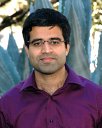
 Pradeep Kumar Ravikumar
· 2 previous affiliations
- Carnegie Mellon UniversitySince 2016
- Full Professor · Since 2022
- Associate Professor · 2016–2022
- The University of Texas at Austin2015–2016
- Associate Professor · 2015–2016
Research Overview
Pradeep Kumar Ravikumar focuses on the theoretical foundations of machine learning, high-dimensional statistics, and representation learning. His trajectory spans foundational work in sparse graphical model selection and regularized estimation to recent advances in self-supervised learning, causal representations, and the alignment of large language models. Currently, his research investigates the theoretical mechanisms underlying data augmentation, preference learning, and latent knowledge in foundation models.
Research Trajectory
The early arc of Ravikumar's research established rigorous theoretical guarantees for high-dimensional statistical learning, particularly in scenarios where the number of variables vastly exceeds the number of observations. A foundational contribution during this period was High-Dimensional Graphical Model Selection Using ℓ1-Regularized Logistic Regression (2006), which provided a framework for learning the structure of discrete graphical models. This work was instrumental in advancing the research direction of Neighborhood Selection for High-Dimensional Graphical Models. Building on these themes of sparsity and structure, he introduced SpAM: Sparse Additive Models (2007), combining sparse linear modeling with additive nonparametric regression to enable interpretable feature selection in high-dimensional biological data. He subsequently extended structural recovery guarantees to continuous domains in Model Selection in Gaussian Graphical Models: High-Dimensional Consistency of l (2008), demonstrating logarithmic sample complexity for accurate graph recovery. This era of work culminated in A unified framework for high-dimensional analysis of $M$-estimators with decomposable regularizers (2009). By formalizing restricted strong convexity and decomposable penalties, this paper provided a generalized convergence analysis for structured parametric models, anchoring the broader area of Unified High Dimensional Analysis with Decomposable Regularizers.
Moving into the next decade, his focus expanded to address robustness, scalability, and complex structure learning in optimization. Participating in the development of robust learning from noisy labels, he contributed to Learning with Noisy Labels (2013), which proposed novel methods to adapt standard loss functions for training models on data corrupted by class-dependent noise. In the domain of scalable algorithms for graphical models, he co-authored QUIC: quadratic approximation for sparse inverse covariance estimation (2014), further refining the computational efficiency of sparse recovery. A major methodological shift in structure learning was marked by DAGs with NO TEARS: Continuous Optimization for Structure Learning (2018). By reformulating the combinatorial search space of Directed Acyclic Graphs (DAGs) into a smooth, continuous optimization problem, this work bypassed traditional discrete search limitations and established a new paradigm for causal structure learning.
In recent years, Ravikumar's research has heavily emphasized representation learning, causality, and the theoretical underpinnings of modern deep learning. In the realm of causal discovery, his group developed Identifying General Mechanism Shifts in Linear Causal Representations (2024), which leverages Independent Component Analysis to identify latent mechanism shifts across environments without requiring exhaustive interventions. Bridging this causal perspective with interpretability, From Causal to Concept-Based Representation Learning (2024) demonstrated that human-interpretable concepts can be rigorously identified as linear subspaces using simple data conditioning, circumventing the need to recover complete generative factors.
Concurrently, he has advanced the theoretical foundations of self-supervised learning and data augmentation. Augmentation Alone Leads to Generalization (2024) and Understanding Augmentation-based Self-Supervised Representation Learning via RKHS Approximation and Regression (2024) introduced the metric of "augmentation complexity," proving that sufficiently diverse data augmentation can drive generalization independently of neural network architecture. This theoretical arc was unified in Contextures: Representations from Contexts (2025), which frames representation learning as capturing the spectral decomposition of an input's context, explaining the mechanistic origins of neural scaling laws. Alongside these deep learning theories, he has continued to scale classical methods, introducing an inductive implementation for semi-supervised learning in Spectrally Transformed Kernel Regression (2024).
Most recently, his work has addressed the deployment and alignment of large language models and programmatic supervision. LLM-Select: Feature Selection with Large Language Models (2024) demonstrated that language models can perform zero-shot predictive feature selection competitive with data-driven methods. Investigating the internal mechanics of these models, On the Fragility of Latent Knowledge: Layer-wise Influence under Unlearning in Large Language Model (2025) explored how unlearning specific data degrades overall model utility by quantifying latent knowledge fragility. In the domain of data-centric learning, Learning from weak labelers as constraints (2025) provided a robust framework for programmatic weak supervision by treating labeler error rates as explicit optimization constraints rather than relying on generative assumptions. Finally, What Does Preference Learning Recover from Pairwise Comparison Data? (2026) shifted preference alignment to a data-centric perspective, proving that standard models recover the KL projection of true preferences based on pairwise margin and comparison connectivity.
Current Directions
The most recent papers in the evidence address the theoretical mechanisms of foundation models, preference alignment, and representation learning. Recent work investigates how pairwise comparison data drives preference learning, identifying the fundamental roles of pairwise margin and comparison connectivity in model alignment. Additionally, his research explores the fragility of latent knowledge during large language model unlearning, quantifying how targeted forgetting impacts internal representations. He also continues to advance a unified theory of self-supervised learning that frames representations as the spectral decomposition of data contexts, alongside developing robust, constraint-based frameworks for programmatic weak supervision.
Profile updated
Loading new papers…
Other researchers whose papers cluster into the same research directions — a proxy for overlapping technical interests and shared intellectual neighborhoods.
See something wrong? Report a mistake