

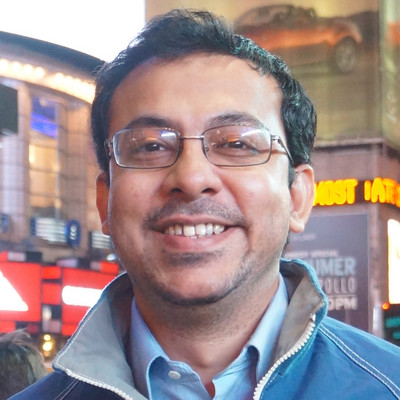
 Pradeep Kr. Banerjee
· 2 previous affiliations
- TU HamburgSince 2023
- Postdoc · Since 2023
- Postdoc · 2019–2023
- PhD student · 2016–2019
Research Overview
Pradeep Kr. Banerjee focuses on information theory, deep learning theory, and reinforcement learning. His work traces an arc from foundational measures of partial information decomposition to unified generalization bounds and the spectral properties of graph neural networks. Most recently, his research addresses zero-shot generalization in reinforcement learning through dynamics-aligned world models.
Research Trajectory
Banerjee’s early research focused on foundational problems in signal processing and information theory, particularly how information is shared, decomposed, and quantified in complex systems. He initially investigated the robustness of energy tracking tools in Noise sensitivity of Teager-Kaiser energy operators and their ratios, analyzing how additive Gaussian noise affects these operators and identifying ways to mitigate limitations in signal analysis. He then turned to the fundamental limits of Partial Information Decomposition (PID). In Synergy, Redundancy and Common Information, he established a critical impossibility result, demonstrating that classical optimization-derived notions of common information cannot guarantee a nonnegative decomposition of mutual information.
Continuing this focus on information structures, he collaborated to challenge prevailing assumptions about data compression in Coarse-Graining and the Blackwell Order, showing that coarse-graining an input can paradoxically yield a channel that performs better according to the Blackwell order despite reducing Shannon information. He subsequently formalized new metrics for quantifying asymmetric information between communication channels in Unique Informations and Deficiencies, grounding these measures in statistical experiments to bound secret key generation. To make these theoretical constructs practically computable, he introduced the admUI algorithm in Computing the Unique Information, enabling the efficient decomposition of mutual information into unique, shared, and synergistic components.
Transitioning into deep learning theory, Banerjee applied information-theoretic principles to representation learning and model generalization. He developed The Variational Deficiency Bottleneck, a method that minimizes "information deficiency" rather than sufficiency, yielding representations that are more robust to distribution shifts. This work naturally led to a broader investigation of generalization bounds. In Information Complexity and Generalization Bounds, he provided a unifying framework that derives both PAC-Bayesian and mutual information-based bounds from a single fundamental inequality. This theoretical bridge facilitated new bounds for complex scenarios, contributing to the research direction of Data Dependent Priors for Tighter Generalization Bounds and advancing methods for Curvature Aware Optimization for Large Scale Neural Networks. He further formalized this unification in PAC-Bayes and Information Complexity, introducing Information Complexity Minimization as a practical optimization objective applicable to modern neural network training paradigms like Entropy-SGD.
Alongside these generalization frameworks, he collaborated on analyzing the asymptotic behavior of learning algorithms. In Learning Curves for Gaussian Process Regression with Power-Law Priors and Targets, the authors characterized the generalization error of kernel ridge regression and Gaussian processes. By leveraging the equivalence between these models and infinitely wide neural networks, this work provided insights relevant to the broader area of Robust Kernel Learning under Model Misspecification.
Banerjee then directed his focus toward the structural limitations of Graph Neural Networks (GNNs), specifically the phenomenon of oversquashing, where information is lost during message passing over long-range dependencies. In Oversquashing in GNNs through the lens of information contraction and graph expansion, he proposed an information-theoretic framework and a local graph rewiring algorithm to improve GNN expressivity by making graphs more expansive without disconnecting them. Building on this, he co-developed a computationally efficient solution in FoSR: First-order spectral rewiring for addressing oversquashing in GNNs. This work systematically adds edges based on spectral properties to prevent oversquashing, making significant contributions to the research direction of Spectral Gap Optimization for Graph Information Flow and the related area of Matrix Perturbation Theory for Efficient Graph Spectral Updates.
Recently, Banerjee has continued to synthesize his foundational work in information theory while expanding into reinforcement learning. He authored Unique Information Through the Lens of Channel Ordering: An Introduction and Review, which connects unique information to channel ordering and its operational significance in cryptographic tasks. In the domain of sequential decision-making, he led research on Dynamics-Aligned Latent Imagination in Contextual World Models for Zero-Shot Generalization. This work addresses how agents can achieve zero-shot generalization by aligning latent imagination with environmental dynamics, contributing to the understanding of reinforcement learning in latent contexts and counterfactual dynamics.
Current Directions
The most recent papers in the evidence indicate a dual focus on advanced reinforcement learning and the continued formalization of information theory. In reinforcement learning, recent work investigates zero-shot generalization through the development of contextual world models. This involves aligning latent imagination with environmental dynamics to enable agents to generalize across unseen contexts, addressing memory bottlenecks and latent disentanglement. Concurrently, ongoing theoretical work synthesizes measures of unique information with channel ordering, exploring their operational significance in cryptographic tasks and the decomposition of complex systems.
Profile updated
Loading new papers…
Other researchers whose papers cluster into the same research directions — a proxy for overlapping technical interests and shared intellectual neighborhoods.
See something wrong? Report a mistake