

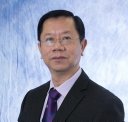
 Pheng-Ann Heng
· 3 previous affiliations
- Chinese University of Hong KongSince 2002
- Full Professor · Since 2002
- National University of Singapore1982–1995
- Researcher · 1992–1995
- Undergrad student · 1982–1985
- Indiana University1985–1992
- PhD student · 1989–1992
- MS student · 1988–1989
- MS student · 1985–1987
Research Overview
Pheng-Ann Heng focuses on medical image analysis, 3D point cloud processing, and surgical simulation. Early work established virtual reality systems for surgical training, while subsequent research has advanced deep learning techniques for automated volumetric quantification and spatial precision in medical imaging. Recent efforts explore multimodal reasoning, protein language models, and scalable spatial transcriptomics.
Research Trajectory
The trajectory begins with early contributions to surgical simulation and anatomical digitization. In A Virtual-Reality Training System for Knee Arthroscopic Surgery, Heng and collaborators developed a real-time virtual reality system incorporating finite-element analysis for soft tissue deformation and tactile feedback. This was complemented by participation in the development of The Chinese Visible Human (CVH) datasets incorporate technical and imaging advances on earlier digital humans, which provided high-resolution digitized anatomical data.
A significant portion of the research arc addresses Deep Learning for Automated Volumetric Quantification and Joint Boundary and Region Learning for Spatial Precision. In DCAN: Deep Contour-Aware Networks for Accurate Gland Segmentation, a multi-task learning framework was introduced to simultaneously output probability maps and clear contours, improving the separation of clustered objects in histology images. This focus on precise segmentation continued with 3D deeply supervised network for automated segmentation of volumetric medical images and VoxResNet: Deep voxelwise residual networks for brain segmentation from 3D MR images, which integrated multi-modal and multi-level contextual information to handle the complex anatomical environment of the brain. Further work in this domain includes H-DenseUNet: Hybrid Densely Connected UNet for Liver and Tumor Segmentation From CT Volumes.
Parallel to medical imaging, the trajectory encompasses significant work in 3D point cloud processing, specifically Upsampling Sparse and Non-Uniform Point Clouds and Multi-Scale Geometric Feature Extraction in Point Clouds. PU-Net: Point Cloud Upsampling Network presented a data-driven technique to learn multi-level features and expand point sets while maintaining uniform distribution on underlying surfaces. This was advanced by PU-GAN: A Point Cloud Upsampling Adversarial Network, which applied adversarial frameworks to further refine point cloud upsampling.
More recently, the research has expanded into complex multimodal reasoning and clinical decision support. SurgLQA: Scalable Long-Horizon Surgical Video Question Answering introduced a framework for long-range procedural dynamics in surgical workflows. Addressing clinical safety, KnowGuard: Knowledge-Driven Abstention for Multi-Round Clinical Reasoning proposed an investigate-before-abstain paradigm, integrating knowledge graph exploration to help language models recognize insufficient medical evidence. Exploring biomolecular design, Be Your Own Teacher: Steering Protein Language Models via Unsupervised Reward Optimization and Exploring the Alignment of Generation and Understanding in Protein Structure Modeling investigated unsupervised reward optimization and representation alignment for protein generation.
Further expanding into robust perception and efficient inference, ObsDriveBench: Benchmarking Multimodal Understanding under Adverse Weather with Observability Awareness evaluated vision-language models under degraded environmental conditions. In medical anomaly detection, Bridging Vision Foundation Model Priors with CLIP for Spatial-aware Few-shot Anomaly Detection in Medical Images combined spatial priors with semantic alignment. MedJev: A System One Vision-Language Decision Model for Fast and Effective Medical Image Understanding addressed Real Time Inference Constraints in Clinical Deep Learning by mapping inputs directly to decisions without autoregressive generation. Towards Scalable Context-Aware Single-Cell Spatial Transcriptomics Prediction from Histology Images presented an efficient framework for single-cell resolution prediction. Finally, LaST1.0: A Unified Latent World-Action Model with Control-Centric SpatioTemporal Reasoning explored latent world modeling for robotic manipulation.
Current Directions
Recent work investigates the intersection of multimodal foundation models and specialized domains such as clinical reasoning, spatial transcriptomics, and robotic control. The most recent papers address the efficiency and reliability of vision-language models in medical contexts, proposing non-autoregressive decision models for faster inference and integrating spatial priors for precise anomaly detection. Additionally, current efforts explore scalable frameworks for single-cell gene expression prediction from histology images and control-centric latent world models for robust robotic manipulation, emphasizing efficient spatiotemporal reasoning and alignment across modalities.
Profile updated
Loading new papers…
Other researchers whose papers cluster into the same research directions — a proxy for overlapping technical interests and shared intellectual neighborhoods.
See something wrong? Report a mistake