

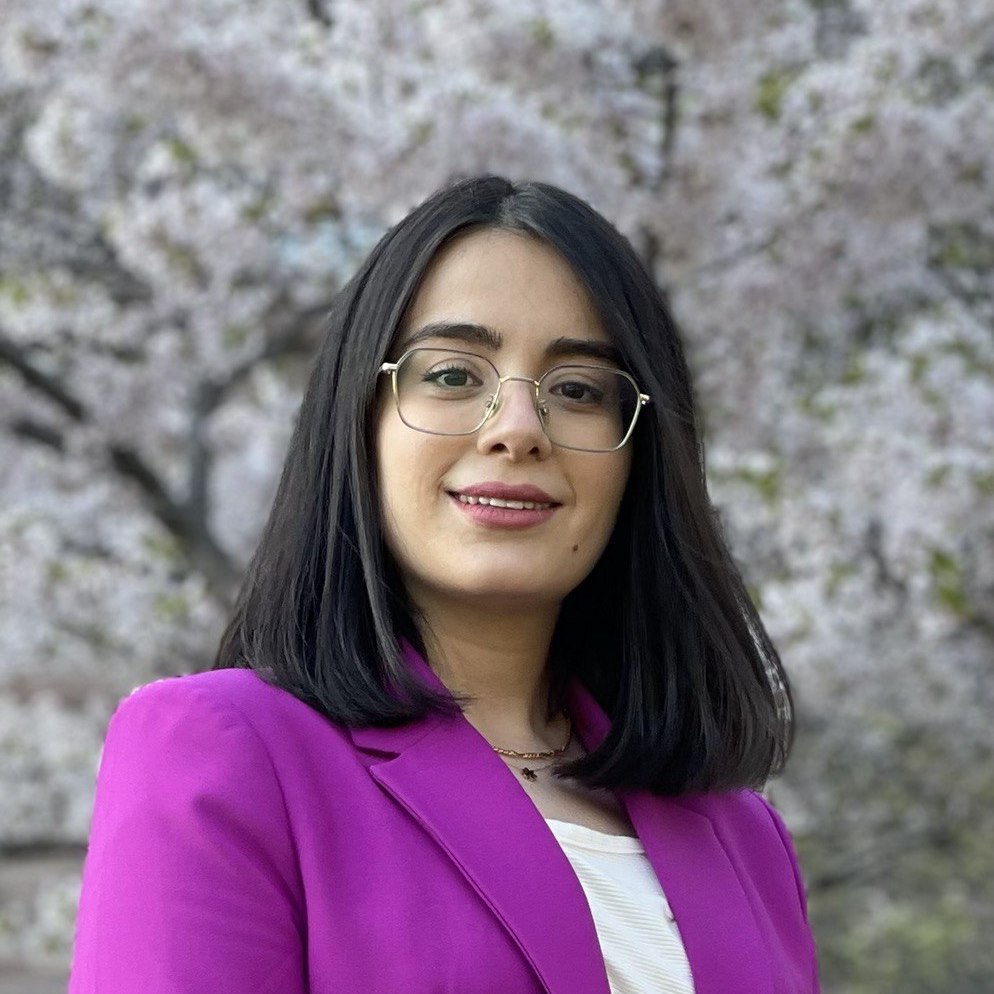
 Parand A. Alamdari
· 2 previous affiliations
- University of TorontoCurrent
- Current
- PhD student · 2020–2025
- Sharif University of Technology2015–2020
- Undergrad student · 2015–2020
Research Overview
Parand A. Alamdari focuses on the intersection of reinforcement learning (RL), AI safety, and social choice theory, with a specific emphasis on developing agents that are fair, considerate, and compliant with complex human values. Alamdari’s research addresses the challenges of underspecified objectives in sequential decision-making, utilizing formal methods and neurosymbolic frameworks to ensure that AI systems respect both the physical and epistemic states of other agents. By bridging the gap between high-level ethical principles and low-level algorithmic implementation, Alamdari develops methods for pluralistic alignment and non-Markovian fairness in multi-agent environments.
Research Trajectory
Alamdari’s early work established a foundation in neurosymbolic reinforcement learning, specifically targeting the interpretability and formal verification of neural controllers. In 2020, this research introduced a methodology for extracting decision-tree-based models from "black-box" neural networks. This approach allowed for the application of formal methods to controllers that were previously too complex for rigorous verification, effectively using the extracted model as an intermediary to handle problems infeasible for either deep RL or formal methods in isolation.
By 2021, Alamdari’s focus shifted toward AI safety and the problem of negative side effects. This transition was marked by an investigation into how agents with underspecified objectives might inadvertently cause harm to their environment or other agents. Alamdari proposed the concept of "considerateness," where an RL agent’s reward function is augmented to include the expected future return of other entities in the environment. This work laid the groundwork for a broader exploration of pluralistic alignment, moving beyond single-agent safety to consider the wellbeing and agency of multiple stakeholders.
In 2023, Alamdari expanded the scope of side-effect research to include epistemic states. While previous safety research focused on physical disruptions, Alamdari participated in defining "epistemic side effects"—undesirable changes to the knowledge or beliefs of other agents in partially observable multi-agent settings. During this same period, Alamdari began investigating the temporal dimensions of fairness. Recognizing that fairness in sequential decision-making is often history-dependent, Alamdari formalized the notion of non-Markovian fairness, arguing that equitable treatment cannot be assessed at a single time point but must be evaluated across the trajectory of an interaction.
The most recent phase of Alamdari’s work, spanning 2024 and 2025, integrates social choice theory with RL to address the "too many cooks" problem in AI alignment. This research treats the space of possible AI behaviors as a geometric polytope and applies voting rules to find collective policies that respect diverse individual preferences. This period also reflects a move toward practical deployment and compliance, including the use of Large Language Models (LLMs) to provide prior knowledge for contextual bandits and the development of auditing frameworks for small and medium-sized enterprises (SMEs). These frameworks adapt formal process monitoring techniques to ensure that advanced AI systems comply with product-specific safety constraints and regulations.
Current Directions
Alamdari’s current research is concentrated on three primary pillars: pluralistic alignment, temporal fairness, and neurosymbolic compliance.
The work on pluralistic alignment seeks to resolve conflicts between stakeholders with divergent values. By framing Tractable Search in Exponential Policy Spaces, Alamdari develops methods to aggregate individual preferences into a single, fair policy. This involves navigating The Computational Complexity of Multiwinner Committee Selection logic, where the goal is to ensure that the resulting AI behavior is representative of the diversity of the electorate or user base.
In the domain of fairness, Alamdari continues to refine the FairQCM algorithm, which utilizes counterfactual memory to handle non-Markovian constraints. This allows agents to "remember" past inequities and adjust current behavior to compensate, ensuring fairness over long-term horizons. Finally, Alamdari is exploring the use of neurosymbolic frameworks to ground high-level linguistic instructions into agentic behaviors, enabling agents to learn complex, multi-stage tasks with high sample efficiency while remaining subject to formal auditing and monitoring.
Representative Work
Formal Methods with a Touch of Magic This work addresses the controller-design problem by combining machine learning with formal methods. Alamdari introduces a process where a "magic book"—a decision-tree-based model—is extracted from a deep RL "wizard" (a neural network). This intermediary model allows for formal reasoning about the agent's behavior, enabling the design of controllers for environments that are otherwise too complex for standard formal verification or too sensitive for unverified RL.
Be Considerate: Objectives, Side Effects, and Deciding How to Act In this first-author paper, Alamdari contends that AI safety requires agents to contemplate the impact of their actions on the wellbeing and agency of others. The research proposes augmenting RL rewards based on the expected future returns of other agents and reactive processes in the environment. This approach provides a mechanism for agents to avoid negative side effects even when their primary objectives are underspecified.
Remembering to Be Fair: Non-Markovian Fairness in Sequential Decision Making Alamdari formalizes the concept that fairness in sequential settings is inherently non-Markovian, meaning it depends on the history of the process rather than just the current state. The paper introduces FairQCM, an RL algorithm that employs counterfactual memory to satisfy temporal fairness constraints. This method demonstrates significantly higher sample efficiency than standard approaches when learning fair policies in complex environments.
Policy Aggregation This research tackles the challenge of creating a single AI policy that satisfies a group of individuals with conflicting values. Alamdari models the space of possible behaviors as a polytope and applies social choice voting rules to identify fair collective policies. The work provides mathematical guarantees that the resulting policies respect individual preferences regardless of how different stakeholders scale their internal reward systems.
Jump Starting Bandits with LLM-Generated Prior Knowledge Alamdari explores the integration of LLMs with Contextual Multi-Armed Bandits to reduce online learning regret. By prompting LLMs to simulate human behaviors and preferences, the proposed algorithm generates a pre-training dataset that "jump-starts" the bandit framework. This approach leverages the extensive human knowledge embedded in LLMs to improve the efficiency of recommendation systems and personalized suggestion engines.
Auditing, Monitoring, and Intervention for Compliance of Advanced AI Systems Focusing on the risks faced by SMEs adopting advanced AI, Alamdari proposes a set of techniques for specifying and monitoring behavioral constraints. The framework adapts formal methods historically used in process monitoring to perform offline auditing and online runtime monitoring of AI systems. This allows developers and third-party evaluators to ensure that LLMs and other agentic systems comply with safety norms, rules, and regulations.
Profile updated
Loading new papers…
Other researchers whose papers cluster into the same research directions — a proxy for overlapping technical interests and shared intellectual neighborhoods.
See something wrong? Report a mistake