

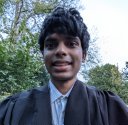
 Param Hanji
· 4 previous affiliations
- Apple (United States)Since 2023
- Researcher · Since 2023
- University of CambridgeCurrent
- Current
- Postdoc · 2022–2023
- PhD student · 2019–2022
- National University of Singapore2018–2019
- Research Assistant · 2018–2019
- National Institute of Technology Karnataka2014–2018
- Undergrad student · 2014–2018
Research Overview
Param Hanji focuses on high dynamic range imaging, visual quality assessment, and 3D scene generation. Early work addressed the reconstruction and evaluation of high dynamic range content under challenging illumination conditions, while later research expanded into perceptual metrics for neural view synthesis and video distortions. Recent efforts investigate generative models for point clouds and structured digital twins of indoor environments.
Research Trajectory
The trajectory begins with a focus on high dynamic range (HDR) imaging, particularly the challenges of reconstructing scenes from multiple exposures. Hanji introduced Noise-Aware Merging of High Dynamic Range Image Stacks Without Camera Calibration, demonstrating that near-optimal radiance reconstruction can be achieved using a simplified Poisson noise estimator rather than requiring complex, camera-specific calibration. This foundational work, along with subsequent research on the Robust Estimation of Exposure Ratios in Multi-Exposure Image Stacks, contributed significantly to the research direction of Deghosting Multi Exposure Images in Dynamic Scenes.
To support the rigorous evaluation of computer vision methods under extreme lighting, Hanji developed HDR4CV: High Dynamic Range Dataset with Adversarial Illumination for Testing Computer Vision Methods. This dataset provided scenes captured across adversarial illuminations, such as low light and glare, alongside uniform reference conditions. Parallel collaborative work explored hardware solutions for perceptual realism, participating in the development of a system for Reproducing reality with a high-dynamic-range multi-focal stereo display to deliver accurate color, wide dynamic range, and binocular depth cues.
The evaluation of HDR content naturally extended into broader visual quality assessment. Hanji investigated the Comparison of single image HDR reconstruction methods - the caveats of quality assessment and collaborated on techniques for Distilling Style from Image Pairs for Global Forward and Inverse Tone Mapping. A major contribution to perceptual metrics was the development of HDR-VDP-3: A multi-metric for predicting image differences, quality and contrast distortions in high dynamic range and regular content. This visual difference predictor advanced the evaluation of image and video quality, touching upon themes relevant to the broader area of Self-Explainable Neural Networks without Performance Loss. The exploration of perceptual metrics continued with ColorVideoVDP: A visual difference predictor for image, video and display distortions, which intersects with the research direction of Asymmetric Spatiotemporal Decoupling for Video Models, and a comprehensive retrospective on the field, 24‐1: Visible Difference Predictors: A Class of Perception‐Based Metrics.
As neural rendering emerged as a dominant paradigm, Hanji applied expertise in perceptual evaluation to 3D vision. With collaborators, they conducted the first comprehensive study on the Perceptual Quality Assessment of NeRF and Neural View Synthesis Methods for Front-Facing Views. By collecting datasets with reference video sequences, this work highlighted temporal artifacts often missed by static image metrics, contributing to the area of Generalizing from Synthetic Data to the Real World. Further methodological work in neural representations included participation in the development of Neural Fields with Hard Constraints of Arbitrary Differential Order, which introduced approaches for enforcing hard constraints on neural fields using techniques inspired by spectral collocation methods.
Current Directions
Most recently, the research focus has expanded into generative modeling for 3D environments and point clouds. Recent work investigates the generation of high-fidelity 3D structures, as seen in FrePolad: Frequency-Rectified Point Latent Diffusion for Point Cloud Generation. This pipeline integrates a variational autoencoder with a denoising diffusion probabilistic model, utilizing spherical harmonics to retain high-frequency content—a method relevant to the research direction of Spectral Bias in Coordinate Neural Networks. Additionally, collaborative efforts address the creation of structured indoor environments in CHOrD: Generation of Collision-Free, House-Scale, and Organized Digital Twins for 3D Indoor Scenes with Controllable Floor Plans and Optimal Layouts, advancing techniques in the broader area of Coarse to Fine Generative Refinement.
Profile updated
Loading new papers…
Other researchers whose papers cluster into the same research directions — a proxy for overlapping technical interests and shared intellectual neighborhoods.
See something wrong? Report a mistake