

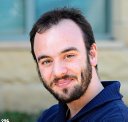
 Panos Achlioptas
· 8 previous affiliations
- OumiSince 2024
- Senior Research Scientist · Since 2024
- OptasSince 2025
- Researcher · Since 2025
- HIFMSSince 2025
- AI Research Scientist · Since 2025
- Stanford UniversityCurrent
- Current
- PhD student · 2021
- Steelperlot2022–2024
- Principal Researcher · 2022–2024
- Steel Perlot2022–2024
- Head of Applied Research · 2022–2024
- Snap Inc.2021–2022
- Researcher · 2021–2022
- AI Research Scientist
- Research Intern · 2019
Research Overview
Panos Achlioptas focuses on the intersection of 3D computer vision, geometric deep learning, and natural language processing. His work explores the representation and generation of 3D geometric data, the grounding of linguistic descriptions in 3D scenes, and the development of neural models for controllable game simulation. His research trajectory reflects a shift from computational genomics toward the analysis of 3D shape collections and, more recently, toward multimodal systems that integrate subjective human perception and language with 3D environments.
Research Trajectory
The early stages of Achlioptas’s research were situated in computational biology and genome-wide association studies (GWAS). In 2011, he addressed the computational bottlenecks of mapping phenotypes to pairs of genetic loci, developing subquadratic algorithms to handle the massive search space of single nucleotide polymorphisms. This work established an early focus on algorithmic efficiency and high-dimensional data analysis.
By 2017, his focus shifted significantly toward 3D computer vision and geometric deep learning. During this period, he investigated how deep representation learning and generative modeling could be applied to 3D point clouds. This work moved beyond traditional 2D image processing to address the unique challenges of 3D geometric data, such as permutation invariance and the lack of a regular grid structure. His contributions in this area involved the development of deep AutoEncoder (AE) networks and Generative Adversarial Networks (GANs) capable of high-quality shape reconstruction, interpolation, and semantic editing.
Following his work on raw point clouds, Achlioptas moved toward more structured shape analysis between 2018 and 2020. This phase of his research emphasized the geometric structure of latent spaces and the use of functional maps to analyze shape collections. By moving away from template-based models, he explored how latent spaces could be endowed with geometric properties to facilitate deformation transfer and the extraction of "limit shapes" that represent the central tendencies of a collection. This period marked a transition from purely generative tasks to the structural and relational analysis of 3D models.
Starting around 2020, Achlioptas’s work increasingly integrated natural language processing with 3D vision. This research direction focuses on visio-linguistic models that can ground human language in 3D scenes, enabling tasks such as reference disambiguation and semantic part segmentation. His work in this domain explores how linguistic priors can inform the perception of compositional structures in 3D objects. More recently, this has evolved into the study of Reference-Free Evaluation for Open-Ended Generation, where the goal is to assess model outputs without relying on rigid human-written gold standards.
His most recent research, spanning 2022 to 2024, expands into subjective image understanding and neural simulation. This includes exploring Affective Visual Reasoning for Subjective Image Understanding, which seeks to bridge the gap between objective object identification and the subjective emotional responses humans have to visual stimuli. Additionally, he has contributed to the development of "Learnable Game Engines" and promptable game models, which use diffusion models and text-guided simulation to create controllable, interactive environments from video data. This work also touches upon Sentiment Anchoring for Consistent Natural Language Generation, addressing the challenge of maintaining consistency between numerical ratings or emotional labels and generated text.
Representative Work
Achlioptas’s early contribution to computational genomics is exemplified by Two-locus association mapping in subquadratic time. As first author, he proposed an algorithm for 2-locus GWAS that overcame the quadratic complexity typically associated with searching for associations between pairs of genetic loci. This work was critical for identifying complex disease associations that single-locus studies often miss, providing a data-dependent approach that scaled to large genomic datasets.
In the domain of 3D geometry, Representation Learning and Adversarial Generation of 3D Point Clouds represents a foundational effort in applying deep learning to point cloud data. As first author, Achlioptas introduced a deep AutoEncoder architecture that achieved state-of-the-art reconstruction and generalization. The study demonstrated that learned representations could enable complex shape manipulations, such as semantic part editing and shape analogies, while also evaluating the performance of GANs trained on raw point clouds versus those trained in the latent space of the AE.
His work on the structural properties of shape collections is detailed in Latent Space Representation for Shape Analysis and Learning. Serving as second author, he contributed to a framework that uses functional map networks to construct shape representations without the bias of a template model. This research showed that properly regularized latent spaces could be endowed with natural geometric structures, facilitating more accurate analysis and processing of diverse shape collections.
As the senior author on 3D-Scene-Entities: Using Phrase-to-3D-Object Correspondences for Richer Visio-Linguistic Models in 3D Scenes, Achlioptas led the curation of a large-scale dataset designed to link natural language phrases to specific 3D objects within complex scenes. This work advanced the field of 3D grounding by providing explicit correspondences between all objects mentioned in a referential sentence and their underlying 3D instances, enabling more sophisticated visio-linguistic reasoning.
Achlioptas also participated in the development of PartGlot: Learning Shape Part Segmentation from Language Reference Games. This research introduced a neural framework for learning semantic part segmentation of 3D geometry using only referential language. By leveraging the way humans naturally describe objects to differentiate them, the model learns to identify and segment parts without explicit part-level supervision, demonstrating the power of linguistic priors in geometric understanding.
His recent involvement in neural simulation is seen in Promptable Game Models: Text-Guided Game Simulation via Masked Diffusion Models. This work moves toward more semantic control of game environments, allowing users to play or "direct" a game using high-level natural language prompts and desired states. By augmenting game models with masked diffusion, the research enables a more flexible and intuitive form of interaction with neural simulators compared to traditional action-by-action control.
Profile updated
Loading new papers…
Other researchers whose papers cluster into the same research directions — a proxy for overlapping technical interests and shared intellectual neighborhoods.
See something wrong? Report a mistake