

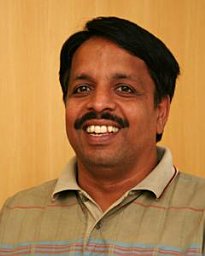
 P J Narayanan
· 6 previous affiliations
- Professor and former Director · Since 2025
- Full Professor · Since 2004
- Professor and Director · 2013–2025
- Professor and Dean (R&D) · 2006–2013
- Associate Professor · 2000–2004
- ACM India2010–2014
- President · 2010–2014
- Scientist (D, E) and Head of Vision/VR Groups · 1996–2000
- Carnegie Mellon University1992–1996
- Researcher · 1992–1996
- University of Maryland, College Park1986–1992
- Graduate Assistant · 1986–1992
- BTech, Computer Science · 1979–1984
Research Overview
P J Narayanan focuses on computer vision, computer graphics, and parallel computing. His early work explored the effective use of parallel architectures for image understanding and the construction of virtual worlds from real scenes. More recently, his research investigates neural rendering, 3D human reconstruction, and real-time relightable avatars.
Research Trajectory
Narayanan’s early research investigated the intersection of parallel processing and computer vision. He developed methods for mapping low- and intermediate-level vision tasks onto SIMD architectures, as detailed in Effective Use of SIMD Parallelism in Low- and Intermediate-Level Vision. Moving into 3D environments, his work pioneered techniques for immersive visual media. In Virtualized Reality: Constructing Virtual Worlds from Real Scenes, his group introduced a framework for digitizing real-world events using multiple cameras to compute depth and intensity. He expanded on this by combining dense stereo views to form visible and complete surface models, enabling fully three-dimensional interaction in Constructing Virtual Worlds Using Dense Stereo.
As commodity graphics processing units (GPUs) became programmable, Narayanan focused on accelerating complex computational tasks. With collaborators, he adapted fundamental graph algorithms for the CUDA programming model, demonstrating significant speedups for massive datasets in Accelerating Large Graph Algorithms on the GPU Using CUDA. This approach was subsequently applied to computer vision optimization problems, notably in CUDA cuts: Fast graph cuts on the GPU, which enabled real-time performance for the computationally heavy push-relabel algorithm. His work in computer graphics also leveraged GPU architectures to efficiently render complex geometry, such as the adaptive marching points algorithm presented in Real-Time Ray Tracing of Implicit Surfaces on the GPU. Returning to large-scale 3D reconstruction, his lab addressed the computational bottlenecks of structure from motion (SfM). They developed a hybrid CPU-GPU implementation of sparse bundle adjustment in Practical Time Bundle Adjustment for 3D Reconstruction on the GPU. Building on this foundation, his group later proposed a highly parallelizable approach to SfM that registers images to a coarse 3D model using direct localization techniques in Multistage SFM: Revisiting Incremental Structure from Motion.
In recent years, Narayanan’s research has heavily engaged with neural rendering and the synthesis of complex materials. His lab has made significant contributions to the research direction of High-Frequency Specular Reflections in Neural Radiance Fields. Within this area, they introduced a framework that disentangles a scene's material properties from its lighting to allow for simultaneous novel view synthesis and texture editing in Appearance Editing with Free-viewpoint Neural Rendering. Continuing to optimize rendering pipelines, his group developed PRTT: Precomputed Radiance Transfer Textures, a method that stores precomputed lighting in textures to achieve real-time rendering of glossy materials on low-resolution meshes. His lab also explored the composition of neural scenes, proposing a distillation method to merge multiple independent models into a single representation with constant rendering speeds in FusedRF: Fusing Multiple Radiance Fields.
Parallel to scene rendering, Narayanan has advanced the 3D reconstruction of humans. His group designed an end-to-end network combining parametric body priors with non-parametric 2D representations to accurately recover the geometry of individuals in loose clothing in SHARP: Shape-Aware Reconstruction of People in Loose Clothing. His research also extends to model interpretability and image enhancement. His lab transformed diagnostic tools into training objectives to steer neural networks away from misleading biases in Concept Distillation: Leveraging Human-Centered Explanations for Model Improvement. He also introduced an interpretable, model-driven network for zero-reference low-light enhancement in Specularity Factorization for Low-Light Enhancement.
Most recently, his group has focused on generalizable and accessible 3D perception. They developed a transformer-based architecture that distills multi-view consistent features for high-quality semantic segmentation on unseen scenes in GSN: Generalisable Segmentation in Neural Radiance Field. Pushing the boundaries of mobile capture, his lab introduced LightHeadEd: Relightable & Editable Head Avatars from a Smartphone, a framework utilizing 2D Gaussian representations and inexpensive polaroid filters to create animatable, realistically relightable 3D head avatars directly from mobile devices.
Current Directions
The most recent papers in the evidence address generalizable 3D perception, accessible neural rendering, and interpretable image enhancement. Work investigates how to perform high-quality 3D semantic segmentation on unseen environments without scene-specific retraining, leveraging multi-view consistent features distilled from foundation models. Additionally, recent research explores the democratization of high-fidelity avatar creation, developing frameworks that allow standard smartphones to capture animatable, relightable 3D head avatars using 2D Gaussian representations. Another active theme involves physics-based, model-driven architectures for zero-reference image enhancement, focusing on interpretable factorization techniques for low-light conditions.
Profile updated
| Title | Venue | Year |
|---|---|---|
| Algebraic Dead Directions in LayerNorm Transformers: A Forward-Pass-Only Diagnostic at LLM Scale | arXiv | 2026 |
| Dead-Direction Signatures: A Cheap Spectral Reading of Singular Complexity | arXiv | 2026 |
| Neural view synthesis with appearance editing from unstructured images | Icvgip '21: Proceedings of the Twelfth Indian Conference on Computer Vision, Graphics and Image Processing | 2025 |
| LightHeadEd: Relightable & Editable Head Avatars from a Smartphone | arXiv | 2025 |
| A novel placement method of a calibration-free pH capsule for continuous wireless measurement of intragastric pH in horses | Journal of Veterinary Internal Medicine | 2024 |
| Reconstruction of People in Loose Clothing | Openreview | 2024 |
| Hybrid deep learning-based skin cancer classification with RPO-SegNet for skin lesion segmentation | Network | 2024 |
| Concept Distillation: Leveraging Human-Centered Explanations for Model Improvement | NeurIPS | 2023 |
| FusedRF: Fusing Multiple Radiance Fields | arXiv | 2023 |
| SHARP: Shape-Aware Reconstruction of People in Loose Clothing | IJCV | 2023 |
Loading new papers…
Other researchers whose papers cluster into the same research directions — a proxy for overlapping technical interests and shared intellectual neighborhoods.
See something wrong? Report a mistake