

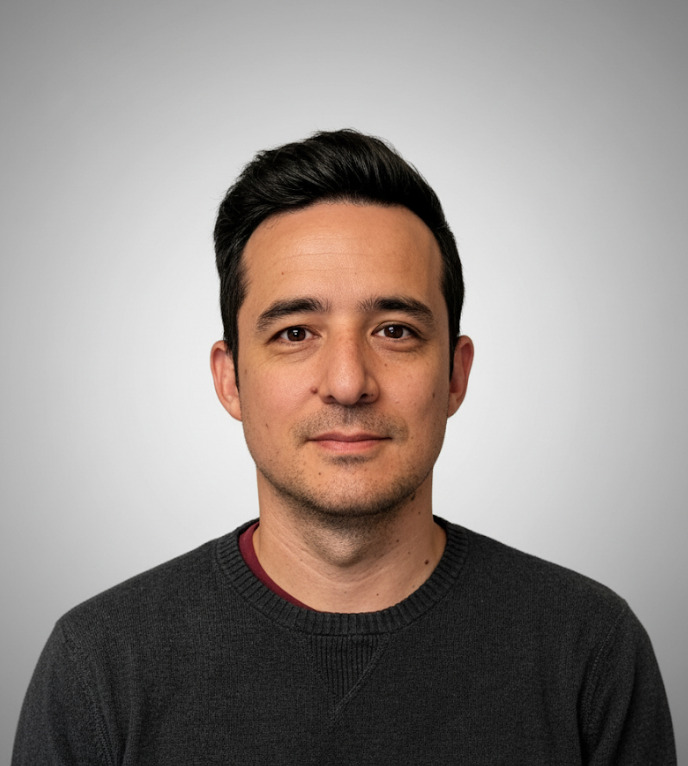
 Oliver Wang
· 5 previous affiliations
- Google (United States)Since 2023
- Principal Researcher · Since 2023
- Current
- Adobe Systems (United States)2015–2023
- Research Scientist · 2015–2023
- Walt Disney (Switzerland)2010–2015
- Research Scientist · 2010–2015
- University of California, Santa Cruz2003–2010
- PhD student · 2003–2010
Research Overview
Oliver Wang focuses on computer vision, computational photography, and generative modeling. His early work addressed video processing and temporal consistency, evolving into significant contributions to perceptual metrics and 3D reconstruction. Most recently, his research investigates high-resolution image synthesis and continuous neural fields for scalable diffusion models.
Research Trajectory
He began his published research by addressing physical scene properties, introducing methods for Material classification using BRDF slices in 2009. This work leveraged multiple images captured under varying lighting conditions to sample bidirectional reflectance distribution functions, improving the separation of distinct material types in image segmentation.
By 2015, his focus expanded into video processing and temporal alignment. He developed techniques for Phase-based frame interpolation for video, which generated in-between frames by modifying per-pixel phase shifts rather than relying on traditional optical flow estimation. This approach contributed to the broader research direction of Motion Analysis via Spatiotemporal Phase Shifts by offering an efficient alternative for bounded motion interpolation.
As deep learning became central to computer vision, he investigated neural architectures for video restoration and generative modeling. In 2017, he guided the development of Deep Video Deblurring for Hand-Held Cameras, training convolutional neural networks end-to-end to aggregate information across neighboring frames without relying on fragile explicit alignment procedures. Concurrently, he collaborated on Toward Multimodal Image-to-Image Translation, exploring conditional generative models that map a single input to a distribution of possible outputs using invertible latent codes to mitigate mode collapse.
The following year marked a significant expansion into perceptual metrics, computational photography, and multimodal video analysis. He directed research into how neural networks evaluate visual similarity, resulting in The Unreasonable Effectiveness of Deep Features as a Perceptual Metric. By introducing a large-scale dataset of human perceptual judgments, this work demonstrated that features extracted from classification networks align closely with human perception, advancing the area of The Perceptual Misalignment of Image Quality Metrics. In computational photography, he participated in creating DeepLens: shallow depth of field from a single image, which utilized a differentiable neural pipeline to simulate lens blur and depth from mobile phone captures. He also contributed to Learning Blind Video Temporal Consistency, employing deep recurrent networks to stabilize image processing algorithms applied independently to video frames.
During this highly productive period, his work extended beyond pure vision to incorporate audio and language. He oversaw the creation of Self-Supervised Generation of Spatial Audio for 360° Video, which used end-to-end networks to separate and localize sound sources on a viewing sphere from mono audio. Additionally, he developed models for Localizing Moments in Video with Temporal Language, reasoning about video context to ground specific temporal relationships described in natural language queries.
Between 2019 and 2022, the trajectory incorporated 3D computer vision and view synthesis. He co-developed Photometric Mesh Optimization for Video-Aligned 3D Object Reconstruction, combining multi-view geometric techniques with data-driven shape priors to optimize object meshes directly from RGB videos without requiring depth or mask information. Building on generative approaches for 3D scenes, he contributed to 3inGAN: Learning a 3D Generative Model from Images of a Self-similar Scene, an unconditional model capable of producing view-consistent volumetric representations from 2D images.
Most recently, his research has focused heavily on the architecture and scaling of diffusion models. In 2024, he collaborated on VecFusion: Vector Font Generation with Diffusion, a cascaded approach that synthesizes complex vector curves conditioned on low-resolution raster fonts. Addressing the challenges of high-resolution image synthesis, he participated in Greedy Growing Enables High-Resolution Pixel-Based Diffusion Models, which introduced a stable training algorithm for scaling architectures without cascaded super-resolution, contributing to the area of Scaling Diffusion Models Directly in Pixel Space. He also co-authored Image Neural Field Diffusion Models, advancing the research direction of Super Resolving Latent Representations for Machine Perception by training diffusion models on continuous representations to generate photorealistic images at arbitrary resolutions.
Current Directions
The most recent papers in the evidence address the scalability and resolution limits of generative diffusion models. Recent work investigates continuous image neural fields to enable resolution-agnostic image synthesis, moving beyond the constraints of fixed-resolution grids to generate highly detailed outputs. Additionally, this research explores stable training methodologies for scaling pixel-based diffusion models and cascaded architectures for specialized generative tasks, such as vector graphic synthesis and structural control.
Profile updated
Loading new papers…
Other researchers whose papers cluster into the same research directions — a proxy for overlapping technical interests and shared intellectual neighborhoods.
See something wrong? Report a mistake