

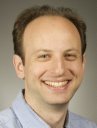
 Oliver Kosut
· 3 previous affiliations
- Arizona State UniversitySince 2012
- Associate Professor · Since 2018
- Assistant Professor · 2012–2018
- Postdoc · 2010–2012
- Cornell Tech2005–2010
- PhD student · 2005–2010
Research Overview
Oliver Kosut focuses on fundamental information theory, machine learning, and the security of cyber-physical power systems. His trajectory spans from early work on adversarial network coding and smart grid vulnerabilities to foundational bounds in multi-user communication. More recently, his research emphasizes differential privacy mechanisms, information leakage metrics, and robust statistical learning algorithms.
Research Trajectory
Kosut’s early research investigated the resilience of distributed systems and critical infrastructure against malicious actors. He formalized the distributed source coding problem under Byzantine attacks, characterizing achievable sum rates when an unknown subset of sensors is compromised in Distributed Source Coding in the Presence of Byzantine Sensors. Extending this adversarial perspective to cyber-physical systems, he analyzed vulnerabilities in power networks, using graph-theoretic approaches to identify the minimum set of compromised meters that could render a smart grid unobservable in Malicious Data Attacks on the Smart Grid. To defend against adversaries controlling unknown nodes in general networks, he introduced polytope codes—constant composition codes over bounded polytopes—in Polytope Codes Against Adversaries in Networks, contributing to the research direction of Overcoming the Limitations of Linear Codes.
A significant portion of his subsequent work addresses data privacy and the rigorous quantification of information leakage. With collaborators, he developed a flexible family of privacy metrics known as "maximal $\alpha$-leakage" to balance privacy and utility under hard distortion constraints in Tunable Measures for Information Leakage and Applications to Privacy-Utility Tradeoffs. This foundational approach was later generalized to "maximal g-leakage" in An Operational Approach to Information Leakage via Generalized Gain Functions, providing operational guarantees for privacy mechanisms against adversaries allowed multiple guesses. He also contributed to the theoretical underpinnings of differential privacy (DP), establishing optimal conversions between approximate DP and Rényi DP in Three Variants of Differential Privacy: Lossless Conversion and Applications. This work advanced the broader areas of Tight Privacy Accounting and Amplification in Distributed Systems and Translating Differential Privacy Budgets into Operational Risk, particularly improving privacy accounting for stochastic gradient descent.
Parallel to his privacy research, Kosut continued to advance multi-user information theory. He established a new second-order converse bound for the two-user multiple-access channel (MAC) using a novel measure called wringing dependence in A Second-Order Converse Bound for the Multiple-Access Channel via Wringing Dependence, informing the area of Information Theory for Short Packet Wireless Communications. He further explored network capacity by analyzing the benefits of cooperation facilitators in On the Benefit of Cooperation in Relay Networks and isolating the specific capacity benefits of perfect versus independent feedback in Perfect vs. Independent Feedback in the Multiple-Access Channel. More recently, he bounded the minimum energy-per-bit for the Gaussian relay channel using rank-1 linear relaying, connecting the optimization problem to differential equations in Nobody Expects a Differential Equation: Minimum Energy-Per-Bit for the Gaussian Relay Channel with Rank-1 Linear Relaying.
In recent years, his focus has expanded to robust machine learning and its application to physical and dynamical systems. Returning to power systems, his group developed a hybrid framework combining physics-based modal analysis with machine learning to identify grid events from limited Phasor Measurement Unit (PMU) data in A Machine Learning Framework for Event Identification via Modal Analysis of PMU Data. His recent algorithmic work addresses both privacy and robustness in learning. He oversaw the development of GeoClip, a geometry-aware gradient clipping framework that accelerates differentially private SGD without consuming extra privacy budget, detailed in GeoClip: Geometry-Aware Clipping for Differentially Private SGD. He also guided the design of the Reveal-or-Obscure (ROO) algorithm for privacy-preserving discrete data sampling in Reveal-or-Obscure: A Differentially Private Sampling Algorithm. In the domain of statistical recovery, his lab introduced the NoMAD algorithm to recover the skeleton of complex Gaussian Graphical Models from noise-corrupted samples in Robust Model Selection of Gaussian Graphical Models. Finally, bridging control theory and reinforcement learning, he formalized a framework unifying Linear Quadratic Regulators with Linear Markov Decision Processes to derive closed-form optimal policies in Linear Dynamics meets Linear MDPs: Closed-Form Optimal Policies via Reinforcement Learning.
Current Directions
The most recent papers in the evidence point toward a sustained focus on the intersection of differential privacy, robust statistical learning, and control theory. Current work investigates methods for optimizing differentially private training—such as geometry-aware gradient clipping and adaptive sampling algorithms—to maximize model utility without compromising strict privacy budgets. Additionally, Kosut is exploring robust structure learning in noisy environments, particularly for Gaussian Graphical Models, and developing hybrid reinforcement learning frameworks that integrate known physical dynamics with unknown stochastic environments to achieve highly efficient, exploration-free optimal control.
Profile updated
Loading new papers…
Other researchers whose papers cluster into the same research directions — a proxy for overlapping technical interests and shared intellectual neighborhoods.
See something wrong? Report a mistake