

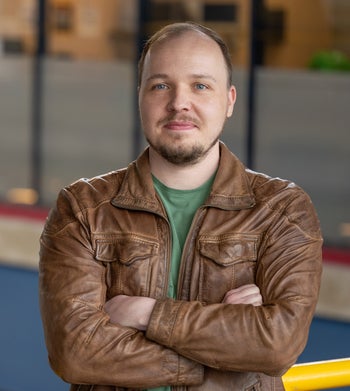
 Nils Lukas
· 3 previous affiliations
- Assistant Professor · Since 2024
- Current
- University of Waterloo2019–2024
- PhD student · 2019–2024
- RWTH Aachen University2012–2018
- MS student · 2016–2018
- Undergrad student · 2012–2016
Research Overview
Nils Lukas focuses on secure machine learning, privacy-preserving inference, and the robustness of AI watermarking systems. His early work explored cryptographic protocols for private data analysis and methods for verifying deep neural network ownership. More recently, his research addresses the vulnerabilities of generative AI watermarks, adversarial attacks on multimodal models, and differentially private mechanisms for large language models.
Research Trajectory
Lukas’s early research examined cryptographic approaches to data privacy. With collaborators, he participated in developing Differentially Private Two-Party Set Operations (2020), creating protocols using homomorphic encryption to allow joint data analysis without exposing sensitive intersection data.
He then shifted toward securing machine learning models against extraction and theft, contributing to the research direction of Defending Machine Learning Models Against Extraction Attacks. In Deep Neural Network Fingerprinting by Conferrable Adversarial Examples, he introduced a method to extract specific inputs from a source model that act as a fingerprint, ensuring that only stolen surrogate models agree on their classification. This work advanced the areas of Ownership Verification for Deep Neural Networks and Black Box Ownership Verification for Deep Neural Networks by leveraging the phenomenon of Cross Model Adversarial Transferability.
A major theme in his trajectory is the critical evaluation of AI watermarking systems, aligning with the research direction of The Vulnerability and Fragility of Neural Network Watermarks. He systematically evaluated existing defenses in SoK: How Robust is Image Classification Deep Neural Network Watermarking?, demonstrating that many popular schemes fail against adaptive attacks. Alongside evaluating vulnerabilities, he also developed new embedding techniques, such as PTW: Pivotal Tuning Watermarking for Pre-Trained Image Generators. Parallel to his work on model ownership, Lukas investigated data leakage in natural language processing. In Analyzing Leakage of Personally Identifiable Information in Language Models, he showed that standard dataset scrubbing techniques are insufficient to prevent the extraction of sensitive personal data, highlighting the need for algorithmic privacy defenses.
As an Assistant Professor at MBZUAI, his research group has continued to stress-test the security of generative AI. He demonstrated that watermarks for diffusion models can be broken using surrogate keys in Leveraging Optimization for Adaptive Attacks on Image Watermarks, contributing to the area of Publicly Verifiable Watermarking via Asymmetric Keys. Extending this vulnerability analysis to text, his lab published Optimizing Adaptive Attacks against Watermarks for Language Models, which challenged assumptions about the robustness of LLM watermarks against adaptive adversaries. This expertise in adversarial evaluation culminated in his team's Winning Solution to the NeurIPS 2024 Invisible Watermark Removal Challenge, where they utilized an adaptive VAE-based evasion attack to bypass watermarks under varying degrees of adversary knowledge. Around this time, his group also explored the detection of genuine media in Robust and Calibrated Detection of Authentic Multimedia Content.
Lukas’s recent work expands into multimodal security and applied differential privacy. His lab addressed the unique vulnerabilities of spoken instruction models in SPIRIT: Patching Speech Language Models against Jailbreak Attacks, proposing post-hoc interventions to mitigate imperceptible audio attacks. In the domain of healthcare, he guided the development of Demo: Sanitizing Medical Documents with Differential Privacy using Large Language Models, which applies differentially private inference to protect sensitive spans during document paraphrasing.
His most recent publications focus on scalable and robust security mechanisms. In Collaborative Threshold Watermarking, his team introduced a protocol for federated learning that requires a quorum of clients to verify a shared ownership signal, preventing unilateral removal. To defend against watermark spoofing, they proposed Mitigating Watermark Forgery in Generative Models via Randomized Key Selection, which drastically reduces forgery success rates. Furthermore, his group advanced private inference with DP-Fusion: Token-Level Differentially Private Inference for Large Language Models, a mechanism that blends output distributions to improve text quality while maintaining formal privacy guarantees. They also identified new statistical vulnerabilities in Context Inference Attacks Without Jailbreaks, showing that models can leak sensitive hidden context even when they successfully resist direct jailbreak attempts.
Current Directions
The most recent papers in the evidence indicate a strong focus on securing large generative models during deployment, particularly through advanced watermarking and privacy-preserving inference. Recent work investigates how to protect sensitive data processed by LLMs, developing token-level differentially private mechanisms that maintain high text quality and identifying subtle statistical leaks that occur even when models resist traditional jailbreaks. Additionally, ongoing research addresses the scalability and integrity of model ownership, exploring threshold-based watermarking for federated learning environments and randomized key selection to prevent watermark forgery in generative AI.
Profile updated
Loading new papers…
Other researchers whose papers cluster into the same research directions — a proxy for overlapping technical interests and shared intellectual neighborhoods.
See something wrong? Report a mistake