

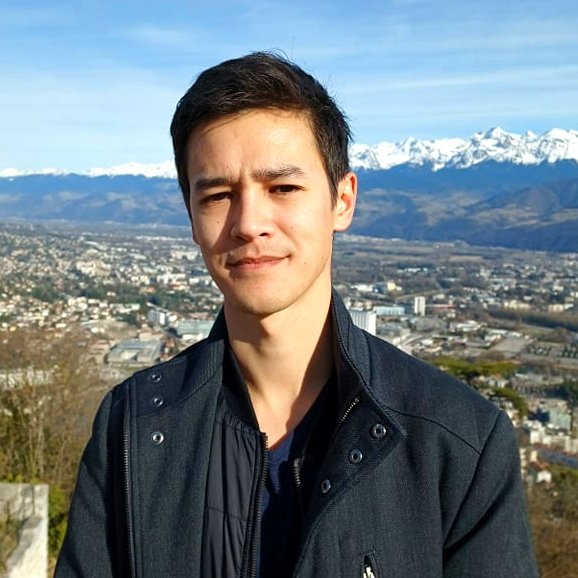
 Nicolas Keriven
· 4 previous affiliations
- Assistant Professor · Since 2019
- GIPSA-Lab2019–2022
- Assistant Professor · 2019–2022
- École Normale Supérieure - PSL2017–2019
- Postdoc · 2017–2019
- PhD student · 2014–2017
Research Overview
Nicolas Keriven focuses on signal processing, machine learning on graphs, and the theoretical foundations of graph neural networks. His trajectory spans early work in compressive learning and structured sparsity to rigorous mathematical analyses of graph representations. Most recently, he investigates the convergence, stability, and optimization dynamics of deep graph neural networks on large-scale structures.
Research Trajectory
Early work focused on sparse signal processing and compressive learning. In 2013, he introduced a backwards elimination strategy to improve structured sparsity in audio analysis with Structured sparsity using backwards elimination for Automatic Music Transcription. This interest in efficient data representation evolved into a broader focus on compressive learning, where massive datasets are compressed into "sketches" to reduce memory and computational overhead. He developed sketching techniques for estimating Gaussian Mixture Models in Sketching for large-scale learning of mixture models and extended this approach to clustering with Compressive K-means, demonstrating that cluster centers could be estimated from a drastically compressed representation independently of the original dataset size. Continuing in the audio domain, he also contributed to the research direction of Non-Gaussian Prior Modeling for Speech Processing by proposing a novel blind source separation algorithm based on characteristic function matching in Blind Source Separation Using Mixtures of Alpha-Stable Distributions.
By 2019, the trajectory shifted significantly toward the theoretical foundations of Graph Neural Networks (GNNs). He established rigorous mathematical proofs for GNN expressivity in Universal Invariant and Equivariant Graph Neural Networks, demonstrating that certain architectures can approximate any continuous function on a graph. Concurrently, he continued developing scalable algorithms for high-dimensional data, introducing a memory-efficient, model-free algorithm for sudden change detection in NEWMA: A New Method for Scalable Model-Free Online Change-Point Detection, which aligns with broader work in the area of Scaling Kernel Methods with Random Fourier Features. Returning to graph theory, he analyzed the behavior of Graph Convolutional Networks on standard random graph models in Convergence and Stability of Graph Convolutional Networks on Large Random Graphs. This work provided non-asymptotic convergence guarantees and advanced the research directions of Continuous Graph Limits for Transferable Neural Networks and Overcoming the Dense Graph Assumption in Graph Learning. During this period, he also participated in a comprehensive review of compressive learning techniques, co-authoring Sketching Data Sets for Large-Scale Learning: Keeping only what you need.
Subsequent research deepened the analysis of graph dynamics and the continuous limits of neural networks. In Sparse and smooth: Improved guarantees for spectral clustering in the dynamic stochastic block model, he established a theoretical link between sparsity and smoothness, proving that spectral clustering can recover communities even in extremely sparse, smoothly evolving networks. A major theme of his recent work addresses the limitations of message-passing architectures. In Not too little, not too much: a theoretical analysis of graph (over)smoothing, he provided a theoretical analysis of mean aggregation, contributing to the broader areas of Over-Smoothing in Graph Neural Networks and Low-Pass Graph Filtering for Feature Denoising. He further expanded the continuous framework for GNNs by analyzing the role of positional encodings in What functions can Graph Neural Networks compute on random graphs? The role of Positional Encoding and exploring generic aggregation functions in Convergence of Graph Neural Networks with generic aggregation functions on random graphs, which revealed the dimensional constraints of "max" aggregations. This line of inquiry culminated in Seeking universal approximation for continuous counterparts of GNNs on large random graphs, bridging discrete GNNs with operator learning. Alongside these theoretical limits, he investigated practical graph reduction techniques, collaborating on Graph Coarsening with Message-Passing Guarantees to preserve spectral properties during message passing. He also led research into optimization bottlenecks, mathematically characterizing the phenomenon of gradient scarcity in semi-supervised settings in Gradient Scarcity in Graph Learning with Bilevel Optimization.
The most recent papers in the evidence continue to refine graph optimization and training dynamics. He participated in developing a new framework for admissible matrices in Taxonomy of reduction matrices for Graph Coarsening, decoupling reduction and lifting matrices to improve spectral preservation. Pushing the analysis of deep GNN training further, he introduced the concept of backward oversmoothing in Backward Oversmoothing: why is it hard to train deep Graph Neural Networks?. This work proved that backpropagated gradients in deep architectures converge to a non-informative constant, creating spurious stationary points that uniquely hinder GNN optimization.
Current Directions
The most recent work in the evidence focuses on the optimization challenges and structural reduction of deep Graph Neural Networks. A primary direction involves diagnosing and mitigating training failures in deep architectures, particularly the phenomenon of backward oversmoothing where gradients attenuate to non-informative constants. Alongside optimization dynamics, current research addresses graph coarsening and sparsification, seeking mathematically grounded methods to reduce large-scale graphs while preserving their spectral properties and message-passing guarantees. These efforts collectively aim to make deep graph learning more scalable, theoretically sound, and practically trainable.
Profile updated
Loading new papers…
Other researchers whose papers cluster into the same research directions — a proxy for overlapping technical interests and shared intellectual neighborhoods.
See something wrong? Report a mistake