

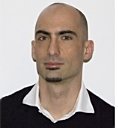
 Nicola Toschi
· 1 previous affiliation
- University of Rome Tor VergataSince 2015
- Associate Professor · Since 2015
Research Overview
Nicola Toschi focuses on computational neuroscience, neural decoding, and the application of generative artificial intelligence to neuroimaging data. His work spans the reconstruction of visual and auditory stimuli from brain activity to the dynamic modeling of functional connectivity. Recently, his research investigates interpretable semantic bottlenecks and multimodal foundation models for both brain-computer interfaces and clinical applications.
Research Trajectory
The trajectory of Toschi's recent research begins with foundational work in translating functional magnetic resonance imaging (fMRI) signals into multimodal outputs. In 2023, his group introduced a method for brain captioning and image reconstruction using latent diffusion models in Multimodal decoding of human brain activity into images and text. By leveraging cutting-edge image captioning models, this work provided enhanced flexibility in interpreting visual information from brain activity patterns, contributing to the broader area of Universal Neural Decoding Across Idiosyncratic Brains.
In 2024, his research expanded across new modalities and developmental models. He developed a differentiable framework for modeling brain wiring in Optimizing Genetically-Driven Synaptogenesis, which allowed gradient-based optimization to discover biological developmental programs capable of solving reinforcement learning tasks. Moving beyond visual stimuli, he investigated auditory perception in Decoding Musical Perception: Music Stimuli Reconstruction from Brain Activity, using generative models like MusicLDM to map brain region activity into latent spaces for accurate audio reconstruction. To unify these diverse signals, he proposed contrastive learning approaches for aligning EEG, MEG, and fMRI data in Towards neural foundation models for vision: Aligning EEG, MEG and fMRI representations to perform decoding, encoding and modality conversion, demonstrating the ability to capture semantic information across different brain imaging techniques.
By 2025, a major theme in his work became opening the "black box" of neural decoding to improve interpretability and generalization. In One Question at a Time: A Semantic Bottleneck for Interpretable Visual Brain Decoding from fMRI and the related Bridging Brains and Concepts: Interpretable Visual Decoding from fMRI with Semantic Bottlenecks, his team introduced semantic bottlenecks—human-readable binary spaces consisting of specific questions about an image—to identify exactly how specific brain regions represent concepts without sacrificing image generation quality. He also addressed inter-subject and inter-dataset variability in NeuroFusion: A Unified Framework for Generalized Visual Stimulus Decoding from fMRI Across Datasets and Subjects, proposing a contrastive learning-based alignment strategy to integrate neural recordings from multiple public datasets. Exploring temporal dynamics in primate spiking data, he demonstrated that lightweight temporal attention models outperform complex architectures for image retrieval in Simple Temporal Attention Beats Complex Decoders for Neural-to-Visual Mapping from Primate Spiking Data. Concurrently, he applied multimodal foundation models to clinical domains, developing a few-shot reinforcement learning framework for radiotherapy treatment planning in Transforming Multimodal Models into Action Models for Radiotherapy, which leveraged the physics and anatomy knowledge of models like GPT-4V.
In 2026, Toschi advanced the modeling of brain networks and the decoding of complex cognitive states. He moved away from static connectivity assumptions in Structure Discovery in fMRI Time-Series via Dynamic Graph Representation Learning, introducing an unsupervised dynamic graph structure learning framework. By learning evolving wiring diagrams directly from data, this work improved the reconstruction of brain activity and directly advanced the research directions of Tracking Time Varying Functional Connectivity and Overcoming Temporal Averaging Bias in Functional Brain Networks. He also participated in research adapting perception-focused models to reconstruct imagined visual content in Seeing the imagined: a latent functional alignment in visual imagery decoding from fMRI data. Finally, he mapped intermediate layers of artificial speech models to human electrocorticography (ECoG) responses in Mapping Whisper Representations to Human ECoG Responses with Interpretable Time-Resolved Neural Encoding, revealing anatomically organized patterns of phoneme representation in the auditory cortex.
Current Directions
The most recent papers in the evidence address the dynamic modeling of brain networks and the alignment of artificial intelligence representations with human neural activity. Current work investigates unsupervised dynamic graph learning to capture time-varying functional connectivity in fMRI data, moving beyond static network assumptions to better predict subject traits and reconstruct brain states. Additionally, ongoing research focuses on mapping complex cognitive processes—such as mental imagery and auditory speech perception—by aligning human electrophysiological responses with the latent spaces of large-scale generative and acoustic models.
Profile updated
Loading new papers…
Other researchers whose papers cluster into the same research directions — a proxy for overlapping technical interests and shared intellectual neighborhoods.
See something wrong? Report a mistake