

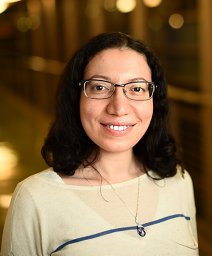
 Nesreen K. Ahmed
· 5 previous affiliations
- Cisco Systems (United States)Since 2024
- Principal Researcher · Since 2024
- Current
- PhD student · 2009–2015
- Masters of Science
- Intel (United States)2015–2024
- Senior Staff Scientist and Tech Lead · 2015–2024
- Technicolor2015
- Research Scientist · 2015
- Research Intern · 2014
Research Overview
Nesreen K. Ahmed focuses on large-scale graph machine learning, memory-efficient algorithmic design, and the representation of complex network structures. Her trajectory spans the development of streaming algorithms for probabilistic models to biologically inspired training frameworks for graph neural networks. Recently, her focus has expanded to include large-scale graph generative models and the application of large language models to domain-specific code translation and personalized reasoning.
Research Trajectory
In 2022, Ahmed advanced several core areas of graph machine learning and network analysis. She introduced foundational methods for capturing structural roles in networks, as seen in Role-Based Graph Embeddings, which contributes to the broader research direction of Learning Node Representations for Structural Equivalence. Expanding beyond simple pairwise connections, she directed the development of A Hypergraph Neural Network Framework for Learning Hyperedge-Dependent Node Embeddings. This work allows models to learn embeddings that depend on specific hyperedges, significantly improving performance on complex relational data by capturing higher-order interactions. Her group also explored the intersection of graph learning and cognitive science, publishing Memory-Augmented Graph Neural Networks: A Neuroscience Perspective, a comprehensive review that proposes a novel taxonomy to address memory bottlenecks in graph neural networks.
Concurrently, Ahmed addressed algorithmic bias and temporal dynamics in networks. She oversaw the design of the FAIRNEIGH framework in Graph Learning with Localized Neighborhood Fairness, which rewires local graph structures to mitigate structural bias amplification. Her research also extended to applied network analysis, including Technology Growth Ranking Using Temporal Graph Representation Learning and Personalized Visualization Recommendation.
A major parallel theme in Ahmed's 2022 work involves scaling probabilistic models under strict computational constraints. She guided research on efficient algorithms for Nonsymmetric Determinantal Point Processes (NDPPs), a class of models used to capture item compatibility. This yielded Online MAP Inference and Learning for Nonsymmetric Determinantal Point Processes, which advanced the area of Single Pass Learning under Strict Memory Constraints. A companion paper, One-Pass Algorithms for MAP Inference of Nonsymmetric Determinantal Point Processes, utilized local search techniques to achieve high-quality solutions with sublinear memory, further contributing to streaming submodular maximization.
Building on her interest in memory-efficient learning, Ahmed's 2024 work introduced biologically inspired training paradigms to bypass the memory-intensive backpropagation algorithm. In Forward Learning of Graph Neural Networks, she and her collaborators presented FORWARDGNN, a framework utilizing local contrastive learning and top-down feedback. This approach achieves predictive accuracy comparable to traditional methods while drastically reducing activation storage for memory-efficient training.
In 2025 and 2026, Ahmed participated in collaborative efforts exploring large-scale generative models and the capabilities of large language models (LLMs). She contributed to A Large-scale Training Paradigm for Graph Generative Models, which shifts graph generation toward pre-training on diverse domains to achieve zero-shot generalization. She also collaborated on A Personalized Conversational Benchmark: Towards Simulating Personalized Conversations, which introduced PersonaConvBench to evaluate personalized reasoning in multi-turn LLM interactions. Most recently, she participated in the development of the T2J framework in Learning Bug Context for PyTorch-to-JAX Translation with LLMs, leveraging execution feedback loops to improve domain-specific code translation. Additionally, Ahmed contributed to Explicit Style Extraction for Personalized Long-Form Text Generation, which introduced the StylePrism taxonomy and SP-Refine framework to guide personalized text generation and iterative revision through explicit inference-time style extraction.
Current Directions
The most recent papers in the evidence indicate a shift toward large-scale generative modeling and the evaluation of large language models in complex, domain-specific tasks. Recent work investigates the pre-training of large graph generative models across diverse datasets to enable zero-shot generalization and natural language-controlled graph synthesis. Additionally, Ahmed is involved in evaluating and improving the reasoning capabilities of LLMs. This includes developing benchmarks for personalized, multi-turn conversational agents and designing frameworks that use in-context learning and execution feedback to reliably translate code between specialized machine learning frameworks like PyTorch and JAX.
Profile updated
Loading new papers…
Other researchers whose papers cluster into the same research directions — a proxy for overlapping technical interests and shared intellectual neighborhoods.
See something wrong? Report a mistake