

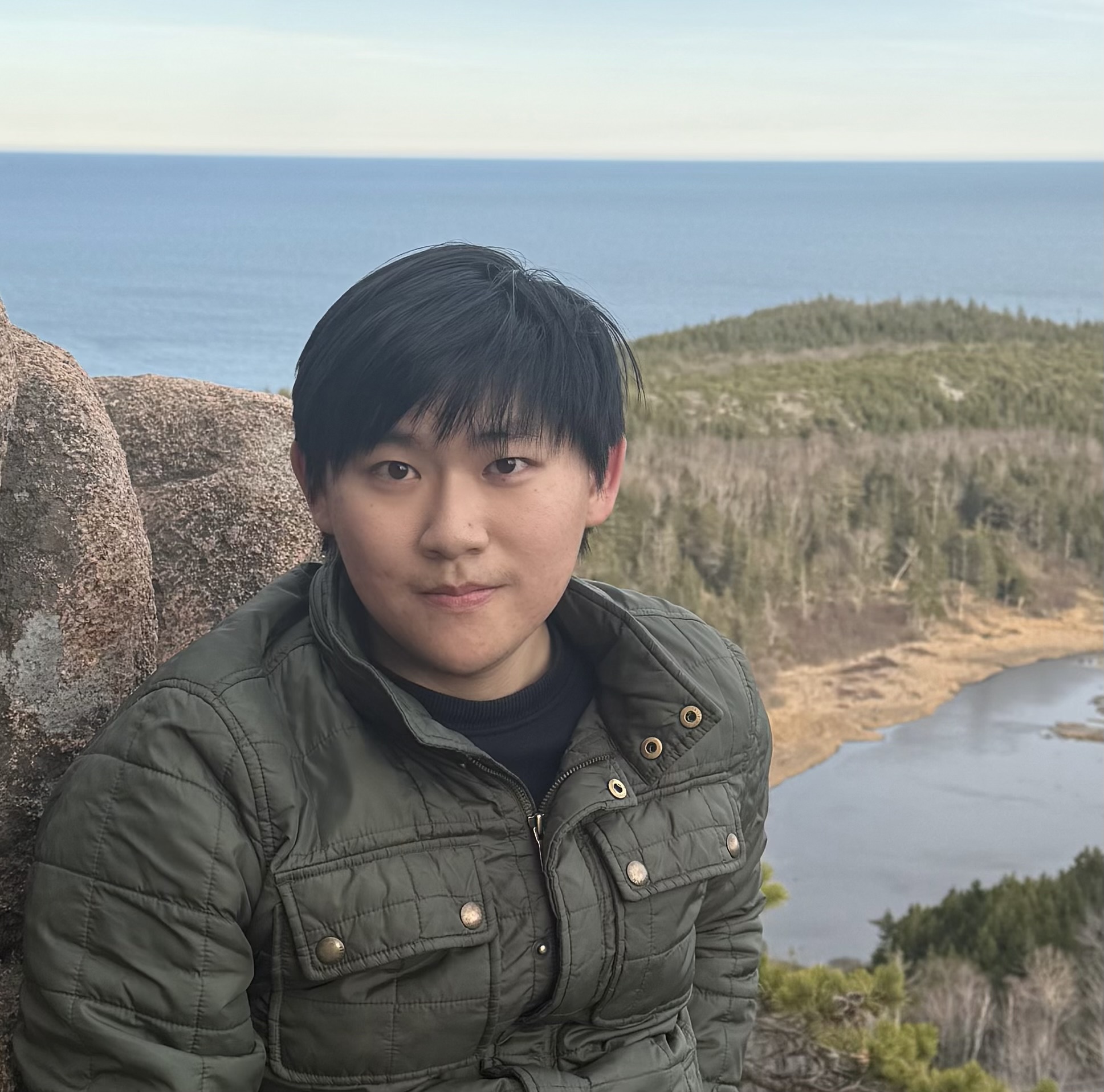
 Neil He
· 5 previous affiliations
- University of Illinois Urbana-ChampaignSince 2025
- Doctor of Philosophy - PhD, Computer Science · 2025–2030
- Research Assistant · Since 2025
- Amazon (United States)Since 2026
- Applied Scientist Intern · Since 2026
- Yale University2021–2025
- Master of Science - MS, Mathematics · 2024–2025
- Undergrad student · 2021–2025
- Undergraduate Research Assistant · 2022
- Massachusetts General Hospital2018–2021
- Research Assistant · 2018–2021
- Harvard Medical School2018–2021
- Research Assistant · 2018–2021
Research Overview
Neil He focuses on geometric deep learning, generative modeling on Riemannian manifolds, and the development of non-Euclidean foundation models. His trajectory spans foundational architectures for hyperbolic neural networks to scalable frameworks for large language models operating beyond Euclidean constraints. Most recently, his work addresses flow matching and diffusion models for complex, symmetric manifolds.
Research Trajectory
He began by addressing fundamental architectural challenges in geometric deep learning. In 2024, he introduced Lorentzian Residual Neural Networks, which tackled the numerical instability, model complexity, and tangent-space mapping errors often found in hyperbolic residual layers. By utilizing the weighted Lorentzian centroid within the Lorentz model of hyperbolic space, this work provided a more robust method for facilitating information flow across deep network layers.
Alongside his core work in geometric deep learning, his early trajectory includes contributions to the research direction of Vectorized Physics Simulation on Deep Learning Hardware and the area of Thermal Management for 3D Stacked Integrated Circuits. This interest in hardware-accelerated simulation is reflected in PyPOD-GP: Using PyTorch for accelerated chip-level thermal simulation of the GPU, where he leveraged deep learning frameworks to accelerate chip-level thermal modeling. Broadly, these early efforts established a foundation in the area of Generalizing Machine Learning to Arbitrary Riemannian Manifolds.
In 2025, his focus expanded significantly toward integrating non-Euclidean geometries into large-scale foundation models. He mapped out this transition in Hyperbolic Deep Learning for Foundation Models: A Survey and articulated a formal roadmap in Position: Beyond Euclidean – Foundation Models Should Embrace Non-Euclidean Geometries. The latter paper argued that traditional Euclidean constraints limit the ability of large language models to represent the complex, exponentially expanding hierarchical structures inherent in real-world data.
Putting this theory into practice, he developed HELM: Hyperbolic Large Language Models via Mixture-of-Curvature Experts. This work successfully scaled fully hyperbolic large language models to the billion-parameter threshold. By replacing standard Euclidean operations with a novel "Mixture-of-Curvature Experts" (MICE) architecture, the model achieved performance gains over established architectures like LLaMA and DeepSeek on complex reasoning benchmarks. This paper directly advanced the research direction of Computational Overhead in Hyperbolic Deep Learning.
To support the broader adoption of these methods, he introduced HyperCore: The Core Framework for Building Hyperbolic Foundation Models with Comprehensive Modules. Noting that token distributions in foundation models often exhibit scale-free properties, this open-source suite was designed to facilitate the construction of hyperbolic models across multiple modalities without the friction of building custom infrastructure from scratch.
During this period, he also collaborated on generative modeling within complex spaces, contributing to Efficient Diffusion Models for Symmetric Manifolds. This research bypassed computationally expensive heat kernels by projecting Euclidean Brownian motion and utilizing a spatially-varying covariance. The approach achieved nearly linear-in-dimension arithmetic complexity, providing polynomial-time sampling guarantees for symmetric manifolds such as spheres and rotation groups.
Moving into 2026, his research continued to address the scalability and stability of non-Euclidean networks. He contributed to the development of Hyperattentive Residuals, which proposed an attention-weighted aggregation mechanism (LAttnRes) to combat the training instability that traditionally plagues large-scale hyperbolic models in domains like graph learning and language modeling.
He also expanded his focus on generative modeling with Flow Matching on General Manifolds via Pulling Back Geodesic Convex Latent Manifolds. This framework, GCL-FM, enables high-fidelity generative modeling on unknown data manifolds by learning a geodesically convex latent space. It outperforms existing manifold-aware methods in trajectory inference for biological and physical data while increasing robustness to noise. This recent work aligns with his broader interests in areas such as Adaptive Curvature Optimization for Non-Euclidean Embeddings and the research direction of Radial Uncertainty in Hyperbolic Embedding Spaces.
Broadening into multimodal agent reasoning and test-time optimization, He co-authored Keel: A Frontier Model Teaches a Vision-Language Model by Rewriting Its Weights, introducing an agentic weight-editing method where a frontier multimodal model inspects and edits vision-language model weights to eliminate reasoning loops. He also contributed to Bel: Step-Level Policy Improvement of Visual Agents Without Training, which improves visual agent policies at test time without training by visually marking candidate actions directly on screenshots for unified evaluation by a decision model. In parallel, He participated in evaluating the economics of inference-time scaling through How Much Can Language Models Gain from Test-Time Computation?, introducing the SELF-POT benchmark to rigorously measure returns from parallel sampling and revision under standardized budgets across math, coding, and agent workflows.
Current Directions
The most recent papers in the evidence, published in 2026, indicate a continued focus on stabilizing and scaling geometric deep learning, as well as advancing generative modeling on complex manifolds. Current work investigates methods for maintaining training stability in massive hyperbolic networks, utilizing attention-weighted residual connections to overcome the limitations of traditional sequential layers. Additionally, recent research addresses flow matching on general, unknown data manifolds, alongside explorations of test-time scaling, candidate selection, and agentic weight editing for vision-language models.
Profile updated
Loading new papers…
Other researchers whose papers cluster into the same research directions — a proxy for overlapping technical interests and shared intellectual neighborhoods.
See something wrong? Report a mistake