

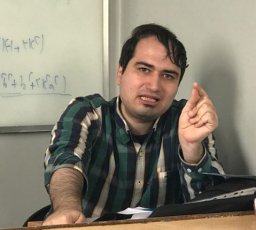
 Navid Safaei
· 8 previous affiliations
- Salam high schoolSince 2005
- Mathematics Department · Since 2005
- Olgoo PublishingSince 2006
- Book writer · Since 2006
- AwesomeMathSince 2015
- Book Author · Since 2015
- Institute of Mathematics and InformaticsSince 2022
- PhD student · Since 2022
- Club Young Scientists2016–2025
- Educational Consultant · 2016–2025
- Sakha junior Science Academy2020
- Guest Speaker · 2020
- Coding Theory · 2019
- Sharif University of Technology2005–2015
- MS student · 2012–2015
- Chemical Engineering, Master of Business and Engineering (MBE) · 2005–2014
Research Overview
Navid Safaei focuses on algebraic combinatorics, spherical geometry, and the development of computational benchmarks for mathematical reasoning. His work primarily addresses the classification and structural properties of spherical designs, employing both analytical proofs and computer-assisted methods to investigate long-standing conjectures in discrete geometry. More recently, his research has expanded to include the evaluation of large language models through the creation of large-scale, multimodal datasets that test mathematical comprehension and structural retrieval.
Research Trajectory
Safaei’s early contributions to the mathematical literature began with the study of functional equations in the late 1980s. This initial focus on classical analysis provided a foundation for later work in more complex algebraic and geometric structures. Following a period of diversification into the theoretical frameworks of evolutionary economics—where he examined the shift from neo-classical Newtonian views to biological models of economic systems—Safaei’s research trajectory consolidated around the specialized field of spherical designs and algebraic combinatorics.
Since 2020, Safaei has focused extensively on the classification of spherical $s$-distance $t$-designs. This area of research involves determining how points can be distributed on a sphere to satisfy specific symmetry and distance constraints. His work in this domain is characterized by the use of divisibility conditions and computational verification to test the limits of existing conjectures. For instance, his collaboration with Peter Boyvalenkov utilized computer-assisted proofs to validate "folklore conjectures" regarding the uniqueness of certain tight designs in high-dimensional spaces. This period of work represents a rigorous application of linear algebra and polynomial theory to problems of geometric optimality.
In the mid-2020s, Safaei’s research focus shifted toward the intersection of mathematics and artificial intelligence. Participating in large-scale collaborative projects, he has contributed to the development of benchmarks designed to measure the reasoning capabilities of multimodal AI models. This work moves beyond traditional problem-solving metrics to address "mathematical retrieval"—the ability of a system to recognize when two differently phrased problems share the same underlying mathematical structure. This transition reflects an interest in how the formal structures of mathematics can be used to probe the limits of machine learning and natural language processing.
Current Directions
Safaei’s current work is divided between the formal classification of geometric designs and the empirical evaluation of AI reasoning. In the realm of spherical geometry, he continues to investigate the rationality of inner products in $s$-distance $t$-designs, particularly for cases where the strength of the design ($t$) is high relative to the number of distances ($s$). This work is essential for understanding the algebraic nature of optimal point configurations.
Simultaneously, Safaei is involved in the ongoing refinement of mathematical benchmarks. By curating expert-authored problems from international competitions, his recent collaborative work aims to provide a more rigorous testing ground for frontier AI models. A key area of interest in this domain is the disconnect between an AI's ability to solve a problem and its ability to understand the problem's structural equivalence to other known problems, a challenge that sits at the core of mathematical comprehension.
Representative Work
A Functional Equation Published in 1989, this early work established Safaei’s involvement in classical mathematical analysis. The paper addresses the properties and solutions of specific functional equations, a theme that would later inform his more complex work in algebraic combinatorics.
On 3-distance spherical 5-designs In this 2020 paper, Safaei investigates the arrangement of points on a sphere that satisfy strict symmetry and distance requirements. The research provides new proofs and computational evidence to support a long-standing conjecture regarding the classification of 3-distance spherical 5-designs, contributing to the broader understanding of how discrete sets of points behave in spherical geometry.
On spherical 4-distance 7-designs Collaborating with Peter Boyvalenkov, Safaei provided a computer-assisted proof for a "folklore conjecture" in geometry. The study derived new divisibility conditions between the dimension of the sphere and the number of points in the design, successfully ruling out the existence of non-tight spherical 4-distance 7-designs in all dimensions up to $n = 1000$. This work demonstrates Safaei’s use of computational tools to resolve theoretical questions that are analytically resistant.
Rationality of the inner products of spherical s-distance t-designs for t ≥ 2s − 2, s ≥ 3 This 2022 publication continues Safaei’s exploration of the algebraic properties of spherical designs. The paper focuses on the conditions under which the inner products of these designs are rational, a critical factor in the classification and construction of highly symmetric point sets.
MathNet: A Global Multimodal Benchmark for Mathematical Reasoning and Retrieval As part of a large research team, Safaei contributed to the development of MathNet, a massive, multilingual, and multimodal dataset of over 17,500 Olympiad-level math problems. The project introduces a new task—mathematical retrieval—which tests whether AI models can identify mathematically equivalent problems despite differences in wording or language. The findings highlight a significant gap in current AI capabilities, where models may solve problems without truly grasping their underlying mathematical structure.
Profile updated
Loading new papers…
Other researchers whose papers cluster into the same research directions — a proxy for overlapping technical interests and shared intellectual neighborhoods.
See something wrong? Report a mistake