

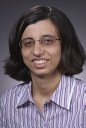
 Namrata Vaswani
· 1 previous affiliation
- Iowa State UniversityCurrent
- Full Professor · Current
Research Overview
Namrata Vaswani focuses on statistical machine learning, signal processing, and computational imaging, with an emphasis on dynamic data recovery and non-convex optimization. Her trajectory spans early work in particle filtering and compressed sensing to core contributions in robust principal component analysis and phase retrieval. Most recently, her research addresses federated low-rank matrix learning and Byzantine-resilient distributed optimization.
Research Trajectory
Vaswani’s early research concentrated on tracking dynamic systems and modeling deformations in high-dimensional spaces. In 2005, she introduced "Shape Activity": A Continuous-State HMM for Moving/Deforming Shapes With Application to Abnormal Activity Detection, which utilized hidden Markov models to detect anomalies in moving shapes. This interest in dynamic object tracking led to collaborative work on Tracking Deforming Objects Using Particle Filtering for Geometric Active Contours (2007), where she and her co-authors formulated a particle filtering algorithm within a geometric active contour framework to successfully handle topological changes in deforming objects. She further advanced these techniques in Particle Filtering for Large-Dimensional State Spaces With Multimodal Observation Likelihoods (2008), developing algorithms to efficiently track high-dimensional states even when sensor observations are noisy and ambiguous.
Building on her expertise in dynamic systems, Vaswani transitioned into the domain of sparse recovery. In 2008, she developed Kalman filtered Compressed Sensing, an algorithm that merged Kalman filtering with compressed sensing to reconstruct dynamic, spatially sparse signals from limited measurements. This work contributed significantly to the research direction of Dynamic Sparsity Adaptation for Signal Recovery. She expanded on this foundation with LS-CS-residual (LS-CS): compressive sensing on least squares residual (2010), introducing a recursive algorithm that leverages past estimates to reduce reconstruction error for signals with time-varying sparsity patterns, advancing the broader area of Linear Stability for Robust Signal Recovery. Her focus on structured noise in sparse recovery culminated in Recursive Robust PCA or Recursive Sparse Recovery in Large but Structured Noise (parts 1 and 2 combined) (2013). Here, she proposed the ReProCS algorithm to separate sparse signals from large, slowly changing noise structures, a key development in the area of Decoupled Support Identification and Value Estimation for Sparse Recovery.
In subsequent years, Vaswani’s focus shifted toward non-convex optimization and its applications in computational imaging and distributed systems. She explored theoretical guarantees for phase retrieval in Nonconvex Structured Phase Retrieval: A Focus on Provably Correct Approaches (2020). This theoretical foundation was applied directly to high-resolution microscopy in UNDERSAMPLED DYNAMIC FOURIER PTYCHOGRAPHY VIA PHASELESS PCA (2022), where her team developed an alternating minimization solution to drastically reduce the sample complexity required for dynamic Fourier ptychographic imaging. Concurrently, she addressed vulnerabilities in distributed computing with Efficient and Robust Distributed Matrix Computations via Convolutional Coding (2021), utilizing convolutional codes to mitigate the impact of slow or failed worker nodes while maintaining numerical stability.
Most recently, Vaswani has concentrated on federated learning and partly-decoupled optimization. She formalized approaches for distributed matrix recovery in Fast Federated Low Rank Matrix Completion (2023) and provided rigorous theoretical backing in Efficient Federated Low Rank Matrix Recovery via Alternating GD and Minimization: A Simple Proof (2024). Her alternating gradient descent and minimization (AltGDmin) framework was adapted for multi-task contextual bandits in Fast and Sample Efficient Multi-Task Representation Learning in Stochastic Contextual Bandits (2024), where truncated spectral initialization was used to achieve exponential convergence, contributing to the research direction of Robust Spectral Initialization for Non-Convex Optimization. Extending this framework to adversarial settings, she developed Byzantine-Resilient Federated Alternating Gradient Descent and Minimization for Partly-Decoupled Low Rank Matrix Learning (2025). By integrating robust estimators like Krum and Geometric Median, this work allows for accurate matrix recovery even when a significant portion of participating nodes are malicious, advancing work in the area of Robust Geometric Aggregation in Distributed Learning. She synthesized these optimization strategies in her 2025 monograph, AltGDmin: Alternating GD and Minimization for Partly-decoupled (Federated) Optimization.
Current Directions
The most recent papers in the evidence indicate a strong focus on federated learning, non-convex optimization, and Byzantine resilience. Vaswani is actively investigating partly-decoupled optimization frameworks, specifically utilizing alternating gradient descent and minimization (AltGDmin) for low-rank matrix learning. Her current work addresses the challenges of highly heterogeneous data and malicious nodes in distributed networks, developing provably resilient algorithms for federated environments. Additionally, she is exploring sample-efficient representation learning in stochastic contextual bandits, leveraging shared low-dimensional structures to optimize multi-task learning and reduce cumulative regret.
Profile updated
Loading new papers…
Other researchers whose papers cluster into the same research directions — a proxy for overlapping technical interests and shared intellectual neighborhoods.
See something wrong? Report a mistake