

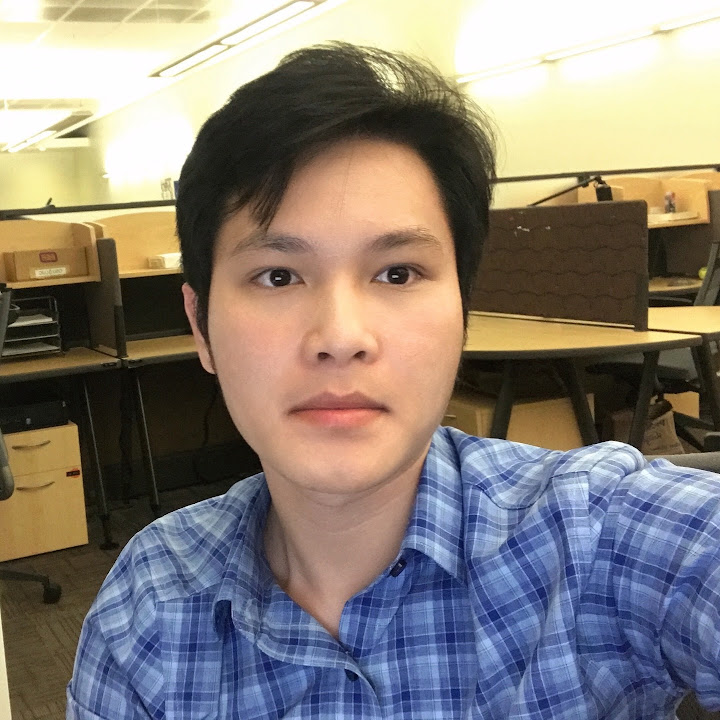
 Nam Nguyen
· 5 previous affiliations
- Oregon State UniversitySince 2022
- PhD student · 2024–2027
- Graduate Research Assistant, Communications and Signal Processing Group · Since 2022
- MS student · 2022–2024
- Los Alamos National LaboratorySince 2026
- Machine Learning Graduate Research Intern · Since 2026
- Machine Learning Research Intern · 2025
- Research Assistant, Optical Communications Research Group · 2019–2021
- Mobifone Plus2020
- Networking and Communication Engineer Intern · 2020
3 other authors named Nam Nguyen: Nam Nguyen (5 papers), Nam Nguyen (2 papers), Nam Nguyen (1 paper)
Research Overview
Nam Nguyen focuses on information theory, neural data compression, and machine learning. His early work addressed the reliability and performance of satellite-based quantum key distribution systems over free-space optical channels. More recently, his research has shifted toward rate-distortion theory and generative compression, investigating how optimal transport and universal representations can balance image reconstruction quality with downstream classification performance.
Research Trajectory
Initial research concentrated on optical communications and quantum cryptography, specifically targeting the physical layer challenges of satellite-based systems. In 2020, he explored methods to mitigate signal degradation in Performance Enhancement of Satellite FSO/QKD Systems using HAP-based Relaying and ARQ. This work proposed utilizing high-altitude platform (HAP) relays alongside link-layer automatic repeat request (ARQ) techniques to improve quantum key distribution (QKD) over free-space optics (FSO). By developing analytical frameworks based on 3-D Markov chain models, the research provided a comprehensive evaluation of key loss rates and delay outage rates under physical layer impairments.
Continuing this focus on atmospheric challenges, he developed a theoretical framework in Performance of Satellite Quantum Key Distribution under Atmospheric Turbulence-Induced Phase Fluctuations (2023). This study derived mathematical expressions, validated via Monte-Carlo simulations, to evaluate how turbulence-induced phase fluctuations impact system performance, ultimately offering recommended setups for various atmospheric conditions. Further advancing the reliability of these systems, he contributed to Reliability Improvement of Satellite-based Quantum Key Distribution Systems using Retransmission Scheme (2025). This research analyzed a QKD system utilizing optical quadrature phase-shift keying (QPSK) modulation and dual-threshold/heterodyne detection receivers to reduce the quantum bit error rate, alongside a newly designed key retransmission scheme.
Parallel to his work in optical channels, he investigated physical layer security in wireless communications. In On Symbol Error Probability-based Beamforming in MIMO Gaussian Wiretap Channels (2025), he introduced novel beamforming techniques that prioritize minimizing the symbol error probability for legitimate receivers rather than strictly maximizing secrecy capacity. This approach involved developing exact and approximate algorithms for both binary and M-ary signaling to enhance transmission reliability and security.
By 2025, the trajectory expanded significantly into fundamental information theory and machine learning, specifically engaging with the research direction of Universal Encoders for the Rate Distortion Perception Tradeoff. In Universal Rate-Distortion-Classification Representations for Lossy Compression, he proposed a framework where a single encoder can support multiple downstream tasks—such as human-perceptual image quality and machine classification—by routing the compressed representation through task-specific decoders. The study proved that for Gaussian sources, this universal encoder achieves the entire range of distortion-classification tradeoffs without incurring a performance penalty, a finding demonstrated practically using the MNIST dataset.
This intersection of compression and machine perception culminated in Cross-Domain Lossy Compression via Rate- and Classification-Constrained Optimal Transport (2026). Moving beyond traditional compression paradigms that aim to reconstruct an exact copy of an input, this work introduced a cross-domain approach where the encoder processes a degraded or noisy image, and the decoder reconstructs a clean, high-quality version optimized for AI tasks. This contribution spans several distinct research areas, including Rate Distortion Theory as Entropic Optimal Transport, Learned Image Compression for Machine Perception, and Shared Randomness for Generative Data Compression. The methodology also intersects with the broader fields of Compression as a Denoising Regularizer and Pareto Optimization for Deep Learning.
Current Directions
The most recent papers in the evidence indicate a dedicated focus on the theoretical and practical dimensions of neural data compression, particularly where it intersects with machine perception. Current work investigates lossy compression systems designed to simultaneously serve human viewing and downstream artificial intelligence tasks. This involves formulating rate-distortion-classification tradeoffs to ensure that compressed representations retain critical semantic features without sacrificing efficiency. Additionally, recent research explores cross-domain compression techniques that leverage optimal transport and generative models. These approaches aim to treat compression not just as a storage mechanism, but as an active denoising and regularization step that recovers high-quality, task-ready signals from degraded inputs.
Profile updated
Loading new papers…
Other researchers whose papers cluster into the same research directions — a proxy for overlapping technical interests and shared intellectual neighborhoods.
See something wrong? Report a mistake