

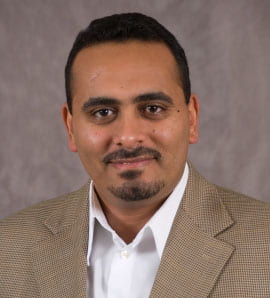
 Nagi Gebraeel
· 3 previous affiliations
- Georgia Institute of TechnologySince 2007
- Full Professor · Since 2019
- Associate Professor · 2011–2019
- Assistant Professor · 2007–2011
- University of Iowa2004–2007
- Assistant Professor · 2004–2007
- Purdue University West Lafayette1997–2003
- PhD student · 1999–2003
- MS student · 1997–1998
Research Overview
Nagi Gebraeel focuses on developing statistical and machine learning models alongside optimization frameworks to improve the reliability and operational efficiency of complex industrial systems. His trajectory spans early work in real-time asset monitoring and degradation modeling to recent advancements in federated learning, cyber-physical security, and distributionally robust optimization. Currently, he investigates decentralized causal learning and prognostic frameworks for dynamic, distributed environments.
Research Trajectory
Gebraeel’s early research established foundational methods for managing and monitoring complex manufacturing and mechanical systems. His initial work addressed real-time control in flexible manufacturing, developing strategies in Deadlock detection, prevention, and avoidance for automated tool sharing systems to ensure continuous operation as tooling needs evolved. Recognizing the critical role of predictive maintenance, he subsequently shifted toward data-driven prognostics. He introduced neural network-based models for Residual life predictions from vibration-based degradation signals: a neural network approach, utilizing accelerated bearing tests to forecast operating times before failure. Building on this, he formalized a stochastic degradation modeling framework in Sensory-Updated Residual Life Distributions for Components With Exponential Degradation Patterns, which combined population-level characteristics with component-specific sensor data to continuously update remaining life estimates.
As his focus expanded from individual component monitoring to system-wide decision-making, Gebraeel began integrating real-time sensor insights with sophisticated optimization frameworks. He formulated complex degradation processes as Markov Decision Processes in Structured Replacement Policies for Components with Complex Degradation Processes and Dedicated Sensors. This work derived monotonically nondecreasing control limit policies that balanced replacement, failure, and observation costs, contributing significantly to the research direction of Monotonic Stochastic Processes for Engineering Reliability. Concurrently, he addressed the operational challenges of large-scale infrastructure, developing an Asynchronous Decentralized Framework for Unit Commitment in Power Systems to improve computational scalability and efficiency in energy grids.
In the late 2010s and early 2020s, Gebraeel’s trajectory incorporated the growing complexities of decision-dependent uncertainty and cyber-physical security. He advanced power system operations with Data-driven maintenance and operations scheduling in power systems under decision-dependent uncertainty. Recognizing the vulnerability of highly instrumented industrial systems, he developed A degradation-based detection framework against covert cyberattacks on SCADA systems. This intersection of reliability and security led to further contributions in the broader area of Stealthy False Data Injection in Cyber-Physical Systems, notably through Blockchain-Based Decentralized Replay Attack Detection for Large-Scale Power Systems. This framework leveraged smart contracts and Bayesian inference to identify coordinated attacks while preserving decentralization. Continuing to balance distributed computation with data protection, he participated in developing Differentially Private Decentralized Generator Maintenance and Operations for Power Networks, advancing the research area of Privacy Preserving Decentralized Optimization by securing network flow estimates over public channels.
Most recently, Gebraeel has focused on highly adaptive optimization, robust machine learning, and advanced prognostics for dynamic environments. He introduced a flexible middle ground between rigid and fully flexible multi-stage planning in Adaptive Two-Stage Stochastic Programming with an Analysis on Capacity Expansion Planning Problem. To handle noise and highly imbalanced data, his group developed a Wasserstein Distributionally Robust Multiclass Support Vector Machine. In parallel, his prognostics research has grown to address increasingly complex failure modes. He designed a Sensor-fusion based Prognostics Framework for Complex Engineering Systems Exhibiting Multiple Failure Modes to distinguish between unknown historical causes of degradation without manual inspection. He also addressed transient industrial issues in An Integrated Detection-Prognostics Methodology for Components With Intermittent Faults, utilizing dynamic time warping and hidden Markov models to identify the onset of permanent degradation. Expanding his decentralized modeling efforts, he developed Federated Granger Causality Learning For Interdependent Clients With State Space Representation, a framework that detects causal influences across distributed systems while minimizing bandwidth and preserving privacy. His ongoing work in reliability modeling includes a Prognostic Framework for Robotic Manipulators Operating Under Dynamic Task Severities, which models degradation as a Brownian motion process influenced by continuous-time Markov chains to predict remaining useful life in dynamic robotic applications.
Current Directions
The most recent work in the evidence highlights a dual focus on distributed machine learning and advanced prognostics for dynamic, complex environments. A major current direction involves federated learning frameworks designed to uncover causal relationships—such as Granger causality—across interdependent industrial clients without centralizing raw sensor data. This approach addresses critical bottlenecks in bandwidth and privacy while maintaining the performance of centralized models.
Concurrently, ongoing research investigates distributionally robust optimization techniques, utilizing Wasserstein ambiguity sets to train machine learning models that remain resilient against noisy features and imbalanced labels. In the realm of reliability engineering, recent efforts address systems exhibiting multiple simultaneous failure modes, intermittent faults, and dynamic task severities. By integrating sensor-fusion techniques, hidden Markov models, and stochastic degradation processes, this work aims to provide highly accurate remaining useful life predictions for autonomous systems and robotic manipulators operating in unpredictable physical environments.
Profile updated
Loading new papers…
Other researchers whose papers cluster into the same research directions — a proxy for overlapping technical interests and shared intellectual neighborhoods.
See something wrong? Report a mistake