

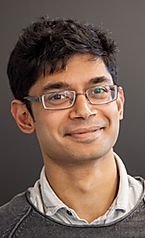
 Nabil Iqbal
· 5 previous affiliations
- Durham UniversitySince 2017
- Full Professor · Since 2023
- Associate Professor, Department of Mathematical Sciences · 2020–2023
- Assistant Professor, Department of Mathematical Sciences · 2017–2020
- University of AmsterdamSince 2024
- Visiting Professor · Since 2024
- Postdoctoral Scholar · 2014–2016
- Kavli Institute for Theoretical Physics2011–2014
- Postdoctoral Scholar · 2011–2014
- Doctor of Philosophy - PhD, Physics · 2006–2011
- Cornell University2002–2006
- Bachelor's degree, Physics · 2002–2006
Research Overview
Nabil Iqbal focuses on the intersection of theoretical physics and machine learning, applying concepts from quantum field theory and gravity to understand neural networks. His work explores how physical principles like conformal symmetry and effective field theory can inform deep learning architectures and dynamics. Recently, he investigates using machine learning to discover dualities in statistical physics and addressing plasticity loss in continual learning.
Research Trajectory
Nabil Iqbal's recent research bridges theoretical physics and artificial intelligence, leveraging concepts from quantum field theory, gravity, and statistical mechanics to analyze and design neural networks. In 2025, he led research applying machine learning to fundamental physics problems, culminating in A Machine Learning Approach to Duality in Statistical Physics. By framing duality as an optimization problem, this work successfully rediscovered the Kramers-Wannier duality and identified novel approximate dualities in complex models, contributing to the broader area of Amortized Inverse Design for Physics-Based Engineering. Concurrently, he explored how physical phenomena manifest within deep learning systems. In Topological defects propagate information in deep neural networks, he demonstrated that spontaneously broken discrete symmetries in a network's internal representation space can lead to the formation of topological defects, analogous to stable localized excitations in physical systems.
In 2026, Iqbal expanded his focus on physics-inspired machine learning architectures and generative models. With collaborators, he investigated the denoising dynamics of convolutional architectures in Information spreading in diffusion models from effective field theory, showing that the inductive bias of locality allows the growth of mutual information to be modeled using effective field theory. He also contributed to the design of novel equivariant architectures, participating in the development of AdS-GNN - a Conformally Equivariant Graph Neural Network. By lifting flat data into a higher-dimensional Anti-de Sitter (AdS) space, this model transforms complex conformal symmetries into geometric distances, advancing research directions such as Zero-Shot Spatial Scaling for Large Scale Environments and Scale Equivariant Neural Networks.
Alongside his physics-driven research, Iqbal has addressed fundamental challenges in machine learning optimization and continual learning. He introduced a mechanism to mitigate the loss of adaptability in repeatedly trained networks in Persistent internal state helps maintain learning plasticity, proposing a persistent, batch-to-batch internal state updated via a learned rule to retain memory of previous tasks. Additionally, he collaborated on Categorical Drifting Models, which extends drifting models to discrete spaces by replacing Euclidean penalties with a Bregman divergence, effectively framing the drifting update as a mirror-descent step on the simplex.
Current Directions
The most recent papers in the evidence indicate an ongoing focus on integrating theoretical physics frameworks with advanced machine learning models. Recent work investigates the application of effective field theory to understand information dynamics in diffusion models and the use of Anti-de Sitter space geometries to enforce conformal equivariance in graph neural networks. Additionally, Iqbal is actively exploring core optimization challenges in deep learning, including methods to preserve plasticity in continual learning environments and the adaptation of continuous generative models to categorical data spaces using information-geometric techniques.
Profile updated
| Title | Venue | Year |
|---|---|---|
| Drifting through Annealed Clustering | Openreview | 2027 |
| AdS-GNN - a Conformally Equivariant Graph Neural NetworkGitHub resource | ICLR | 2026 |
| Categorical Drifting Models | SPIGM @ ICML | 2026 |
| Information spreading in diffusion models from effective field theory | Sci4DL @ ICLR | 2026 |
| Spontaneous symmetry breaking and Goldstone modes for deep information propagation | arXiv | 2026 |
| Persistent internal state helps maintain learning plasticity | TTU Main Track @ ICLR | 2026 |
| A Machine Learning Approach to Duality in Statistical PhysicsGitHub resource | ICML | 2025 |
| Topological defects propagate information in deep neural networks | AI4Science @ NeurIPS | 2025 |
| Machine learning and optimization-based approaches to duality in statistical physics | arXiv | 2024 |
Loading new papers…
Other researchers whose papers cluster into the same research directions — a proxy for overlapping technical interests and shared intellectual neighborhoods.
See something wrong? Report a mistake