

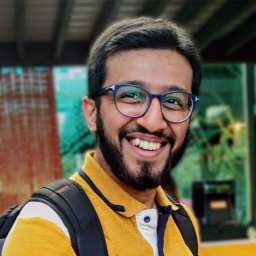
 Mustafa Mukadam
· 6 previous affiliations
- Amazon (United States)Since 2025
- Researcher · Since 2025
- University of WashingtonSince 2025
- Affiliate Assistant Professor · Since 2025
- Meta (United States)2019–2024
- Researcher · 2019–2024
- Georgia Institute of Technology2014–2019
- Graduate Research Assistant · 2014–2019
- Robotics Research Intern · 2018
- Master of Science (MS), Aerospace Engineering - Robotics · 2012–2014
Research Overview
Mustafa Mukadam focuses on robotic manipulation, tactile perception, and differentiable optimization for autonomous control. His early work developed foundational motion planning algorithms and differentiable geometric solvers that integrate seamlessly into deep learning architectures. More recently, his research emphasizes multimodal touch representations and visuo-tactile perception, enabling dexterous robots to manipulate objects robustly in complex, unstructured environments.
Research Trajectory
Mukadam’s early research concentrated on probabilistic and computational approaches to robot motion planning. In 2018, he introduced Continuous-time Gaussian process motion planning via probabilistic inference, formulating trajectory generation as an inference problem to produce smooth, collision-free motions. During the same period, he contributed to the development of RMPflow: A Computational Graph for Automatic Motion Policy Generation, a framework that combined Riemannian motion policies into a computational graph to generate reactive behaviors for complex robotic systems.
By 2022, his focus expanded to bridge classical robotics algorithms with deep learning through differentiable programming. He led the development of Theseus: A Library for Differentiable Nonlinear Optimization, an application-agnostic framework built on PyTorch that enables end-to-end structured learning by embedding nonlinear least squares solvers directly into neural architectures. Concurrently, he advanced the research direction of Continuous Geometry via Neural Implicit Representations with iSDF: Real-Time Neural Signed Distance Fields for Robot Perception. This system allowed robots to reconstruct 3D environments in real time using neural distance fields, contributing significantly to the broader area of Differentiable Distance Fields for Real Time Robot Control.
In 2023, Mukadam and his collaborators extended these implicit representations to new domains, including grasping and semantic mapping. They proposed Neural Grasp Distance Fields for Robot Manipulation, which modeled valid grasp manifolds as continuous distance fields, allowing grasp synthesis to be jointly optimized with trajectory smoothness and collision avoidance. This was complemented by USA-Net: Unified Semantic and Affordance Representations for Robot Memory, which encoded both spatial affordances and semantic meaning into a single implicit map to facilitate natural language-driven navigation. Parallel to his work in perception and grasping, he also addressed large-scale optimization bottlenecks in 3D reconstruction with Decentralization and Acceleration Enables Large-Scale Bundle Adjustment, an approach later formalized in the journal publication DABA: Decentralized and accelerated large-scale bundle adjustment.
A major shift toward tactile and visuo-tactile perception emerged in his work starting in 2023, addressing the domain of Overcoming Visual Self Occlusion in Robotic Manipulation. He guided the development of Neural feels with neural fields: Visuo-tactile perception for in-hand manipulation, a framework that fused vision and touch to track and reconstruct unknown objects even when heavily occluded by the robot's own hand. This work advanced the area of 3D Shape Reconstruction from Sparse Tactile and Visual Contact. To bridge the sim-to-real gap for tactile sensors, his group introduced Learning to Read Braille: Bridging the Tactile Reality Gap with Diffusion Models, utilizing generative models to synthesize hyper-realistic tactile images. This laid the groundwork for the emerging direction of Scaling Tactile Perception through Multimodal Foundation Models. Building on this, he presented Sparsh: Self-supervised touch representations for vision-based tactile sensing in 2024, offering general-purpose, self-supervised models capable of interpreting data across diverse tactile sensor designs without relying on task-specific handcrafted features.
In 2025, Mukadam's research further scaled tactile perception across modalities and form factors. He co-authored Tactile Beyond Pixels: Multisensory Touch Representations for Robot Manipulation, which fused image, audio, motion, and pressure signals into a unified representation to capture complex physical properties during contact-rich interactions. To address the limitations of fingertip-only sensors, he also contributed to Self-supervised perception for tactile skin covered dexterous hands, developing a pre-trained encoder for magnetic skin sensors distributed across the entire hand. Alongside these perceptual advances, he continued to improve control mechanisms for dexterous hands, introducing Geometric Retargeting: A Principled, Ultrafast Neural Hand Retargeting Algorithm to enable intuitive, high-speed human teleoperation of robotic hands by optimizing geometric objectives like motion preservation and configuration-space coverage.
Current Directions
Mukadam’s most recent work investigates the integration of self-supervised learning and multimodal foundation models to achieve unprecedented robotic dexterity. By moving beyond isolated vision-based tactile sensors, his current research emphasizes full-hand tactile skins and multisensory fusion—combining visual, auditory, kinematic, and pressure data into unified latent representations. These rich perceptual models are being deployed to solve complex, contact-rich tasks, contributing heavily to the broader area of Robust Manipulation Under In-Hand Slippage and Object Displacement. Additionally, his recent focus on ultrafast neural retargeting algorithms highlights an ongoing effort to seamlessly map human dexterity onto robotic hardware, bridging the gap between human teleoperation and autonomous, tactile-driven control.
Profile updated
Loading new papers…
Other researchers whose papers cluster into the same research directions — a proxy for overlapping technical interests and shared intellectual neighborhoods.
See something wrong? Report a mistake