

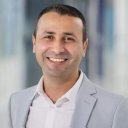
 Mohammad Yaqub
· 6 previous affiliations
- Oxford EMI TrainingSince 2017
- Senior Lecturer · Since 2017
- University of OxfordSince 2018
- Honorary research fellow · Since 2018
- DPhil, Biomedical Engineering · 2008–2011
- Associate Professor · Since 2023
- Assistant Professor · 2020–2023
- MICCAI SocietySince 2025
- Member Board of Directors · Since 2025
- Intelligent Ultrasound Limited (United Kingdom)2012–2020
- Vice President Of Engineering - IU Oxford · 2016–2020
- Consultant · 2012–2016
- University of Jordan2003–2005
- Master's degree, Computer Science · 2003–2005
Research Overview
Mohammad Yaqub focuses on medical image analysis, multi-modal clinical diagnostics, and the development of robust vision-language models for healthcare. His early work developed machine learning techniques for fetal ultrasound and neurosonography, gradually expanding to address adversarial vulnerabilities and lifelong learning in medical vision. Currently, he investigates specialized foundation models and multi-omics integration to bridge the gap between artificial intelligence and reliable clinical deployment.
Research Trajectory
The early phase of Mohammad Yaqub's research focused on applying classical machine learning techniques to complex medical imaging tasks. He introduced enhancements to Random Forests for 3D volumetric segmentation in Investigation of the Role of Feature Selection and Weighted Voting in Random Forests for 3-D Volumetric Segmentation, contributing to the broader area of Delineating Ambiguous Boundaries in Low-Contrast Images. By selecting strong features and weighting individual trees, this work improved voxel classification accuracy. Following this, he applied these techniques to fetal ultrasound, developing methods to categorize unlabeled scans in Guided Random Forests for Identification of Key Fetal Anatomy and Image Categorization in Ultrasound Scans. He expanded on this domain by designing a regression forest framework to detect the parasagittal plane in Plane Localization in 3-D Fetal Neurosonography for Longitudinal Analysis of the Developing Brain, enabling the longitudinal tracking of neonatal brain development from pre-birth through early postnatal life.
As the field transitioned toward deep learning, his focus expanded to include the robustness and adaptability of emerging architectures, intersecting with the research direction of Hybrid CNN-Transformer Architectures for Global-Local Vision. He contributed to techniques designed to protect Vision Transformers from adversarial attacks in Self-Ensembling Vision Transformer (SEViT) for Robust Medical Image Classification, addressing critical safety concerns for clinical deployment. Around this time, he also explored knowledge transfer mechanisms, investigating how models can adapt over time in Lifelong Learning of Task-Parameter Relationships for Knowledge Transfer, which aligns with the broader research direction of Dynamic Architecture Expansion for Continual Learning.
A major theme in his recent trajectory involves ensuring reliability across diverse clinical environments and handling complex, multi-modal data. In the area of Overcoming Cross-Institutional Domain Shift in Medical AI, his lab developed a framework to automatically rate artifact severity in low-field pediatric brain MRIs in BRIQA: Balanced Reweighting in Image Quality Assessment of Pediatric Brain MRI. He also addressed the challenge of out-of-distribution data in vision-language models by separating invariant from spurious features in DiMPLe - Disentangled Multi-Modal Prompt Learning: Enhancing Out-Of-Distribution Alignment with Invariant and Spurious Feature Separation. His work frequently tackles the integration of disparate data types, contributing to the research direction of Multi-View Integration in Automated Medical Diagnosis. He guided the development of a framework for dementia subtyping that fuses longitudinal MRI radiomics with genetic and clinical data in MINDSETS: Multi-omics Integration with Neuroimaging for Dementia Subtyping and Effective Temporal Study. To address the scarcity of certain imaging modalities, his group proposed methods for combining CT and PET scans without catastrophic forgetting in Efficient Parameter Adaptation for Multi-Modal Medical Image Segmentation and Prognosis.
A significant portion of his recent output focuses on adapting large-scale vision-language foundation models for specialized medical tasks. He oversaw the creation of a dedicated foundation model for fetal ultrasound, trained on over 210,000 image-text pairs, in FetalCLIP: A Visual-Language Foundation Model for Fetal Ultrasound Image Analysis. Building on this, he introduced a framework that aligns visual motion with clinical text to detect congenital heart defects in TPA: Temporal Prompt Alignment for Fetal Congenital Heart Defect Classification. To unify diverse diagnostic tasks such as classification, detection, and report generation, his team developed a modular framework based on quantized low-rank adaptation in ME-VLIP: A Modular and Efficient Vision-Language Framework for Generalizable Medical Image Parsing. He further extended prompt-based learning to multi-modal segmentation and prognosis across CT, MRI, and PET in DuPLUS: Dual-Prompt Vision-Language Framework for Universal Medical Image Segmentation and Prognosis. Yaqub's group also examined the vulnerability and repair of prompt-adapted medical foundation models in BAPLe++: Cross-Model Transferability and Prompt-Level Defense of Backdoors in Medical Foundation Models, studying cross-model backdoor transferability and proposing DePLe to mitigate infected prompts without retraining backbones.
Recognizing the need for rigorous evaluation, his research actively addresses the direction of Bridging the Simulation to Reality Gap in Clinical AI. He led the creation of standardized benchmarks to evaluate foundation models, first in echocardiography with CardioBench: Do Echocardiography Foundation Models Generalize Beyond the Lab?, and subsequently in fetal ultrasound with FETAL-GAUGE: A BENCHMARK FOR ASSESSING VISION-LANGUAGE MODELS IN FETAL ULTRASOUND. Finally, looking beyond current generative approaches, he co-authored a review advocating for systems that simulate the causal structure of care in Beyond Generative AI: World Models for Clinical Prediction, Counterfactuals, and Planning.
Continuing their work on clinical foundation models and efficient deployment, Yaqub led the development of EchoAlign: Echocardiography foundation model with multilevel report alignment, which leverages a visibility matrix and multi-level text alignment across millions of echocardiography studies to eliminate spurious correlations. To streamline vision foundation models for constrained environments, their lab also introduced Carve VFM: Carving Specialists out of Generalists, Automatic Task-Specific Compression of Vision Foundation Models, an automated structured-pruning framework that jointly allocates task-specific capacity and applies closed-form low-rank recovery without retraining. Advancing training-free segmentation with frozen encoders, Yaqub's group developed DINO-KNN: Training-Free Multiclass In-Context Segmentation via Nearest Neighbors, which stores reference patch representations from DINOv3 in a single memory and labels target patches via distance-weighted nearest-neighbor voting to achieve efficient multiclass in-context segmentation across natural and medical datasets.
Current Directions
The most recent papers in the evidence indicate a strong focus on adapting large-scale vision-language foundation models for specialized clinical environments. Recent work investigates how to ground these models in complex medical domains, such as fetal ultrasound and echocardiography, using techniques like temporal prompt alignment, multi-level report alignment, structured task-specific compression, and defenses against prompt-level vulnerabilities. A parallel priority is the rigorous evaluation of these systems; recent benchmarking efforts aim to expose the performance gap between controlled laboratory settings and real-world clinical utility. Additionally, current research explores the integration of multi-omics and longitudinal imaging for precision diagnostics, alongside a conceptual shift toward developing "world models" capable of causal reasoning and autonomous clinical planning.
Profile updated
Loading new papers…
Other researchers whose papers cluster into the same research directions — a proxy for overlapping technical interests and shared intellectual neighborhoods.
See something wrong? Report a mistake