

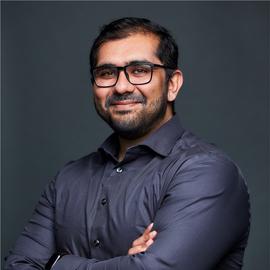
 Mohammad Sultan
· 6 previous affiliations
- Absci CorpCurrent
- Current
- Absci2023–2025
- Principal AI Scientist · 2023–2025
- insitro, inc. (United States)2018–2023
- Machine Learning Senior Manager / Staff ML Engineer · 2022–2023
- Senior ML Engineer · 2020–2022
- Founding team member · 2018–2020
- Inistro Inc.2018–2020
- Researcher · 2018–2020
- Stanford University2012–2018
- Graduate Research Assistant · 2012–2018
- Yale University2007–2012
- Theoretical Chemistry Research Assistant · 2010–2012
- Undergrad student · 2007–2011
- B.S(Intensive), Chemistry
Research Overview
Mohammad Sultan focuses on the intersection of machine learning, computational chemistry, and molecular design. His work centers on developing algorithmic frameworks to interpret complex biological data, ranging from molecular dynamics simulations and microscopy imaging to DNA-encoded library (DEL) screens for drug discovery. His research emphasizes the creation of scalable, physically grounded models that can extract meaningful signals from noisy experimental and simulated datasets.
Research Trajectory
Sultan’s early research focused on the physical laws governing protein dynamics and the challenges of analyzing massive datasets generated by molecular dynamics simulations. During his doctoral work, he contributed to the development of machine learning frameworks designed to model protein states with high temporal resolution. This work utilized L1-regularized, reversible hidden Markov models to provide interpretable relaxation timescales, which are essential for rational protein engineering and drug design. He expanded this line of inquiry by demonstrating how supervised machine learning algorithms, such as Support Vector Machines and Neural Networks, could be repurposed to automatically design collective variables. This approach allowed for the acceleration of molecular simulations by using the decision boundaries of these models to drive transitions between known protein states, reducing the reliance on expert-level intuition for coordinate selection.
Following his work in biophysics, Sultan applied deep learning techniques to the domain of imaging and microscopy. He developed a two-stage pipeline for automated cell segmentation and counting that addressed a critical gap in high-throughput screening: the need for uncertainty quantification. By providing confidence intervals for every prediction, this system offered a robust method for flagging failure cases where automated models might otherwise produce unreliable results.
In recent years, Sultan’s focus has shifted toward the computational challenges of drug discovery, specifically regarding DNA-encoded libraries (DELs). DEL technology allows for the efficient testing of millions of molecules, but the resulting sequencing data is often obfuscated by technical variation and intrinsic assay noise. Sultan has contributed to several methodologies aimed at denoising this data, including the use of graph neural networks (GNNs) and compositional deep probabilistic models. These models decompose molecular representations into their constituent building blocks (synthons) to better predict binding affinities from raw sequencing counts. As a senior researcher, he has overseen the development of frameworks that integrate molecular docking with DEL modeling to improve the identification of high-affinity leads. Most recently, he has participated in large-scale collaborative efforts to release open-source benchmarks, such as the KinDEL dataset, which provides the community with millions of screened compounds and 3D docking poses to standardize the evaluation of machine learning models in drug discovery.
Representative Work
In Understanding Protein Dynamics with L1-Regularized Reversible Hidden Markov Models, Sultan participated in the development of a scalable machine learning framework for modeling protein dynamics. The approach adheres to physical laws while providing the interpretability required for drug design, using an EM algorithm for learning and a model selection criterion based on relaxation timescales.
As a sole author in Decision functions from supervised machine learning algorithms as collective variables for accelerating molecular simulations, Sultan introduced a data-driven framework that repurposes supervised machine learning classifiers to design collective variables. This method enables the efficient driving of transitions between protein states in molecular simulations without requiring pre-existing long-range trajectories or expert intuition.
In Using Deep Learning for Segmentation and Counting within Microscopy Data, Sultan developed a two-stage deep learning pipeline using Feature Pyramid Networks and VGG-style architectures. The work is notable for its focus on reliability, providing a confidence interval for every cell count prediction to identify model uncertainty in microscopy data.
Serving as the senior author, Sultan led the research in DEL-Dock: Molecular Docking-Enabled Modeling of DNA-Encoded Libraries. This work addresses the noise inherent in DEL selection experiments by integrating molecular docking into the modeling process, allowing for more accurate denoising of sequencing counts and the identification of molecules with superior binding affinity.
In Compositional Deep Probabilistic Models of DNA Encoded Libraries, Sultan contributed to the development of DEL-Compose, a probabilistic model that decomposes molecular representations into mono-, di-, and tri-synthon building blocks. This compositional approach helps uncover latent binding signals that are often masked by the complexity of the DEL data-generation process.
Sultan also participated in the development of KinDEL: DNA-Encoded Library Dataset for Kinase Inhibitors, a large-scale open-source dataset containing 81 million compounds. This project provides a benchmark for the field, combining raw DEL screening data with high-quality biophysical measurements and 3D docking poses to bridge the gap between noisy experimental counts and reliable drug leads.
Profile updated
| Title | Venue | Year |
|---|---|---|
| KinDEL: DNA-Encoded Library Dataset for Kinase Inhibitors | ICML | 2025 |
| Compositional Deep Probabilistic Models of DNA Encoded Libraries | Journal of Chemical Information and Modeling | 2023 |
| Machine Learning enabled Pooled Optical Screening in Human Lung Cancer Cells | LMRL @ NeurIPS | 2022 |
| DEL-Dock: Molecular Docking-Enabled Modeling of DNA-Encoded Libraries | arXiv | 2022 |
| Regression modeling on DNA encoded libraries | AI4Science @ NeurIPS | 2021 |
| Understanding Protein Dynamics with L1-Regularized Reversible Hidden Markov Models | ICML | 2014 |
Loading new papers…
Other researchers whose papers cluster into the same research directions — a proxy for overlapping technical interests and shared intellectual neighborhoods.
See something wrong? Report a mistake