

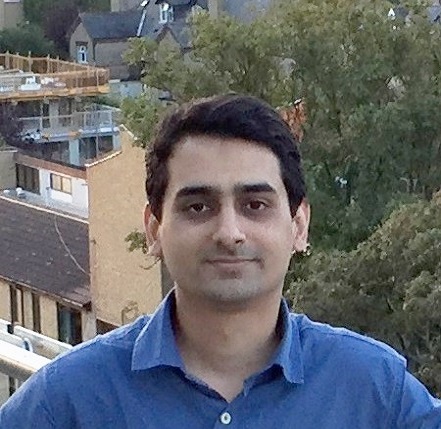
 Mohammad Raza
· 3 previous affiliations
- Qatar Computing Research InstituteSince 2024
- Principal Researcher · Since 2024
- Microsoft (United States)2010–2023
- Principal Researcher · 2010–2023
- Imperial College London2006–2010
- PhD student · 2006–2010
Research Overview
Mohammad Raza focuses on program synthesis, neuro-symbolic methods, and natural interaction interfaces. His early work established foundational techniques in programming by example and predictive synthesis for data manipulation tasks. More recently, his research explores the integration of large language models with formal logical solvers to ensure reliable, verifiable reasoning in complex automation pipelines.
Research Trajectory
Mohammad Raza’s early research background is rooted in formal methods and logic, as seen in his 2010 work on Resource Reasoning and Labelled Separation Logic. Building on this theoretical foundation, his focus shifted toward making complex computational tasks accessible to end users through natural interaction and automated synthesis. In 2014, he introduced Programming by Example Using Least General Generalizations, which addressed the challenge of transforming richly formatted XML documents. By applying inductive inference techniques and designing a novel domain-specific language, this approach bypassed the scalability limitations of contemporary programming-by-example (PBE) methods, allowing for minimal program generation based on subsumption ordering. He subsequently expanded the expressivity of end-user programming with Compositional Program Synthesis from Natural Language and Examples (2015). This research proposed a domain-agnostic algorithm that allowed users to specify tasks compositionally, moving beyond the constraints of holistic, single-modality specifications to handle more complex programs.
Continuing his work in data manipulation, Raza developed techniques to reduce the user burden in specification. With Automated Data Extraction Using Predictive Program Synthesis (2017), he explored how predictive intelligence could infer extraction programs directly from input data alone, without requiring explicit input-output examples from the user. He then addressed the critical challenge of generalization in PBE systems with Disjunctive Program Synthesis: A Robust Approach to Programming by Example (2018). This work tackled the ambiguity inherent in learning from sparse examples by introducing robust ranking mechanisms to select the correct program candidate from a large space of possibilities, ensuring that synthesized programs do not fail when applied to unseen inputs.
In recent years, Raza’s trajectory has evolved to integrate large language models (LLMs) with formal symbolic methods, contributing to the research direction of Reliable Reasoning via Neural Translation and Symbolic Execution. In Instantiation-based Formalization of Logical Reasoning Tasks Using Language Models and Logical Solvers (2025), he developed a neuro-symbolic system that pairs the linguistic flexibility of LLMs with the mathematical rigor of logical solvers. This approach advances the broader area of Decoupling Linguistic Interpretation from Symbolic Reasoning and supports work in Semantic Verification through Generative Reconstruction by enabling systems to quantify their certainty and verify logical outputs.
Expanding into multimodal domains, Raza collaborated on SpatiaLab: Can Vision–Language Models Perform Spatial Reasoning in the Wild? (2026). This benchmark evaluation of over 25 state-of-the-art models demonstrated that current vision-language models struggle with true 3D geometry, relying instead on surface-level patterns rather than physical understanding. This participation aligns with emerging challenges in the area of Perceptual Error Propagation in Multimodal Reasoning and the field of Modular Multi Agent Decomposition for Complex Reasoning. Most recently, he oversaw the development of VeriSimpl: Robust Optimization Modeling from Natural Language using Simplification-based Verification (2026). This framework utilizes optimization solvers to verify LLM-generated code by breaking down complex mathematical models into simplified, solver-guided diagnostic queries. By catching subtle semantic errors that standard debugging misses, this work significantly improves the reliability of natural-language-to-optimization pipelines, advancing the research direction of Semantic Alignment for Machine Verifiable Logic.
Current Directions
Raza’s most recent research investigates the intersection of generative artificial intelligence and formal verification, specifically focusing on neuro-symbolic architectures. A primary theme in his current work is the use of deterministic logical solvers and optimization frameworks to verify, constrain, and correct the outputs of large language models. By translating natural language instructions into machine-verifiable logic, this research aims to eliminate the semantic errors and hallucinations common in purely neural code generation. Additionally, his recent collaborative efforts explore the limitations of spatial and physical reasoning in multimodal models, highlighting an ongoing interest in bridging the gap between perceptual pattern recognition and rigorous, structured reasoning in complex, real-world environments.
Profile updated
Loading new papers…
Other researchers whose papers cluster into the same research directions — a proxy for overlapping technical interests and shared intellectual neighborhoods.
See something wrong? Report a mistake