

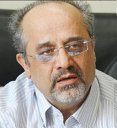
 Mohammad Ghodsi
· 1 previous affiliation
- Full Professor · Current
Research Overview
Mohammad Ghodsi focuses on computational social choice, fair division, and mechanism design. His trajectory spans from strategy-proof cake-cutting algorithms to spatial voting theory and the allocation of indivisible goods. The most recent work in the evidence addresses how network externalities impact fairness criteria and models the effects of voter abstention on election distortion.
Research Trajectory
The available evidence for Mohammad Ghodsi's research trajectory spans from 2017 to 2019, centering on algorithmic game theory and computational social choice. Early in this period, Ghodsi participated in collaborative research on the classic problem of fair division. As a co-author on Envy-Free Mechanisms with Minimum Number of Cuts (2017), he contributed to the development of strategy-proof mechanisms for dividing a heterogeneous, divisible resource. This work focused on satisfying envy-freeness—ensuring no player prefers another's allocation—while simultaneously minimizing the number of cuts required, introducing expansion processes to handle different valuation functions.
By 2019, Ghodsi's work expanded into spatial voting theory and more complex allocation scenarios, demonstrating leadership in these areas as both a first and senior author. As the lead author of On the Distortion Value of the Elections with Abstention. (2019), he investigated how the distortion value of an election—a measure of the winner's quality—changes when less motivated agents are allowed to abstain. This research proposed a generalized abstention model for two-candidate elections and defined new concepts of expected winner and expected distortion to evaluate voting mechanisms.
In the same year, acting as the senior author, Ghodsi guided research into the intersection of resource allocation and network effects. Externalities and Fairness (2019) addressed the fair allocation of indivisible goods in contexts where an agent's utility is affected by the shares allocated to others. Drawing inspiration from network diffusion models, this work introduced a network externalities model and generalized the concept of the maximin-share to establish new fairness criteria for interdependent agents.
Current Directions
The most recent papers in the evidence are from 2019. These works indicate a focus on refining theoretical models of social choice to account for realistic human behaviors and interdependent utilities. Specifically, recent work investigates how voter abstention impacts the theoretical guarantees of spatial voting mechanisms, seeking to quantify the expected distortion when participation is not guaranteed. Concurrently, this research direction addresses the complexities of fair allocation when agents are embedded in networks, focusing on how externalities alter traditional fairness benchmarks and necessitate new criteria for equitable distribution.
Profile updated
| Title | Venue | Year |
|---|---|---|
| On the Distortion Value of the Elections with Abstention | AAAI | 2019 |
| Externalities and Fairness | WWW | 2019 |
| Fair Allocation of Indivisible Items With Externalities | arXiv | 2018 |
| Approximate Minimum Diameter | arXiv | 2017 |
| Envy-Free Mechanisms with Minimum Number of Cuts | AAAI | 2017 |
Loading new papers…
Other researchers whose papers cluster into the same research directions — a proxy for overlapping technical interests and shared intellectual neighborhoods.
See something wrong? Report a mistake