

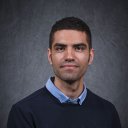
 Mohammad Farazi
· 6 previous affiliations
- AI Engineer · Since 2025
- Plus2024
- Perception Research Engineer Intern · 2024
- Arizona State University2019–2024
- PhD student · 2019–2024
- Graduate Research Associate · 2019–2022
- Zendar2023
- Machine Learning Researcher · 2023
- RadiusAI, Inc.2022
- computer vision intern · 2022
- University of Tehran2014–2017
- Master’s Degree, Electrical and Electronics Engineering · 2014–2017
Research Overview
Mohammad Farazi focuses on geometric deep learning, medical image analysis, and topological data analysis. His early work introduced persistent homology techniques for brain network analysis before evolving into the development of specialized graph convolutional networks for 3D shape correspondence and volumetric meshes. Currently, he investigates architectural improvements for medical image segmentation and explores advanced geometric representations for non-Euclidean data.
Research Trajectory
Farazi’s early work applied topological data analysis to neuroimaging. As the first author of A Univariate Persistent Brain Network Feature Based on the Aggregated Cost of Cycles from the Nested Filtration Networks (2020), he addressed the challenges of arbitrary network thresholding in binary network conversions. Drawing inspiration from persistent homology, this research defined a new aggregation cost based on the number of cycles within a nested filtration network, providing a threshold-free, univariate persistent feature for brain network analysis.
Moving into 2022 and 2023, Farazi's primary research focus shifted toward geometric deep learning, specifically designing neural architectures capable of operating on non-Euclidean domains. This work aligns with the broader area of Generalizing Machine Learning to Arbitrary Riemannian Manifolds. As the first author of Anisotropic Multi-Scale Graph Convolutional Network for Dense Shape Correspondence (2023), he developed a hybrid model that combines a U-Net feature extractor with a spectral-based graph convolutional network. This approach also touches upon the research direction of Polynomial Filter Approximation for Spectral Graph Neural Networks by utilizing anisotropic wavelet basis filters to capture diverse directional and band-pass information, effectively mitigating the over-smoothing behavior common in conventional graph neural networks.
Continuing his leadership in geometric deep learning for medical applications, Farazi was the first author of TetCNN: Convolutional Neural Networks on Tetrahedral Meshes (2023). Recognizing the limitations of applying standard convolutional networks to volumetric meshes, he introduced an interpretable graph CNN framework specifically for tetrahedral structures. By exploiting the volumetric Laplace-Beltrami Operator (LBO), the model successfully incorporated the Riemannian metric information of 3D manifolds, enabling more accurate pooling adaptations for brain image analysis.
In parallel with his foundational work on geometric deep learning, Farazi has participated in collaborative research focused on clinical image quality. Contributing as a middle author to Optimal Transport Guided Unsupervised Learning for Enhancing Low-Quality Retinal Images (2023) and OTRE: Where Optimal Transport Guided Unpaired Image-to-Image Translation Meets Regularization by Enhancing (2023), he helped investigate the use of optimal transport theory for unpaired image-to-image translation. These models map low-quality, artifact-heavy retinal fundus images to high-quality counterparts using Generative Adversarial Networks (GANs). These collaborative efforts fall within the research direction of Image Restoration for Downstream Medical AI Tasks and touch upon themes such as Preserving Diagnostic Information in Medical Vision Augmentation, emphasizing the need to maintain diagnostic integrity while enhancing clinical imagery.
Most recently, in 2024, Farazi has contributed to structural improvements in standard medical vision architectures. As a co-author of SelfReg-UNet: Self-Regularized UNet for Medical Image Segmentation, he participated in analyzing the feature redundancy and asymmetric supervision that limit standard U-Net models. The proposed self-regularized framework balances supervision between the encoder and decoder to reduce the learning of irrelevant features. This work contributes directly to the area of Bridging the Semantic Gap in Encoder-Decoder Networks.
Current Directions
The most recent papers and themes in the evidence indicate a dual focus on refining established dense prediction architectures and exploring advanced geometric representations. Recent collaborative work investigates structural inefficiencies in U-Net models, specifically addressing how feature redundancy and asymmetric supervision impact medical image segmentation. By proposing self-regularization techniques, this research aims to optimize the internal feature representations of standard encoder-decoder networks.
Additionally, thematic evidence from 2024 suggests an ongoing interest in the emerging direction of Manifold Attention Mechanisms. Building on his prior first-author work with the Laplace-Beltrami Operator and spectral graph filtering, this area explores how signals residing on curved surfaces—such as brain networks or complex 3D meshes—can be integrated into modern attention-based frameworks without losing their underlying geometric and topological structure.
Profile updated
Loading new papers…
Other researchers whose papers cluster into the same research directions — a proxy for overlapping technical interests and shared intellectual neighborhoods.
See something wrong? Report a mistake