

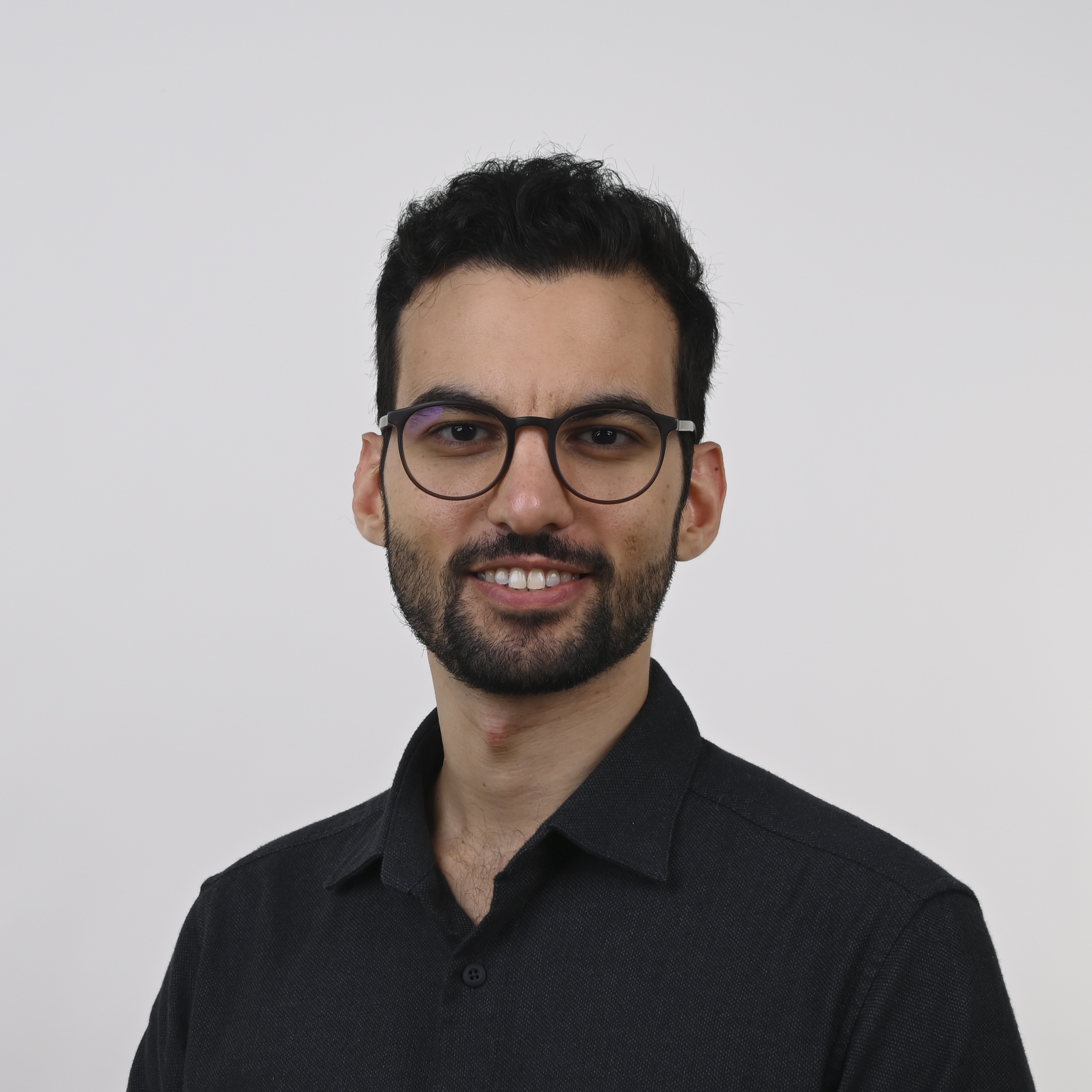
 Mohamad Shahbazi
· 4 previous affiliations
- Apple (United States)Since 2024
- Researcher · Since 2024
- Current
- Intern · 2024
- ETH Zurich2019–2024
- PhD student · 2019–2024
- Intern · 2023
Research Overview
Mohamad Shahbazi focuses on generative modeling, 3D-aware image synthesis, and the efficient training of generative adversarial networks under limited or imbalanced data. His early work explored scale-agnostic image synthesis and mitigating mode collapse in conditional generation. More recently, his research investigates text-driven object insertion in neural radiance fields and unsupervised scene extrapolation using diffusion models.
Research Trajectory
Mohamad Shahbazi’s research trajectory begins with foundational improvements to the architecture and training stability of Generative Adversarial Networks (GANs). In 2022, he contributed to the development of scale-consistent positional encodings in Arbitrary-Scale Image Synthesis. This work addressed the limitations of adversarial networks that struggled to maintain perceptual quality at unseen scales. By designing encodings invariant to generator layer transformations and incorporating inter-scale augmentations, the method enabled the generation of high-quality images at arbitrary resolutions. This contribution intersects with several broader research areas, including the direction of Resolution Agnostic Generative Models for Arbitrary Scale Synthesis, as well as work in Breaking Translation Invariance with Coordinate Convolutions and the area of The Spatial Inductive Bias of Zero Padding.
During the same period, Shahbazi investigated the failure modes of conditional generative models in data-constrained environments. He led the study Collapse by Conditioning: Training Class-conditional GANs with Limited Data, which identified that class-conditioning paradoxically induces mode collapse when training data is limited, even in settings where unconditional learning succeeds. To resolve this, he proposed a training strategy that leverages unconditional learning to stabilize the conditional generation process, contributing to the broader area of Unifying Adversarial and Variational Generative Models.
In 2023, his focus expanded to encompass 3D-aware generation and the structural properties of latent spaces. Recognizing the computational overhead of volumetric rendering in 3D-aware GANs, he introduced NeRF-GAN Distillation for Efficient 3D-Aware Generation with Convolutions. This research demonstrated how to distill 3D knowledge from pretrained Neural Radiance Field (NeRF) GANs into pose-conditioned 2D convolutional networks. This approach significantly improved inference efficiency while maintaining the necessary 3D consistency when generating from single-view datasets. Concurrently, he collaborated on StyleGenes: Discrete and Efficient Latent Distributions for GANs, which proposed replacing continuous prior distributions with a finite set of learnable latents. To avoid the intractable memory scaling typically associated with discrete parametrizations, the latent space was partitioned into "genes" with small banks of variants, allowing for diverse generation through combinatorial sampling.
He also participated in the development of DiffDreamer: Towards Consistent Unsupervised Single-view Scene Extrapolation with Conditional Diffusion Models. This unsupervised framework utilizes the stochastic nature of guided denoising steps in conditional diffusion models to synthesize novel views along long camera trajectories. By addressing the highly ambiguous joint inpainting and 3D refinement problem, the model successfully extrapolates scenes while trained entirely on unstructured internet images of natural environments.
Moving into 2024, Shahbazi continued to address data imbalance in generative modeling while advancing the capabilities of 3D scene editing. He contributed to Taming the Tail in Class-Conditional GANs: Knowledge Sharing via Unconditional Training at Lower Resolutions, which tackled the challenge of long-tailed training distributions where GANs typically fail to generate diverse, high-quality samples for minority classes. The proposed method facilitated knowledge sharing from data-rich classes to tail classes via unconditional training at lower resolutions. In the domain of 3D synthesis, he developed InseRF: Text-Driven Generative Object Insertion in Neural 3D Scenes. While prior 3D editing methods excelled at style transfer or object removal, generating entirely new objects within a reconstructed scene remained difficult. InseRF solved this by grounding text-to-image diffusion priors with 2D bounding boxes in a reference viewpoint, enabling the coherent insertion of novel objects into NeRF reconstructions based on user-provided textual descriptions.
Current Directions
The most recent papers in the evidence indicate a dual focus on robust generative modeling under imperfect data distributions and advanced 3D scene manipulation. Recent work investigates how to overcome long-tailed data imbalances in class-conditional generation, ensuring that minority classes achieve the same generative quality and diversity as majority classes through cross-class knowledge sharing. Concurrently, Shahbazi is advancing the intersection of text-to-image diffusion models and neural radiance fields. This direction addresses the complex problem of generative object insertion, moving beyond global style editing to enable precise, text-driven structural additions within reconstructed 3D environments.
Profile updated
Loading new papers…
Other researchers whose papers cluster into the same research directions — a proxy for overlapping technical interests and shared intellectual neighborhoods.
See something wrong? Report a mistake