

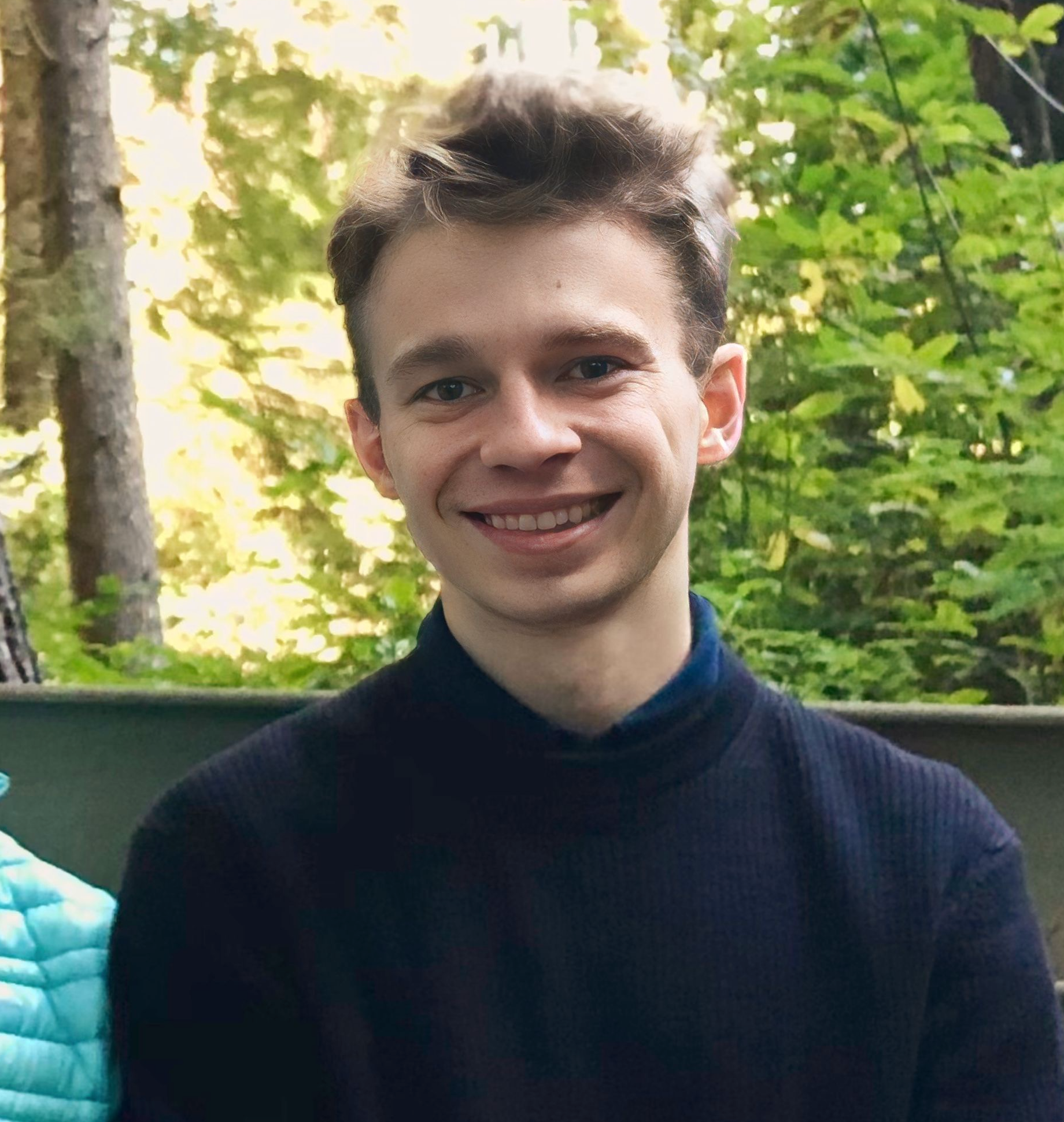
 Mitchell Black
· 2 previous affiliations
- University of California San DiegoSince 2024
- Postdoc · Since 2024
- Current
- Oregon State University2019–2024
- PhD student · 2019–2024
1 other author named Mitchell Black: Mitchell Black (Massachusetts Institute of Technology · MIT Lincoln Laboratory · 21 papers)
Research Overview
Mitchell Black focuses on computational topology, graph neural networks, and quantum algorithms for topological data analysis. His trajectory spans foundational algorithms for simplicial complexes to theoretical frameworks for graph representation learning. Currently, he investigates structural inductive biases and adaptive topologies in geometric deep learning.
Research Trajectory
During his doctoral studies at Oregon State University, Black's early research centered on computational topology, particularly extending spectral and electrical network concepts to higher-dimensional spaces. In Effective Resistance and Capacitance in Simplicial Complexes and a Quantum Algorithm, he generalized effective resistance and capacitance to simplicial complexes, revealing that cycles in these higher-dimensional structures can exhibit exponential resistance due to relative torsion. This work also introduced a quantum algorithm for testing null-homology whose query complexity depends on these new measures. He developed a nearly-linear time algorithm for solving 1-Laplacian systems parameterized by the first Betti number in Hodge Decomposition and General Laplacian Solvers for Embedded Simplicial Complexes, generalizing previous solvers to accommodate complexes with arbitrary first homology. Concurrently, he explored parameterized complexity in topology, establishing optimal algorithms for the Connected Subsurface Recognition and Sum-of-Genus Subsurface Recognition problems in ETH-Tight Algorithms for Finding Surfaces in Simplicial Complexes of Bounded Treewidth. He continued to advance algorithmic foundations for topological spaces in Computational Topology in a Collapsing Universe: Laplacians, Homology, Cohomology.
In 2023, his focus expanded to the theoretical analysis of graph neural networks (GNNs) and the limitations of quantum algorithms. He established a rigorous theoretical link between the phenomenon of oversquashing in GNNs and effective resistance in Understanding Oversquashing in GNNs through the Lens of Effective Resistance. By proving that lower effective resistance between nodes guarantees better information flow, he introduced a greedy rewiring algorithm that strategically adds shortcut edges to minimize a graph's total resistance. Returning to quantum computation, he examined the constraints of Quantum Topological Data Analysis in An Incremental Span-Program-Based Algorithm and the Fine Print of Quantum Topological Data Analysis. This work introduced a novel quantum algorithm for computing Betti numbers while demonstrating that worst-case exact computation is bottlenecked by the spectral gap, contributing to the research direction The Spectral Gap as a Quantum Speed Limit.
Building on his expertise in spectral graph theory, Black investigated alternatives to effective resistance for capturing global topology. In Biharmonic Distance of Graphs and its Higher-Order Variants: Theoretical Properties with Applications to Centrality and Clustering, he provided a theoretical foundation for biharmonic distance, demonstrating its superiority in capturing an edge's importance to a graph's global structure rather than just local connectivity. This research advanced methods in areas such as Low-Pass Graph Filtering for Feature Denoising and Overcoming the All Pairs Shortest Path Bottleneck. He also formalized the structural inductive biases of Graph Transformers in Comparing Graph Transformers via Positional Encodings, proving that relative positional encodings possess a fundamental advantage over absolute encodings when graphs include node features, and establishing a hierarchy of encoding power.
Now a postdoctoral fellow at the University of California San Diego, his more recent work has addressed generative modeling and the practical implementation of positional encodings. With collaborators, he developed Noise-Conditioned Graph Networks in Geometric Generative Modeling with Noise-Conditioned Graph Networks, an architecture that dynamically adjusts its connectivity range and resolution based on noise levels, contributing to the broader area of Data-Driven Discovery of Adaptive Graph Topologies. He further explored the utility of effective resistance in Graph Inference with Effective Resistance Queries, participating in the development of efficient algorithms for testing graph properties like planarity and connectivity. In Understanding Truncated Positional Encodings for Graph Neural Networks, he analyzed the computational tradeoffs of positional encodings, revealing that commonly used truncated versions lose theoretical equivalence to their complete counterparts. To address this, he proposed a mix-and-match strategy combining different families of truncated encodings to recover performance with lower overhead.
Current Directions
The most recent papers in the evidence address the scalability and adaptability of graph representation learning. Recent work investigates how to dynamically adjust graph neural network architectures in response to varying noise levels, enabling more robust geometric generative modeling across domains like 3D modeling and genomics. Additionally, Black is exploring the theoretical properties and practical limitations of positional encodings in deep learning, specifically analyzing how truncated spectral features impact the expressive power of graph models. His ongoing research also examines graph inference problems, utilizing effective resistance queries to efficiently reconstruct and test the properties of complex network topologies.
Profile updated
Loading new papers…
Other researchers whose papers cluster into the same research directions — a proxy for overlapping technical interests and shared intellectual neighborhoods.
See something wrong? Report a mistake