

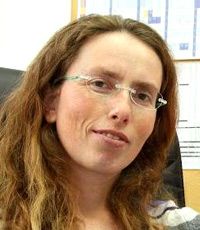
 Mirela Ben-Chen
· 1 previous affiliation
- Full Professor · Current
Research Overview
Mirela Ben-Chen focuses on geometry processing, spectral shape analysis, and the mathematical representation of mappings between complex surfaces. Her trajectory spans foundational work in functional maps and vector field design to the integration of deep learning techniques for 3D shape analysis. Recently, her focus has expanded to applied spectral geometry for tracking deformations in high-resolution biological structures.
Research Trajectory
Ben-Chen’s early research concentrated on the intrinsic properties of shapes, particularly symmetry and vector field design. As first author of On Discrete Killing Vector Fields and Patterns on Surfaces (2010), she led work on encoding semantic and aesthetic information through symmetry. This research formalized discrete approximations of Killing vector fields to generate and analyze patterns on curved surfaces, establishing a foundation for her subsequent work in intrinsic geometry.
A significant methodological shift in shape analysis occurred with her contributions to Functional maps: a flexible representation of maps between shapes (2012). As a key co-author, Ben-Chen helped introduce a framework that generalized the concept of mappings. Rather than computing point-to-point correspondences—which are often computationally expensive and prone to local minima—this approach aligned real-valued functions across shapes. By projecting these functions onto a multi-scale basis, such as the eigenfunctions of the Laplace-Beltrami operator, the functional map framework reduced complex constraints (like landmark correspondences and descriptor preservation) to linear systems. This compact representation became highly influential for global inference in geometry processing.
Building on these mathematical foundations, Ben-Chen expanded her focus to physical simulations on curved domains. As principal investigator, she directed Functional Fluids on Surfaces (2014), which addressed the challenge of simulating fluid dynamics on arbitrary 3D surfaces rather than bounded Euclidean domains. This research utilized functional representations to manage the complex differential operators required for fluid simulation. Her investigations into surface-based fluid mechanics intersect with the broader research direction of Divergence Free Neural Architectures for Incompressible Fluid Dynamics, as the field increasingly seeks robust mathematical constraints for physical simulations.
As deep learning began to permeate computer graphics, Ben-Chen’s lab explored how to adapt neural networks to the irregular domains of 3D geometry. In GWCNN: A Metric Alignment Layer for Deep Shape Analysis (2017), she served as senior author on a novel architecture designed to incorporate semantic information into geometry processing. Because 3D shapes lack the regular grid structure of images, this work introduced a metric alignment layer that allowed convolutional neural networks to operate effectively on geometric data, bridging the gap between deep learning and traditional shape analysis.
Continuing her leadership in shape matching, Ben-Chen’s group addressed the limitations of existing correspondence algorithms when dealing with sharp geometric features. In Elastic Correspondence between Triangle Meshes (2019), her team proposed a hybrid optimization scheme capable of matching crease features across triangular meshes. This work demonstrated a continued commitment to refining the accuracy of geometric alignments in the presence of complex, non-smooth surface details.
Most recently, Ben-Chen has applied her expertise in spectral geometry to large-scale, real-world biological datasets. As principal investigator on S‐ACORD: Spectral Analysis of COral Reef Deformation (2025), she directed the development of an efficient pipeline for registering and detecting changes in 3D models of coral reefs over time. Because photogrammetric reconstructions of corals produce dense triangle meshes with millions of vertices, traditional correspondence algorithms struggle to scale. By combining globally optimal iterative closest point algorithms with fast approximations for extracting Laplace-Beltrami eigenvectors, her team successfully adapted functional map techniques to track intricate, multi-scale structural deformations in marine ecosystems.
Current Directions
The most recent papers in the evidence indicate a strong focus on scaling spectral geometry processing to handle massive, unstructured, and highly complex curved domains. A primary challenge in modern geometry processing is the computational bottleneck associated with dense meshes generated by 3D scanning and photogrammetry. Recent work investigates fast approximation algorithms and geometric multigrid solvers that rely on intrinsic prolongation to efficiently solve linear systems on unstructured surfaces.
Furthermore, Ben-Chen is actively applying these scalable geometric methods to ecological and biological monitoring. By translating abstract mathematical frameworks—such as the Laplace-Beltrami operator and functional maps—into applied tools for analyzing high-resolution 3D reconstructions, her current research addresses the practical challenges of tracking structural changes in complex natural environments over time.
Profile updated
| Title | Venue | Year |
|---|---|---|
| SDFs from Unoriented Point Clouds using Neural Variational Heat Distances | Computer Graphics Forum | 2026 |
| CageNet: A Meta-Framework for Learning on Wild Meshes | arXiv | 2025 |
| MDNF: Multi-Diffusion-Nets for Neural Fields on Meshes | Computer Graphics Forum | 2025 |
| An Elastic Basis for Spectral Shape Correspondence | Siggraph (conference Paper Track) | 2023 |
| A Convex Optimization Framework for Regularized Geodesic Distances | arXiv | 2023 |
| VEMPIC: particle-in-polyhedron fluid simulation for intricate solid boundaries | ACM Trans. Graphics | 2022 |
| A Differential Geometry Perspective on Orthogonal Recurrent Models | arXiv | 2021 |
| Surface multigrid via intrinsic prolongation | ACM Trans. Graphics | 2021 |
| Reversible Harmonic Maps between Discrete Surfaces | ACM Trans. Graphics | 2019 |
| Parallel Transport on the Cone Manifold of SPD Matrices for Domain Adaptation | IEEE TSP | 2019 |
| Paper | Venue | Year |
|---|---|---|
| Recovering Hidden Components in Multimodal Data with Composite Diffusion OperatorsGitHubshnitzer/ | SIAM J. Math. Data Sci | 2019 |
Loading new papers…
Other researchers whose papers cluster into the same research directions — a proxy for overlapping technical interests and shared intellectual neighborhoods.
See something wrong? Report a mistake