

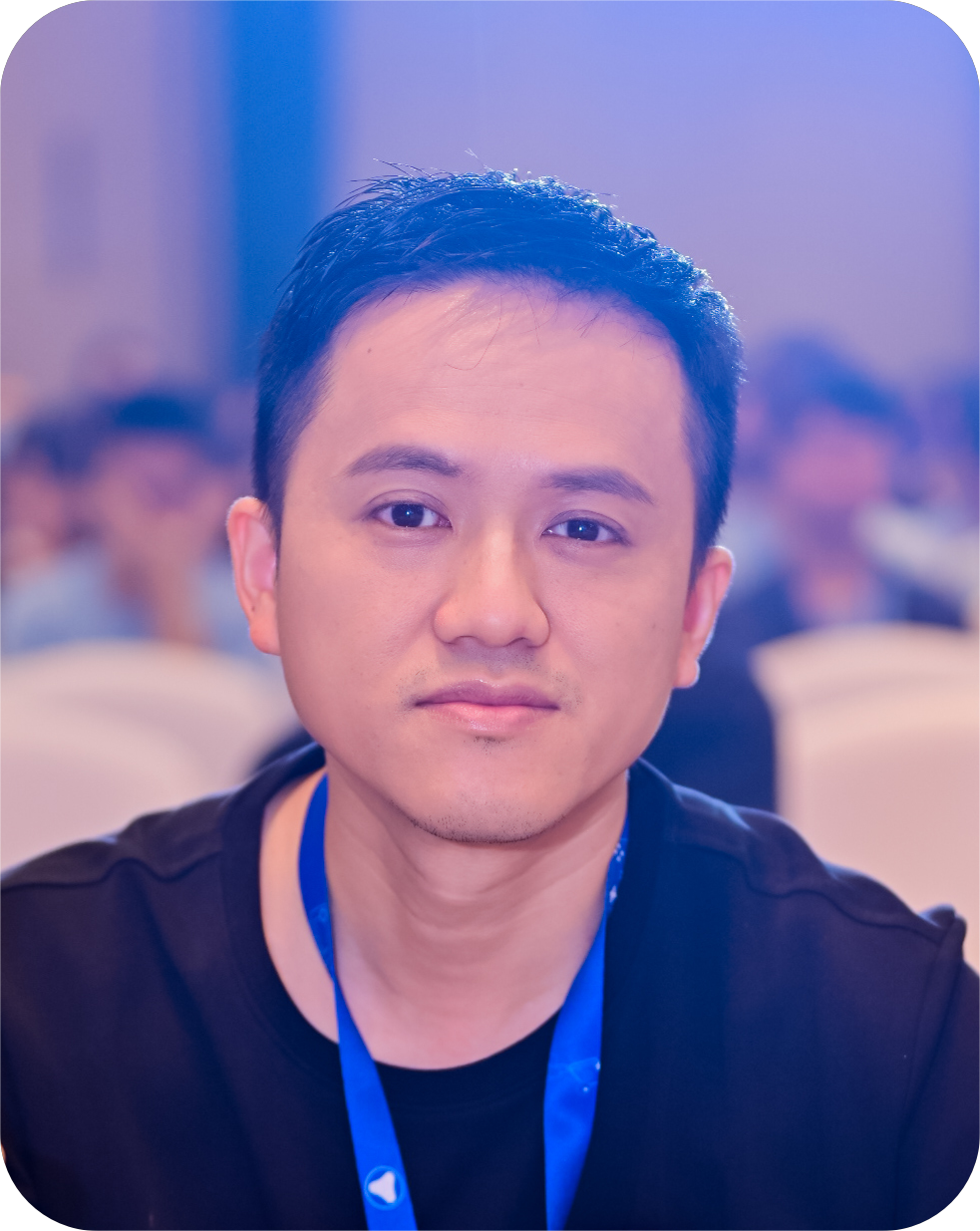
 Minwen Deng
· 4 previous affiliations
- Tencent (China)Since 2010
- Researcher · Since 2010
- Tencent AI LabCurrent
- Current
- Alibaba Group (China)2009–2010
- Researcher · 2009–2010
- Chinese Academy of Sciences2006–2009
- MS student · 2006–2009
Research Overview
Minwen Deng focuses on hardware-aware compiler optimization, deep learning inference acceleration, and the development of complex reinforcement learning environments. His trajectory spans from creating high-performance convolution kernels and large-scale multi-agent datasets to designing sample-free dynamic tensor program compilers. Recently, his work investigates foundational frameworks for interactive video generation and sparse matrix multiplication on GPUs.
Research Trajectory
Early work in 2022 demonstrates a dual focus on complex reinforcement learning (RL) environments and low-level hardware optimization. In the domain of reinforcement learning, Deng contributed to the design of Honor of Kings Arena: an Environment for Generalization in Competitive Reinforcement Learning. This project introduced an open-source Python interface for the popular multiplayer online battle arena (MOBA) game, establishing a platform to test generalization capabilities across diverse targets and opponents in competitive multi-agent scenarios. Parallel to this, Deng participated in research on deep learning inference acceleration, co-authoring Automatic Generation of High-Performance Convolution Kernels on ARM CPUs for Deep Learning. This work presented FastConv, a template-based library that automates the generation of Winograd-based convolution solvers across diverse ARM CPU architectures, addressing the challenge of consistently optimizing solvers for varying tensor shapes.
Building on the earlier RL environment research, Deng and collaborators released Hokoff: Real Game Dataset from Honor of Kings and its Offline Reinforcement Learning Benchmarks in 2023. By providing high-quality, pre-collected datasets derived from intricate game dynamics, this project addressed the lack of realism in existing offline RL and multi-agent RL (MARL) benchmarks. The release supported several broader research areas, including the direction of Evaluating Strategic Intelligence through Multi-Agent Tournaments, the area of Credit Assignment in Cooperative Multi-Agent Systems, and the ongoing development of Standardized Interfaces for Reinforcement Learning Environments.
In 2024, Deng's focus on hardware-aware optimization culminated in Vortex: Efficient Sample-Free Dynamic Tensor Program Optimization via Hardware-aware Strategy Space Hierarchization. Guiding this project, he introduced a hardware-driven compiler designed specifically for dynamic-shape tensor programs. Vortex bypasses the limitations of sample-driven compilation methods, enabling more efficient management of the variable input sizes frequently encountered in real-time deep neural network applications.
By 2025, Deng's collaborative efforts expanded into interactive generative models and advanced GPU sparsity optimizations. He contributed to Yan: Foundational Interactive Video Generation, a framework that unifies real-time simulation, multi-modal generation, and dynamic editing. By explicitly disentangling physics simulation from visual rendering, the pipeline allows users to interactively control high-fidelity virtual worlds. This research intersects with the direction of Mitigating Temporal Drift in Autoregressive Video Generation and the broader area of Closing the Sim-to-Real Gap in Robotics. Concurrently, Deng participated in the development of NM-SpMM: Accelerating Matrix Multiplication Using N:M Sparsity with GPGPU. This work introduced a novel GPGPU implementation that leverages a hierarchical blocking mechanism and memory footprint reduction to accelerate deep learning inference, advancing techniques in the research area of Hiding Memory Latency with Asynchronous Software Pipelining.
Current Directions
The most recent work in the evidence points toward two primary technical directions: the acceleration of deep learning primitives and the development of interactive, multi-modal generative frameworks. In the realm of hardware optimization, current efforts focus on exploiting structured sparsity (such as N:M sparsity) on GPGPUs to maximize inference performance and minimize memory latency. Simultaneously, in the generative space, recent research investigates foundational models for video generation that integrate real-time physics simulation with visual rendering. This dual focus highlights an ongoing interest in both the underlying computational efficiency of neural networks and their application to complex, interactive virtual environments.
Profile updated
Loading new papers…
Other researchers whose papers cluster into the same research directions — a proxy for overlapping technical interests and shared intellectual neighborhoods.
See something wrong? Report a mistake