

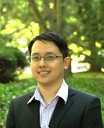
 Minh Hoang
· 3 previous affiliations
- Princeton UniversitySince 2023
- Postdoc · Since 2023
- Carnegie Mellon University2018–2023
- PhD student · 2018–2023
- National University of Singapore2012–2016
- Undergrad student · 2012–2016
Research Overview
Minh Hoang focuses on scalable probabilistic modeling, federated learning, and automated algorithm design for computational biology. His trajectory spans foundational improvements to Gaussian process inference and decentralized optimization, evolving toward robust meta-learning and sequence sketching techniques. Currently, he investigates offline black-box optimization and late-interaction retrieval mechanisms for genomic and protein analysis.
Research Trajectory
Early work focused on scaling probabilistic models for large datasets. He contributed to the development of A Unifying Framework of Anytime Sparse Gaussian Process Regression Models with Stochastic Variational Inference for Big Data, designing models that balance predictive performance and computational speed. Extending this to distributed settings, he worked in the area of Scalable Gaussian Process Inference for Non-Gaussian Data. In this domain, he co-developed A Distributed Variational Inference Framework for Unifying Parallel Sparse Gaussian Process Regression Models to facilitate scalable hyperparameter learning across parallel architectures. He then advanced sparse spectrum approximations by formulating A Generalized Stochastic Variational Bayesian Hyperparameter Learning Framework for Sparse Spectrum Gaussian Process Regression, which mitigates overfitting by treating spectral frequencies probabilistically.
Shifting toward distributed and multi-agent systems, his research expanded into decentralized optimization. He participated in the design of Decentralized High-Dimensional Bayesian Optimization With Factor Graphs to coordinate decentralized agents. Building on this theme of collective intelligence, he introduced techniques for Collective Model Fusion for Multiple Black-Box Experts, enabling independent models with heterogeneous architectures to combine their predictive capabilities. Returning to the theoretical foundations of Gaussian processes, he established new sample complexity bounds in Revisiting the Sample Complexity of Sparse Spectrum Approximation of Gaussian Processes. This work, contributing to the broader direction of Uniformly Accurate Approximations for Model Selection, utilized a data disentangling condition and custom variational auto-encoders to prove that accurate approximations can scale to millions of data points across the parameter space.
In subsequent years, his focus broadened to address heterogeneity in federated learning and sequence analysis in computational biology. Recognizing the limitations of one-size-fits-all models in decentralized networks, he designed Personalized Neural Architecture Search for Federated Learning (FedPNAS), an algorithm that allows local devices to structurally adapt a base architecture to their specific data distributions. Concurrently, he began applying differentiable optimization to genomics, introducing DeepMinimizer: A Differentiable Framework for Optimizing Sequence-Specific Minimizer Schemes to learn optimal k-mer sampling strategies without relying on intractable discrete optimization. These parallel tracks in machine learning and bioinformatics were synthesized in his overview of Practical Methods for Automated Algorithm Design in Machine Learning and Computational Biology.
More recently, his research has tackled complex optimization challenges in both continuous and discrete spaces. He proposed an approach for Learning Surrogates for Offline Black-Box Optimization via Gradient Matching that estimates the gradient field of a target function from static datasets, improving the reliability of surrogate models in materials science and drug discovery. In computational biology, he extended his work on sequence sketching by formulating the Density and Conservation Optimization of the Generalized Masked-Minimizer Sketching Scheme, a bi-level framework that simultaneously optimizes sketch density, conservation, and coverage.
Returning to federated systems, he contributed to the area of Mitigating Client Drift in Heterogeneous Federated Learning by co-developing Probabilistic Federated Prompt-Tuning with Non-IID and Imbalanced Data. This method treats prompt aggregation as a probabilistic set-modeling task to align concepts across highly imbalanced client data without full-model fine-tuning. He also addressed task diversity in meta-learning, advancing the direction of Unsupervised Discovery of Latent Task Structures. By introducing Efficient Heterogeneous Meta-Learning via Channel Shuffling Modulation, he utilized a Gumbel-Benes layer to enable efficient adaptation across highly heterogeneous task distributions. Finally, his collaborative work in computational biology includes the development of ProtoCol: Late Interaction Retrieval for Protein Homolog Search, which utilizes residue-level embeddings and a MaxSim operator to detect remote homologs in low-similarity regimes.
Current Directions
The most recent papers in the evidence indicate a dual focus on adapting large-scale machine learning models to heterogeneous environments and advancing retrieval mechanisms for computational biology. In the machine learning domain, current work investigates parameter-efficient adaptation strategies—such as probabilistic prompt-tuning and channel shuffling modulation—to handle non-IID data and diverse task distributions in federated and meta-learning settings. In parallel, his bioinformatics research addresses the efficient representation and retrieval of biological sequences, utilizing bi-level optimization for genomic sketching and late-interaction embedding models to identify remote protein homologs.
Profile updated
Loading new papers…
Other researchers whose papers cluster into the same research directions — a proxy for overlapping technical interests and shared intellectual neighborhoods.
See something wrong? Report a mistake