

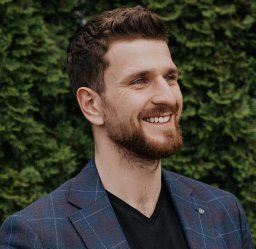
 Michał Stypułkowski
· 8 previous affiliations
- Cantina LabsSince 2025
- Researcher · Since 2025
- Meta (United States)2023–2024
- Intern · 2023–2024
- President of Scientific Committee, Member of General Committee · 2024
- University of Wroclaw2018–2024
- Doctor of Philosophy - PhD, Informatyka · 2020–2024
- Teaching Assistant · 2020–2021
- Magister (Mgr), Matematyka · 2018–2020
- Research Assistant · 2021–2024
- University of Wrocław2020–2024
- PhD student · 2020–2024
- Intern · 2023
- Intern · 2022
Research Overview
Michał Stypułkowski focuses on 3D point cloud generation, self-supervised speech representation, and video synthesis. His early work developed normalizing flows for modeling unstructured spatial data and advanced contrastive predictive coding for audio sequences. More recently, he investigates continual learning techniques and autoregressive diffusion models for realistic, audio-driven talking-head generation.
Research Trajectory
The trajectory of his work begins with generative modeling for complex spatial structures. In 2019, he introduced Conditional Invertible Flow for Point Cloud Generation, addressing core challenges in the area of Deep Learning on Unstructured 3D Point Clouds. This work treated point clouds as conditional distributions governed by learned embeddings, yielding a generative model that was order-invariant and robust to varying point counts. He expanded upon this framework in 2021 with Representing point clouds with generative conditional invertible flow networks. By sharing model weights across entire object classes and utilizing discrete normalizing flows alongside object-specific embeddings, this approach significantly accelerated training times compared to prior continuous-flow methods. This contribution advanced the research direction of Scaling 3D Generative Models to Large Vocabularies and intersected with the broader field of Continuous Neural Flows and Differential Equations.
Concurrently in 2021, his research expanded into self-supervised learning for audio and speech processing. He oversaw the development of Aligned Contrastive Predictive Coding, a method designed to extract slowly varying latent representations by forcing a prediction network to anticipate sequences of symbols without requiring exact timing alignment. This architectural work provided insights relevant to the area of The Spatial Inductive Bias of Zero Padding. In a related application, he guided the research detailed in Information Retrieval for ZeroSpeech 2021: The Submission by University of Wroclaw. This work demonstrated how refining contrastive predictive coding (CPC) representations with low-resource methods could yield stable features for pattern matching and retrieval in zero-resource speech tasks, even when the representations remained too noisy for full language model training.
Returning to 3D spatial data in 2023, he collaborated on Continual learning on 3D point clouds with random compressed rehearsal. This work explored memory-efficient strategies for updating models on new spatial data over time, contributing to the research direction of Mitigating Catastrophic Forgetting in Continual Learning.
Also in 2023, he shifted focus toward generative video synthesis, specifically audio-driven facial animation. He introduced Diffused Heads: Diffusion Models Beat GANs on Talking-Face Generation, an autoregressive diffusion model capable of synthesizing realistic talking-head videos from a single identity image and an audio sequence. By successfully hallucinating natural head movements and facial expressions like blinks while preserving background details, this work addressed key challenges in the area of Mitigating Temporal Drift in Autoregressive Video Generation.
Current Directions
The most recent papers in the evidence indicate a dual focus on adapting spatial models over time and advancing high-fidelity video synthesis. In the 3D domain, recent work investigates memory-efficient continual learning techniques to prevent catastrophic forgetting when processing sequential point cloud data. Simultaneously, in the generative modeling space, his current efforts address the synthesis of realistic, audio-driven video. By leveraging autoregressive diffusion models, this research tackles the complex problem of generating temporally coherent facial expressions and natural head movements from minimal reference data, pushing the boundaries of stable, long-form video generation.
Profile updated
Loading new papers…
Other researchers whose papers cluster into the same research directions — a proxy for overlapping technical interests and shared intellectual neighborhoods.
See something wrong? Report a mistake