

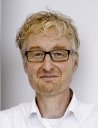
 Max Welling
· 6 previous affiliations
- University of AmsterdamSince 2013
- Full Professor · Since 2013
- University of California, Irvine2003–2013
- Full Professor · 2003–2013
- University of Toronto2001–2003
- Postdoc · 2001–2003
- University College London2000–2001
- Postdoc · 2000–2001
- California Institute of Technology1998–2000
- Postdoc · 1998–2000
- Utrecht University1993–1998
- PhD student · 1993–1998
Research Overview
Max Welling focuses on probabilistic machine learning, equivariant neural networks, and physics-inspired deep learning. His trajectory spans early work in theoretical physics to foundational contributions in variational inference, graph representation learning, and geometric deep learning. Most recently, his research investigates dynamical systems, differential privacy, and the application of physical principles to generative modeling and neural partial differential equation solvers.
Research Trajectory
His early academic work was rooted in theoretical physics, exploring the mathematical landscape of gravity and the topological properties of 2+1-dimensional universes in Explicit solutions for point particles and black holes in spaces of constant curvature in 2+1-D gravity.
Transitioning to machine learning, he made foundational contributions to probabilistic modeling. He introduced a framework bridging optimization and Bayesian posterior sampling in Bayesian Learning via Stochastic Gradient Langevin Dynamics, advancing the research direction of Trading Bias for Variance in Stochastic MCMC. Building on this probabilistic foundation, he developed the Variational Auto-Encoder (VAE) in Auto-Encoding Variational Bayes. This work provided a scalable, differentiable approach to training directed probabilistic models with continuous latent variables, fundamentally altering the landscape of generative modeling.
Expanding into distributed systems and structured data, his research group developed a prototype framework for the area of Browser-Based Distributed Machine Learning with MLitB: machine learning in the browser, enabling massive-scale model training across heterogeneous devices using standard web protocols. Concurrently, he began influential work in geometric deep learning. With collaborators, he generalized convolutional networks to exploit symmetries in Group Equivariant Convolutional Networks. He also introduced Graph Convolutional Networks (GCNs) in Semi-Supervised Classification with Graph Convolutional Networks, leveraging first-order approximations of spectral graph theory to efficiently learn from node features and graph topology simultaneously.
Applying neural architectures to complex search spaces, he participated in the development of attention-based models for the Travelling Salesman Problem in Attention, Learn to Solve Routing Problems!. This work improved training efficiency using REINFORCE and contributed to the area of Dynamic Action Masking for Neural Combinatorial Optimization. Returning to geometric deep learning, his lab extended convolutional networks to non-Euclidean spaces. He directed research on Coordinate Independent Convolutional Networks - Isometry and Gauge Equivariant Convolutions on Riemannian Manifolds, addressing the area of Gauge Equivariant Convolutions on Curved Manifolds. He also collaborated on E(n) Equivariant Graph Neural Networks, an architecture that respects physical symmetries like rotation and translation without relying on computationally expensive spherical harmonics. This broader focus on symmetry has also encompassed the research direction of Geometric Algebra for Equivariant Neural Networks.
His recent trajectory includes applications in public health, computational chemistry, and physics-inspired neural architectures. He led the development of a decentralized algorithm for COVID-19 contact tracing in Protect Your Score: Contact-Tracing with Differential Privacy Guarantees, which aligns with his broader contributions to the area of Differentially Private Inference via Sufficient Statistic Perturbation. In drug discovery, he directed work on Learning Protocols for Non-Equilibrium Conformational Free-Energy Estimation Using Optimal Transport and Conditional Flow Matching, utilizing non-equilibrium thermodynamics to estimate free-energy differences without exhaustive equilibrium sampling.
Moving into 2025, his research heavily integrates dynamical systems and physical principles into deep learning. He directed the development of LangevinFlow in Langevin Flows for Modeling Neural Latent Dynamics, utilizing physics-inspired stochastic differential equations to track hidden factors in brain activity. He also explored synchronization dynamics through Kuramoto oscillators, treating pixels as coupled oscillators for generative modeling in Kuramoto Orientation Diffusion Models. This oscillatory approach was further applied to unsupervised object discovery and complex reasoning in Artificial Kuramoto Oscillatory Neurons. Concurrently, he addressed computational efficiency in physical simulations, introducing spatially adaptive quantization for irregular meshes in Adaptive Mesh Quantization for Neural PDE Solvers.
In 2026, Welling's research expanded into efficient transformer architectures and quantum control. They directed the development of AVQ-Attention-2: Adaptive Vector-Quantized Attention with Exact Local Blocks and Linear-Cost Training, which combines exact local attention with adaptive key clustering to achieve linear-cost training and high-fidelity drop-in replacement for dense attention. In quantum systems, Welling directed QMaxCal: Decoherence-Aware Quantum Optimal Control via Girsanov's Theorem, employing Girsanov's theorem to construct closed-form regularizers that penalize the observable impacts of control on decoherence channels in continuously monitored open quantum systems.
Current Directions
The most recent themes in the evidence focus on the intersection of non-equilibrium thermodynamics, oscillatory dynamics, and deep learning. Current work investigates how biological synchronization mechanisms—such as Kuramoto oscillators—can be embedded into neural networks to create powerful inductive biases for generative modeling, unsupervised object discovery, and complex reasoning tasks. Additionally, there is an ongoing focus on applying physical priors, such as underdamped Langevin dynamics and optimal transport, to improve the modeling of neural latent dynamics and the estimation of conformational free energy in computational chemistry. Another active area involves optimizing neural partial differential equation solvers by dynamically adapting computational resources to the spatial complexity of physical systems, ensuring that computationally simple regions and complex phenomena are processed with appropriate efficiency.
Profile updated
Loading new papers…
Other researchers whose papers cluster into the same research directions — a proxy for overlapping technical interests and shared intellectual neighborhoods.
See something wrong? Report a mistake