

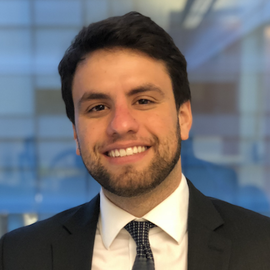
 Max Kleiman-Weiner
· 7 previous affiliations
- University of WashingtonSince 2024
- Assistant Professor · Since 2024
- Google (United States)Since 2026
- Researcher · Since 2026
- Common Sense Machines2020–2026
- Principal Researcher · 2020–2026
- Harvard University2018–2020
- Postdoc · 2018–2020
- PhD student · 2012–2018
- University of Oxford2009–2011
- MS student · 2009–2011
- Stanford University2005–2009
- Undergrad student · 2005–2009
Research Overview
Max Kleiman-Weiner focuses on computational cognitive science, modeling social intelligence, cooperation, and moral reasoning. By integrating probabilistic causal models, reinforcement learning, and evolutionary game theory, this research investigates how humans infer intentions and coordinate behavior. Recent work explores the alignment, persuasive capabilities, and cooperative dynamics of large language model agents in multi-agent environments.
Research Trajectory
Early research focused on the cognitive mechanisms underlying moral judgments and responsibility attribution. Participation in Wins above replacement: Responsibility attributions as counterfactual replacements (2014) explored how people attribute responsibility by comparing prior expectations of an agent's actions with posterior observations. Kleiman-Weiner subsequently led the development of Inference of Intention and Permissibility in Moral Decision Making (2015), which introduced a formalism for inferring intentions as counterfactual contrasts over influence diagrams to quantitatively explain moral permissibility judgments. This foundational work on morality was expanded in Towards Formal Definitions of Blameworthiness, Intention, and Moral Responsibility (2018), which provided formal definitions relative to epistemic states and actual causality, contributing to the broader research area of Responsibility Attribution in Distributed and Autonomous AI Systems.
The trajectory then expanded to encompass multi-agent coordination and social learning. Theory of Minds: Understanding Behavior in Groups through Inverse Planning (2019) applied inverse planning to group behavior, advancing work in the area of Reinforcement Learning for Dynamic Agent Populations. Parallel work on moral cognition continued with What if everybody did that?: Universalization as a mechanism of moral decision-making (2019), which detailed how contractualist universalization reasoning operates in free-rider scenarios. In 2020, Kleiman-Weiner oversaw Too Many Cooks: Coordinating Multi-agent Collaboration Through Inverse Planning, introducing Bayesian Delegation to enable decentralized agents to infer sub-tasks and coordinate without communication. This work bridged the research direction of Bayesian Inverse Planning for Goal Inference with the area of Robust Zero Shot Coordination with Unseen Partners. That same year, Downloading Culture.zip: Social learning by program induction formalized social learning as probabilistic program induction, demonstrating that observing execution traces significantly accelerates learning.
Subsequent research investigated the semantic and empirical dimensions of coordination and morality. Contributions to Zero-Shot Coordination via Semantic Relationships Between Actions and Observations (2022) examined how attention-based architectures exploit semantic relationships to produce human-compatible policies. In 2025, the focus shifted toward large language models, with Estimating the Empowerment of Language Model Agents and the empirical moral study When Is It Acceptable to Break the Rules? Knowledge Representation of Moral Judgements Based on Empirical Data (Extended Abstract).
By 2026, the research agenda heavily emphasized the evaluation, alignment, and cooperative capacities of autonomous AI systems. Modeling Others' Minds as Code introduced the ROTE algorithm, which treats action understanding as a program synthesis problem to predict human behavior. To address value alignment, Generative Value Conflicts Reveal LLM Priorities presented ConflictScope, an automated pipeline for evaluating how language models navigate tradeoffs between competing values. The persuasive impact of these models was analyzed in A Model of Multi-turn Human Persuadability Using Probabilistic Belief Tracing, which developed the PERSUASIONTRACE framework to track latent belief updates during human-LLM interactions.
Further 2026 work explored emergent cooperation and system dynamics. Kleiman-Weiner directed Commitment To Cooperation With Self-Negotiated Contracts, demonstrating how LLM agents can use self-negotiated contracts to solve principal-agent problems and secure mutual benefits. Additional collaborative work included s$^3$: Simple Scaling of Swarms via Cooperative Multi-agent RL, which allowed agents to self-organize without predefined roles, and Tapes Together Strong: The Co-evolution of Computation and Cooperation, which introduced Autopoietic Game Theory to study how physical computational costs influence the evolution of cooperative strategies. Finally, AI Assistants Overassist investigated the behavioral impacts of over-reliance on automated assistance.
Current Directions
Current research investigates the complex social dynamics, alignment, and evaluation of large language model agents. A major focus is on how these models navigate value conflicts and persuade human users, utilizing frameworks that trace probabilistic belief updates during multi-turn interactions. Additionally, recent work explores mechanisms for establishing credible commitments among autonomous agents, such as self-negotiated contracts, and models human social routines as executable behavioral programs to improve human-AI collaboration.
Profile updated
| Paper | Venue | Year |
|---|---|---|
| Cooperate or Collapse: Emergence of Sustainable Cooperation in a Society of LLM AgentsGitHubgiorgiopiatti/ | NeurIPS | 2024 |
| Multilingual Trolley Problems for Language ModelsGitHubgiorgiopiatti/ | Pluralistic-alignment | 2024 |
Loading new papers…
Other researchers whose papers cluster into the same research directions — a proxy for overlapping technical interests and shared intellectual neighborhoods.
See something wrong? Report a mistake