

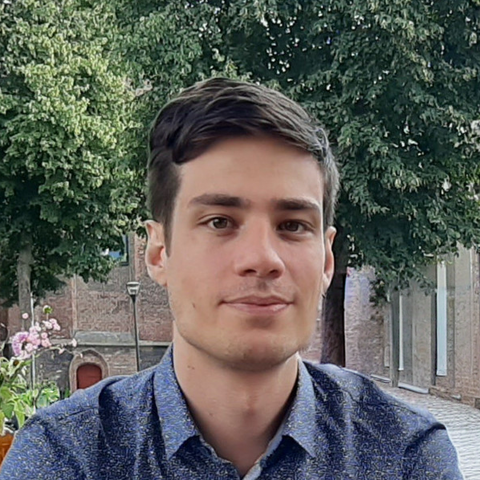
 Maurice Weiler
· 3 previous affiliations
- Massachusetts Institute of TechnologySince 2024
- Postdoctoral Associate · Since 2024
- Postdoc · 2024–2026
- PhD student · 2018
- Heidelberg University2015–2017
- MS student · 2015–2017
Research Overview
Maurice Weiler focuses on geometric deep learning, specifically the design of equivariant convolutional neural networks and their underlying representation theory. His trajectory spans from foundational frameworks for steerable filters in Euclidean spaces to gauge field theories for neural networks on Riemannian manifolds. Recently, his work has expanded to include multimodal foundation models for 3D molecules and materials.
Research Trajectory
In 2018, Weiler established foundational architectures for rotationally equivariant features in volumetric data. He introduced 3D Steerable CNNs: Learning Rotationally Equivariant Features in Volumetric Data, developing SE(3)-equivariant convolutions parameterized by a complete steerable kernel basis. Concurrently, he addressed joint equivariance under translations and rotations in Learning Steerable Filters for Rotation Equivariant CNNs, which advanced the area of The Discretization Gap in Equivariant Neural Networks by efficiently computing orientation-dependent responses without interpolation artifacts. To formalize these architectures mathematically, he oversaw the development of a unified framework for steerable layers in Intertwiners between Induced Representations (with Applications to the Theory of Equivariant Neural Networks), demonstrating that all such layers can be expressed as convolutions or cross-correlations with specific equivariant kernels.
Moving into 2019, his focus expanded to more general symmetry groups and non-Euclidean domains. He detailed E(2)-equivariant convolutions in General E(2)-Equivariant Steerable CNNs, reducing constraints for arbitrary group representations to constraints under irreducible representations, contributing to the research direction of Hierarchical Symmetry Relaxation in Deep Neural Networks. He also guided a systematic classification of group equivariant networks on homogeneous spaces in A General Theory of Equivariant CNNs on Homogeneous Spaces, a key contribution to the broader area of Linear Equivariance through Constrained Convolutional Kernels. Around this time, he collaborated on extending these principles to manifolds, participating in the introduction of gauge equivariance in Gauge Equivariant Convolutional Networks and the Icosahedral CNN.
In 2021, this gauge-theoretic perspective was formalized further. Weiler proposed Coordinate Independent Convolutional Networks - Isometry and Gauge Equivariant Convolutions on Riemannian Manifolds, arguing that network inference on Riemannian manifolds must be independent of the choice of coordinates, which necessitates gauge symmetry constraints on the neural connectivity. He also collaborated on applying these concepts to discrete geometric structures in Gauge Equivariant Mesh CNNs: Anisotropic convolutions on geometric graphs, utilizing anisotropic gauge equivariant kernels and parallel transport for message passing over mesh edges. To further characterize the spaces of steerable kernels, he co-authored A Wigner-Eckart Theorem for Group Equivariant Convolution Kernels.
In 2022, he led efforts to generalize these models to arbitrary dimensions, presenting A Program to Build E(N)-Equivariant Steerable CNNs. He also bridged equivariant deep learning with physics by characterizing equivariant partial differential operators in Steerable Partial Differential Operators for Equivariant Neural Networks. This work derived a G-steerability constraint for partial differential operators between feature vector fields, advancing the research direction of Rotation Equivariant Convolutions via Partial Differential Operators.
More recently, his collaborative work has explored complex physical and chemical domains. In 2024, he participated in the development of Clifford-Steerable Convolutional Neural Networks, which implicitly parameterize convolution kernels using Clifford algebras to achieve exact equivariance to Lorentz boosts in pseudo-Euclidean spaces like Minkowski spacetime. In 2026, he contributed to Zatom-1: A Multimodal Flow Foundation Model for 3D Molecules and Materials, shifting toward large-scale generative and predictive modeling of chemical structures.
Current Directions
The most recent papers in the evidence address the application of geometric and equivariant principles to complex physical and chemical systems. Recent work investigates the use of Clifford algebras to design networks for pseudo-Euclidean spaces, enabling exact equivariance to transformations such as Lorentz boosts for physics forecasting. Additionally, his collaborative efforts have expanded into foundation models for 3D molecules and materials, focusing on unified generative and predictive learning through multimodal flow matching objectives that jointly model discrete atom types and continuous 3D geometries.
Profile updated
Loading new papers…
Other researchers whose papers cluster into the same research directions — a proxy for overlapping technical interests and shared intellectual neighborhoods.
See something wrong? Report a mistake