

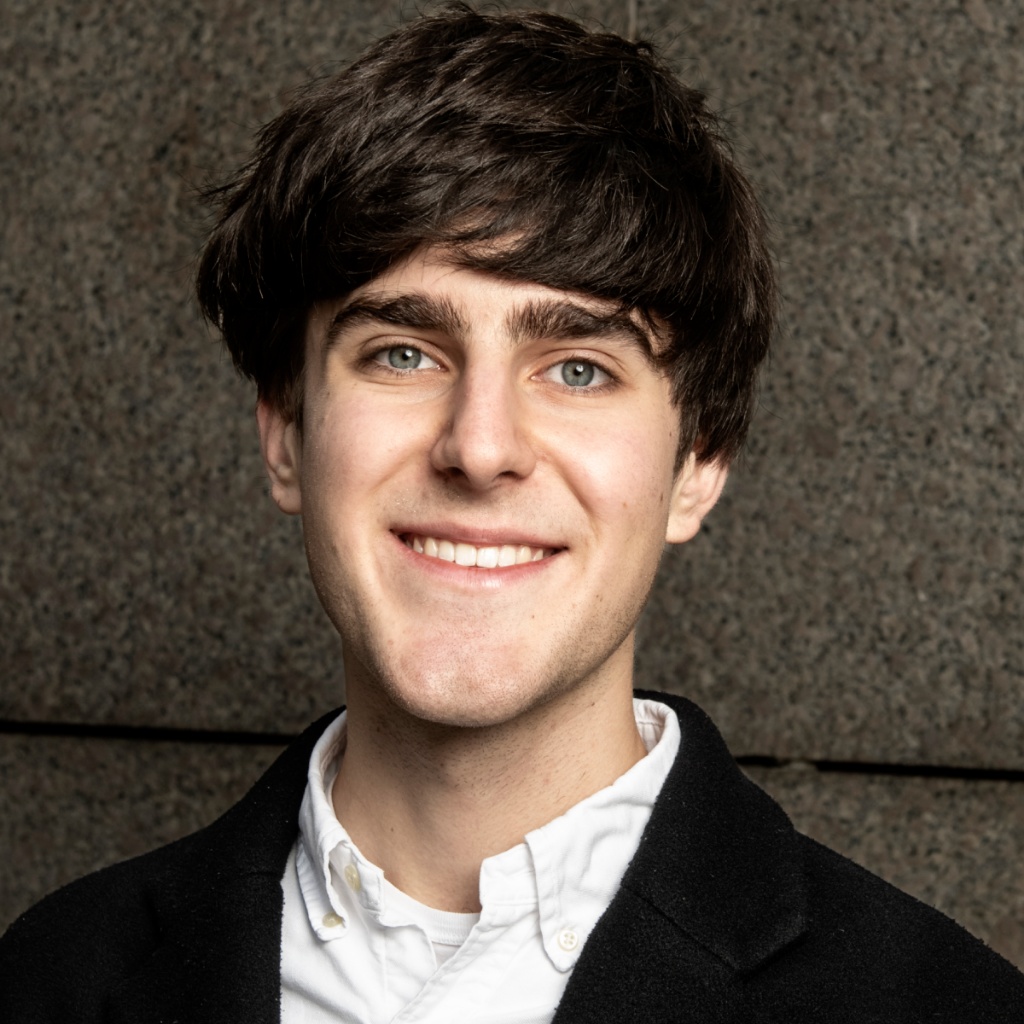
 Maty Bohacek
· 6 previous affiliations
- Stanford UniversitySince 2023
- Undergrad student · 2023–2027
- Student Fellow · Since 2026
- Student Researcher @ Agrawala Lab · Since 2025
- Hoover InstitutionSince 2026
- Student Fellow · Since 2026
- Student Researcher · 2025
- University of California, Berkeley2022–2025
- Student Researcher @ Farid Lab · 2022–2025
- Google (United Kingdom)2024–2025
- Intern · 2024–2025
- Student Researcher · 2024
- Johannes Kepler Grammar School2019–2023
- High school student · 2019–2023
Research Overview
Maty Bohacek focuses on the evaluation, interpretability, and security of generative artificial intelligence, alongside foundational work in computer vision for sign language recognition. His trajectory spans from developing efficient pose-based models for gesture recognition to detecting synthetic media and analyzing the geometric properties of generated images. Most recently, his research investigates the internal representations of large language models and the structural vulnerabilities of generative systems.
Research Trajectory
Bohacek’s early research concentrated on improving the accessibility and efficiency of sign language recognition (SLR) systems. He initially led an ensemble approach for the CVPR 2021 ChaLearn Challenge in Mutual Support of Data Modalities in the Task of Sign Language Recognition, which combined 3D ConvNets, body-pose Transformers, and semantic hand regions to achieve high accuracy on isolated sign gestures. Recognizing the computational heavy lifting required by appearance-based models, he subsequently developed lightweight Transformer architectures. In Combining Efficient and Precise Sign Language Recognition: Good pose estimation library is all you need, he demonstrated that swapping the underlying pose estimation library could yield real-time, in-browser translation capabilities. This work contributed to the research direction of Skeletal Graph Reduction for Sign Language Recognition and the broader area of Scaling Visual Recognition to Thousands of Distinct Classes. He expanded on this architecture in Sign Pose-based Transformer for Word-level Sign Language Recognition, introducing a robust pose normalization scheme that processes hand poses in a local coordinate system independent of the body. To address the persistent challenge of data scarcity in SLR, he introduced an "in-the-wild" dataset scraped from online dictionaries and a novel Validation Score-Conscious Training method in Learning from What is Already Out There: Few-shot Sign Language Recognition with Online Dictionaries. Later, he collaborated on Pose-aware Large Language Model Interface for Providing Feedback to Sign Language Learners, applying large language models to provide accessible, automated feedback without the need for specialized equipment.
Parallel to his vision work in accessibility, Bohacek began investigating the growing threat of disinformation and synthetic media. He introduced a personalized detection model in Protecting President Zelenskyy against Deep Fakes, which combined facial and gestural mannerisms to distinguish authentic videos from sophisticated deepfakes. Broadening his scope to textual disinformation, he led the creation of the Verifee dataset in Fine-grained Czech News Article Dataset: An Interdisciplinary Approach to Trustworthiness Analysis, moving beyond binary labels to train models for nuanced trustworthiness classification. As generative text models became widely accessible, he evaluated their capabilities and the failure of existing AI detectors in The Unseen A+ Student: Evaluating the Performance and Detectability of Large Language Models in High School Assignments.
Returning to visual media, Bohacek analyzed the physical realism of generated content in A Geometric and Photometric Exploration of GAN and Diffusion Synthesized Faces, comparing the 3D geometric and photometric properties of AI-generated faces against natural scenes. He subsequently developed robust detection methods for video manipulation, utilizing CLIP embeddings to identify synthetic kinematics in Human Action CLIPS: Detecting AI-generated Human Motion. He also tackled highly realistic voice cloning by leveraging audio-video mismatches in Lost in Translation: Lip-Sync Deepfake Detection from Audio-Video Mismatch, a technique that independently translates audio and lip-reading to find discrepancies. He contextualized these technological threats within the broader media ecosystem in From Open-Source to Primetime: The Making of an AI News Anchor and its Role in the New Landscape of Disinformation.
In his most recent work, Bohacek scrutinizes the training practices, structural vulnerabilities, and internal mechanisms of generative models. Addressing concerns over intellectual property, he examined the efficacy of style removal in Evaluation of Concept Erasing for Artistic Styles in Diffusion Models and proposed a computationally efficient, black-box method for copyright auditing in Has an AI model been trained on your images?. He also demonstrated the systemic risks of recursive training loops in Nepotistically Trained Generative Image Models Collapse, showing how models suffer significant distortion and loss of diversity when retrained on their own generated content.
To better understand these failure modes, Bohacek has adopted mechanistic interpretability techniques. He applied these methods to visual models in Uncovering Conceptual Blindspots in Generative Image Models Using Sparse Autoencoders, utilizing sparse autoencoders to identify representational gaps and contributing to the research area of Frequency Dependent Factual Recall in Parametric Memory. Extending this approach to text, he developed an automated method to identify model failures in Uncovering Competency Gaps in Large Language Models and Their Benchmarks. By mapping performance onto thousands of interpretable internal concepts, this work reveals where models struggle with boundaries and where benchmarks overlook critical real-world topics, advancing several research directions including Sparse Dictionary Learning for Exhaustive Feature Discovery, Decomposing Aggregate Metrics for Fine-Grained Model Diagnosis, and Convergent Internal Representations in Large Language Models.
Current Directions
The most recent papers in the evidence indicate a strong focus on the mechanistic interpretability and diagnostic evaluation of large-scale generative models. Bohacek is currently investigating how Sparse Autoencoders (SAEs) can be used to look inside the "black box" of both large language models and generative image models. By decomposing dense neural representations into interpretable features, his work aims to map exactly where models fail, identify conceptual blindspots, and reveal the limitations of current benchmarking practices. This direction bridges the gap between theoretical interpretability and practical model auditing, providing tools to ensure that AI systems are reliable, legally compliant, and structurally robust against phenomena like model collapse.
Profile updated
| Title | Venue | Year |
|---|---|---|
| The DeepSpeak-Agentic Dataset | arXiv | 2026 |
| Uncovering Competency Gaps in Large Language Models and Their BenchmarksGitHub resource | ICML | 2026 |
| The DeepSpeak Dataset | Cvpr 2026 Findings | 2026 |
| Uncovering Conceptual Blindspots in Generative Image Models Using Sparse Autoencoders | ICLR | 2026 |
| Multimodal AI Detection In Two Words | NeurIPS | 2026 |
| Synthetic Human Action Video Data Generation with Pose TransferGitHub resource | SynData4CV @ CVPR | 2025 |
| Nepotistically Trained Generative Image Models Collapse | Data Problems @ ICLR | 2025 |
| Can Pose Transfer Models Generate Realistic Human Motion? | arXiv | 2025 |
| Has an AI model been trained on your images? | arXiv | 2025 |
| Evaluation of Concept Erasing for Artistic Styles in Diffusion Models | Creativity & Cognition | 2024 |
Loading new papers…
Other researchers whose papers cluster into the same research directions — a proxy for overlapping technical interests and shared intellectual neighborhoods.
See something wrong? Report a mistake