

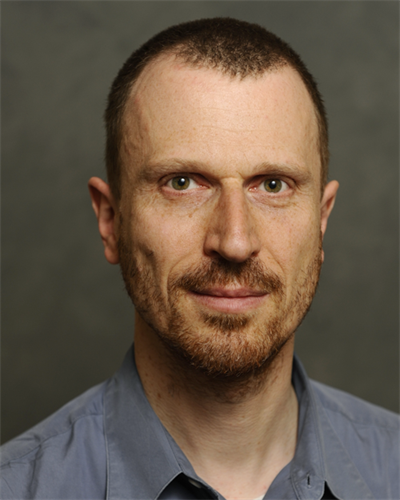
 Matthias Scheutz
· 1 previous affiliation
- Tufts UniversitySince 2010
- Full Professor · Since 2010
Research Overview
Matthias Scheutz focuses on cognitive architectures, human-robot interaction, and reasoning under uncertainty. His historical work explores the translation of natural language into formal logic and the application of Dempster-Shafer theory to uncertain logic processing. Recently, his research has centered on developing neurosymbolic frameworks that enable artificial agents to detect and adapt to novelties in open-world environments.
Research Trajectory
Matthias Scheutz’s research trajectory demonstrates a long-standing interest in bridging natural language, formal logic, and robotic execution, evolving over time to address increasingly complex, unpredictable environments.
In the late 2000s, Scheutz contributed to the development of integrated robotic architectures designed to process spoken language instructions. A key challenge in this domain was parsing natural language utterances quickly and translating them into formal logical goal descriptions. This early work intersected with the broader research direction of Taming Combinatorial Ambiguity in Natural Language Parsing, as robotic systems require rapid, unambiguous translation of human instructions into executable action sequences. A representative contribution from this period is What to do and how to do it: Translating natural language directives into temporal and dynamic logic representation for goal management and action execution, which detailed an architecture capable of incrementally generating goal representations and checking them against existing constraints.
Throughout the 2010s, Scheutz participated in extensive collaborative research addressing how artificial systems handle ambiguous, vague, or incomplete information. Moving beyond deterministic logic, this work heavily utilized the Dempster-Shafer (DS) theoretical framework to model uncertainty. His collaborative efforts during this decade spanned multiple applications, including fusing "soft" textual data with "hard" physics-based sensor data, and modeling the deep semantics of indirect speech acts. This line of inquiry culminated in the formalization of a robust framework for logic-based inference, detailed in Uncertain Logic Processing: logic-based inference and reasoning using Dempster-Shafer models, which provided a rigorous method for assigning probability and uncertainty measures in first-order logic.
Entering the 2020s, Scheutz’s focus shifted toward the robustness of machine learning models and the capacity of autonomous agents to operate in "open worlds"—environments where the underlying rules, objects, or dynamics can change unexpectedly. Early in this decade, he contributed to methodological improvements in domain generalization, such as the framework proposed in Joint Covariate-Alignment and Concept-Alignment: A Framework for Domain Generalization, which sought to minimize both covariate-shift and concept-shift across seen domains to improve performance on unseen data.
Simultaneously, Scheutz became deeply involved in research on novelty detection and accommodation, driven by the limitations of standard closed-world AI benchmarks. Recognizing that traditional visual novelty datasets (like repurposed object classification tasks) fail to capture the complexity of embodied agents, he collaborated on NovelCraft: A Dataset for Novelty Detection and Discovery in Open Worlds. This dataset provided multimodal episodic data of an agent completing tasks in a modified Minecraft environment where novel objects and dynamics were introduced.
By 2023, Scheutz was leading research in this area as a principal investigator. As senior author on Methods and Mechanisms for Interactive Novelty Handling in Adversarial Environments, he guided the development of general architectural mechanisms that allow agents to detect, characterize, and build adaptive models to accommodate novelties using logical representations and reasoning methods.
Current Directions
The most recent papers in the evidence indicate a continued, dedicated focus on open-world environments, specifically through the lens of neurosymbolic AI. Recent work investigates how to move beyond the "closed world" assumption that underpins most traditional artificial intelligence research, addressing scenarios where novel agents, objects, and events actively contradict an agent's previous understanding of its environment.
This direction is exemplified by A neurosymbolic cognitive architecture framework for handling novelties in open worlds. In this work, Scheutz and his collaborators propose a comprehensive cognitive architecture that integrates deep computer vision, reinforcement learning, symbolic planning, and counterfactual reasoning. By combining the pattern-recognition strengths of neural networks with the structured reasoning capabilities of symbolic logic, this current research aims to create highly adaptable agents capable of surviving and succeeding in fundamentally unpredictable domains.
Profile updated
Loading new papers…
Other researchers whose papers cluster into the same research directions — a proxy for overlapping technical interests and shared intellectual neighborhoods.
See something wrong? Report a mistake