

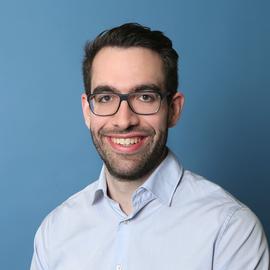
 Mathias Gehrig
· 4 previous affiliations
- SkydioSince 2024
- Senior Autonomy Engineer - Deep Learning · Since 2024
- University of Zurich2017–2023
- PhD Student · 2017–2023
- ETH Zurich2010–2016
- Research Engineer · 2016
- Msc. Robotics, Systems and Control · 2014–2016
- Bsc. Mechanical Engineering, Mechatronics, Robotics, and Automation Engineering · 2010–2013
- Intern · 2015
Research Overview
Mathias Gehrig focuses on neuromorphic vision and autonomous robotics, specifically the development of algorithms for event cameras to enable high-speed, low-latency perception. His work addresses the fundamental challenges of processing asynchronous event streams, including motion compensation, sim-to-real transfer, and the development of data-efficient learning frameworks for object detection and feature tracking. By leveraging the unique properties of neuromorphic sensors—such as high temporal resolution and high dynamic range—Gehrig’s research aims to overcome the limitations of traditional frame-based computer vision in highly dynamic environments.
Research Trajectory
Gehrig’s early research in 2019 concentrated on the foundational principles of event-based vision and its application to agile robotics. Event cameras, unlike traditional sensors that capture full image frames at fixed intervals, report per-pixel brightness changes asynchronously. This creates a need for specialized objective functions to interpret the resulting data. In Focus Is All You Need: Loss Functions for Event-Based Vision, Gehrig contributed to a systematic taxonomy of twenty-two objective functions designed to analyze event alignment. These "focus loss functions" are critical for motion compensation, as they allow for the maximization of contrast in event-based reconstructions, effectively de-blurring the signal generated by rapid sensor movement.
During this same period, Gehrig applied these perception techniques to the domain of high-speed autonomous flight. In Beauty and the Beast: Optimal Methods Meet Learning for Drone Racing, he explored the intersection of optimal control and deep learning to enable micro aerial vehicles to navigate unknown race tracks. This work addressed the problem of Safety Critical Control under Perception and State Uncertainty, where robots must make split-second decisions based on noisy sensor data. By representing global track layouts with coarse gate locations, the approach bypassed the need for precise metric maps, a significant step in Closing the Sim2Real Gap for Neuromorphic Vision. This trajectory aligns with broader efforts in Game-Theoretic Planning for Multi-Agent Autonomous Racing, where the goal is to achieve human-level performance in dynamic, competitive environments.
As the field matured, Gehrig’s focus shifted toward the "data drought" that hindered the training of deep neural networks for event-based tasks. Because event sensors are relatively new, large-scale labeled datasets are scarce compared to traditional video repositories. To mitigate this, Gehrig worked on methods for Overcoming the Neuromorphic Data Bottleneck by recycling existing resources. In Video to Events: Recycling Video Datasets for Event Cameras, he presented a method to convert standard frame-based video datasets into synthetic event streams. This allowed researchers to leverage decades of computer vision data to train neuromorphic models, providing a scalable solution to the lack of native event data.
In 2021, Gehrig participated in research extending event-based vision to video synthesis. In Time Lens: Event-Based Video Frame Interpolation, he contributed to a method that uses the high temporal resolution of events to fill the "blind time" between standard video frames. While traditional interpolation relies on optical flow approximations that fail during non-linear motion, the asynchronous event stream provides a continuous record of visual changes, allowing for the synthesis of high-frame-rate video even in highly dynamic scenarios. This work highlights the utility of Tensorizing Asynchronous Event Streams for Deep Learning, converting sparse temporal data into formats compatible with modern neural architectures.
Current Directions
Gehrig’s recent work demonstrates a transition toward senior leadership in the field, focusing on robust, data-driven perception and label-efficient learning. As the senior author of Data-driven Feature Tracking for Event Cameras, he oversaw the development of the first data-driven tracker for neuromorphic sensors. Moving away from handcrafted algorithms that require extensive parameter tuning, this approach leverages low-latency events to track features initially detected in grayscale frames. This hybrid model combines the structural clarity of traditional frames with the temporal precision of events, ensuring robust performance in scenarios where motion blur or lighting changes would typically cause tracking failure.
Most recently, Gehrig has addressed the economic and logistical barriers to scaling event-based vision. In LEOD: Label-Efficient Object Detection for Event Cameras, he introduced a framework for weakly- and semi-supervised object detection. Given that labeling event streams is exceptionally costly due to their high temporal resolution, LEOD utilizes a self-training mechanism. By using a detector pre-trained on limited labels to generate pseudo-ground truth on unlabeled data—and then refining that detector through bi-directional inference and tracking-based reasoning—the method significantly reduces the human effort required for training. This focus on efficiency is a critical step toward making neuromorphic systems viable for real-world applications in robotics and mobile sensing.
Gehrig’s ongoing work also intersects with emerging architectural trends in computer vision, such as the use of Overlapping Patch Embeddings for Spatial Continuity in Transformers. As event-based data is increasingly processed using Transformer-based backbones, ensuring spatial continuity across the sparse, asynchronous input remains a key technical challenge.
Representative Work
The following papers represent key contributions to the fields of neuromorphic vision and autonomous navigation:
- Focus Is All You Need: Loss Functions for Event-Based Vision: A comprehensive study of objective functions for motion compensation in event-based cameras, establishing a framework for contrast maximization.
- Beauty and the Beast: Optimal Methods Meet Learning for Drone Racing: An integrated approach to autonomous navigation that combines learning-based perception with optimal control for high-speed flight in unseen environments.
- Video to Events: Recycling Video Datasets for Event Cameras: A methodology for generating synthetic event data from standard video, addressing the primary data bottleneck in neuromorphic deep learning.
- Data-driven Feature Tracking for Event Cameras: The first end-to-end learned feature tracker for event sensors, providing increased resilience to noise and unmodeled physical effects compared to handcrafted methods.
- LEOD: Label-Efficient Object Detection for Event Cameras: A semi-supervised learning framework that utilizes temporal consistency and self-training to enable object detection with minimal labeled data.
- Time Lens: Event-Based Video Frame Interpolation: A collaborative work demonstrating the use of event data to reconstruct high-quality intermediate frames in video sequences, surpassing the limits of flow-based interpolation.
Profile updated
| Paper | Venue | Year |
|---|---|---|
| Video to Events: Recycling Video Datasets for Event CamerasGitHubuzh-rpg/ | Unknown | 2022 |
Loading new papers…
Loading research neighbors…
See something wrong? Report a mistake