

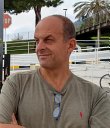
 Massimo Bertozzi
· 1 previous affiliation
- University of ParmaSince 2020
- Associate Professor · Since 2020
- Associate Professor · 2014–2015
- Assistant Professor · 1999–2014
Research Overview
Massimo Bertozzi focuses on computer vision, autonomous perception systems, and generative image synthesis. His early research concentrated on multi-modal pedestrian detection using classical machine learning techniques like support vector machines and oriented gradients. More recently, his collaborative work has shifted toward image-to-image translation, exploring how localized spatial characteristics can improve the performance of generative adversarial networks in complex visual environments.
Research Trajectory
Massimo Bertozzi’s research trajectory spans from classical computer vision approaches for object detection to modern deep learning techniques for generative image synthesis. His early work demonstrates a strong focus on applied perception systems, particularly in the context of pedestrian detection for vehicle safety. As the first author of A Pedestrian Detector Using Histograms of Oriented Gradients and a Support Vector Machine Classifier (2007), Bertozzi led the development of a filtering subsystem for a tetra-vision framework. This system utilized both visible and far-infrared cameras to generate initial areas of attention based on symmetry assumptions. Bertozzi and his collaborators then applied Histograms of Oriented Gradients (HOG) and Support Vector Machine (SVM) classifiers to validate the presence of human shapes, successfully classifying a high percentage of pedestrians within these targeted regions.
Following this early work in classical feature extraction and classification, the available corpus reflects a later shift toward deep generative models and domain adaptation. In a collaborative capacity, Bertozzi contributed to Leveraging Local Domains for Image-to-Image Translation (2021), which was subsequently published at VISIGRAPP in 2022. As a middle author on this project, he participated in addressing the limitations of standard image-to-image (i2i) networks, which often capture global scene structures—such as overall color or lighting—while missing critical local details like lane markings in driving scenarios. To resolve this, the research team utilized human knowledge of spatial domain characteristics, training a patch-based Generative Adversarial Network (GAN) with geometrical guidance to hallucinate unseen domains and facilitate transfer learning.
This collaborative work aligns with the broader research direction of Localized and Semantic Control for Neural Stylization, where researchers seek to prevent global style leakage and maintain fine-grained control over specific regions of an image. It also touches upon challenges central to the area of Disentangling Geometry and Appearance for Controllable Generative Synthesis, ensuring that structural traits are preserved during appearance translation.
Current Directions
The most recent papers in the evidence indicate a focus on generative computer vision, specifically the refinement of image-to-image translation networks. Current directions involve improving how generative models handle localized spatial characteristics during domain transfer. Rather than relying solely on global scene translation, this work investigates the use of geometrical guidance and patch-based GAN architectures to preserve critical local features—such as road markings in autonomous driving datasets—when adapting images from one visual domain to another. By hallucinating intermediate domains from limited source data, this approach aims to make transfer learning more robust and context-aware in complex visual environments.
Profile updated
| Title | Venue | Year |
|---|---|---|
| Leveraging Local Domains for Image-to-Image Translation | Visigrapp (5: Visapp) | 2022 |
| A Pedestrian Detector Using Histograms of Oriented Gradients and a Support Vector Machine Classifier | ITSC | 2007 |
Loading new papers…
Loading research neighbors…
See something wrong? Report a mistake