

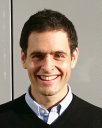
 marco cuturi
· 6 previous affiliations
- ENSAE ParisSince 2016
- Full Professor · Since 2016
- Apple (United States)Since 2022
- Researcher · Since 2022
- Google (United States)2018–2022
- Research scientist · 2018–2022
- Kyoto University2010–2016
- Assoc Prof · 2010–2016
- Princeton University2009–2010
- Lecturer · 2009–2010
- Postdoc · 2005–2007
Research Overview
Marco Cuturi focuses on optimal transport, machine learning, optimization, and time-series analysis. His foundational work established scalable computational methods for optimal transport, enabling its widespread adoption across data science and deep learning. More recently, his research investigates generative modeling, simulation-based inference, and differentiable relaxations for discrete operations.
Research Trajectory
His early research addressed the challenge of applying kernel methods to complex, non-Euclidean data structures. In Semigroup Kernels on Finite Sets, he introduced positive definite kernels for objects that can be represented as finite sets of simpler components, such as image patches or text bags-of-words, proving a general integral representation for these mergers. He later extended this focus to temporal data with Fast Global Alignment Kernels. By providing new theoretical insights into dynamic time warping (DTW), he proposed alternative formulations that yield valid positive definite kernels while significantly improving computational efficiency in classification tasks. This work contributed to the broader research area of Designing Positive Definite Kernels from Non-Euclidean Distances.
A defining shift in his trajectory occurred with the introduction of highly scalable methods for optimal transport (OT). Historically, OT distances were bottlenecked by the prohibitive cost of linear programming. The publication of Sinkhorn Distances: Lightspeed Computation of Optimal Transport resolved this by applying an entropic regularization term to the classical problem, replacing the linear program with a fast, iterative algorithm. This breakthrough established the foundational research direction of Entropic Regularization for Optimal Transport and enabled the widespread adoption of OT in machine learning. Building on this differentiable framework, he and his collaborators developed Soft-DTW: a Differentiable Loss Function for Time-Series, which allowed temporal alignments to be integrated into end-to-end neural network training. He further expanded the scope of differentiable operations with Differentiable Ranking and Sorting using Optimal Transport, providing a mechanism to backpropagate through inherently discrete sorting operations and advancing the area of Differentiable Relaxations for Sorting and Ranking. The rapid algorithmic developments of this period were comprehensively synthesized in the monograph Computational Optimal Transport.
As optimal transport found wider application, his research addressed both its computational limits and statistical properties. To handle massive datasets, he developed Low-Rank Sinkhorn Factorization, which regularizes the OT problem by directly constraining the coupling matrix to a low nonnegative rank, achieving linear time complexity without relying solely on entropic smoothing. This approach was subsequently generalized in Unbalanced Low-rank Optimal Transport Solvers, driving progress in the area of Linear Time Optimal Transport via Low Rank Factorization. Alongside algorithmic scaling, he investigated the theoretical nuances of OT estimators. In Debiaser Beware: Pitfalls of Centering Regularized Transport Maps, he demonstrated that while debiasing techniques improve distance calculations in the infinite-data limit, they can inject statistical noise and degrade the estimation of transport maps in practical, finite-sample regimes. During this period, he also participated in applying OT to biological systems, contributing to Proximal Optimal Transport Modeling of Population Dynamics. This work addressed the challenge of single-cell genomics—where measuring particles destroys them—by reconstructing individual cellular trajectories from cross-sectional snapshots, a key problem in the area of Trajectory Inference from Static Population Snapshots.
In recent years, his work has increasingly focused on generative modeling, representation learning, and simulation-based inference. He introduced novel regularizers for unsupervised learning, such as the Gromov-Monge Gap, which leverages quadratic optimal transport to balance latent priors with intrinsic data geometry in Disentangled Representation Learning with the Gromov-Monge Gap. In the generative domain, he explored tying noise distributions to generative maps via convex potentials in Sample and Map from a Single Convex Potential: Generation using Conjugate Moment Measures, structuring the noise to resemble a blurred version of the target data. His research has also addressed the training of sampling procedures for diffusion models, moving beyond heuristic confidence thresholding to trained policies in Learning Unmasking Policies for Diffusion Language Models. Furthermore, he advanced the area of Straightening Probability Paths for Fast Generative Modeling through methods like Flow Matching with Semidiscrete Couplings. Beyond generative AI, he developed robust frameworks for scientific discovery, using optimal transport to calibrate misspecified simulators with real-world data in Addressing Misspecification in Simulation-based Inference through Data-driven Calibration.
Current Directions
The most recent papers in the evidence indicate a strong focus on the intersection of optimal transport and modern generative artificial intelligence. Recent work investigates the optimization of diffusion language models and flow matching techniques, aiming to improve both the sample quality and token throughput of large-scale generative systems by replacing manual heuristics with principled, trained sampling policies. Additionally, there is an ongoing emphasis on bridging the gap between simulated environments and real-world data, utilizing transport-based calibration to enable robust scientific inference even when underlying physical or biological models are misspecified.
Profile updated
Loading new papers…
Other researchers whose papers cluster into the same research directions — a proxy for overlapping technical interests and shared intellectual neighborhoods.
See something wrong? Report a mistake