

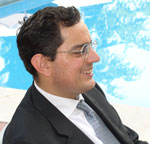
 Marco Bertini
· 4 previous affiliations
- Director · Since 2020
- Researcher · Since 2002
- University of FlorenceSince 1999
- Associate Professor · Since 2015
- Teacher · 2000–2015
- Assistant Professor · 2007–2015
- Ph.D., Computer Science · 2001–2004
- Honors Degree (Laurea), Computer Science · 1999
- Small PixelsSince 2020
- Co-founder · Since 2020
- B4 S.r.l.2000–2007
- IT Consultant · 2000–2007
Research Overview
Marco Bertini focuses on computer vision, multimedia analysis, and visual information retrieval. His early work addressed automatic video annotation and semantic transcoding for sports and broadcast media. More recently, his research investigates multimodal large language models, zero-shot composed image retrieval, and AI-driven video quality improvement, emphasizing the alignment of visual and textual representations.
Research Trajectory
Bertini's early research concentrated on the automatic analysis and annotation of video content. In 2003, he contributed to methods for extracting semantic meaning from sports broadcasts, such as Semantic annotation of soccer videos: automatic highlights identification. Over the following decade, his focus expanded to encompass broader challenges in multimedia retrieval. He collaborated on comprehensive evaluations of image tagging systems, exploring how social media data can be leveraged in the research direction of Bridging the Gap Between Pixels and Semantic Meaning, as detailed in Socializing the Semantic Gap: A Comparative Survey on Image Tag Assignment, Refinement, and Retrieval.
Moving into the deep learning era, his work began addressing specific computer vision challenges across diverse domains. He guided research on Bottom-up and Layerwise Domain Adaptation for Pedestrian Detection in Thermal Images, adapting object detection models to non-visible spectra. Concurrently, he developed real-time solutions for video enhancement. In Fast and effective AI approaches for video quality improvement, he introduced techniques for video super-resolution and compression artifact removal designed to operate as post-processing steps without altering existing transmission pipelines. This period also marked his increasing engagement with vision-language models, contributing to Conditioned and composed image retrieval combining and partially fine-tuning CLIP-based features.
In 2023, he provided a foundational overview of Content-based image retrieval while continuing to advance video restoration techniques. He oversaw work on Optimization Techniques of Deep Learning Models for Visual Quality Improvement, which investigated post-training quantization to reduce the computational complexity and memory footprint of super-resolution models without sacrificing performance.
His recent trajectory reflects a strong emphasis on multimodal alignment and complex visual understanding. He led the development of QualiCLIP, a self-supervised approach that aligns image and text representations to measure image quality without relying on human-annotated scores, contributing to the broader area of Semantic Alignment for Visual Quality Assessment in Quality-Aware Image-Text Alignment for Real-World Image Quality Assessment. He also directed the application of Multi-modal Large Language Models (MLLMs) to domain-specific visual question answering, as seen in Context-aware chatbot using MLLMs for Cultural Heritage. Expanding the scope of visual analysis to narrative media, he introduced CoMix: A Comprehensive Benchmark for Multi-Task Comic Understanding, a dataset designed to test AI models on complex tasks like character naming and dialogue generation across diverse artistic styles.
Most recently, his work has probed the internal mechanics and limitations of contrastive vision-language models. He participated in research exposing intra-modal misalignment in CLIP architectures, demonstrating in Cross the Gap: Exposing the Intra-modal Misalignment in CLIP via Modality Inversion that modality inversion can significantly improve retrieval performance. He has also continued to refine composed retrieval methods, contributing to iSEARLE: Improving Textual Inversion for Zero-Shot Composed Image Retrieval.
Current Directions
Recent work investigates the capabilities and limitations of Multi-modal Large Language Models (MLLMs) and contrastive vision-language architectures like CLIP. The most recent papers in the evidence address the challenge of zero-shot composed image retrieval and expose fundamental intra-modal misalignments within existing multimodal models. Additionally, this current research explores complex, narrative-driven visual understanding—such as analyzing character consistency and dialogue in comics—and applies MLLMs to domain-specific tasks like cultural heritage chatbots and self-supervised image quality assessment.
Profile updated
Loading new papers…
Other researchers whose papers cluster into the same research directions — a proxy for overlapping technical interests and shared intellectual neighborhoods.
See something wrong? Report a mistake