

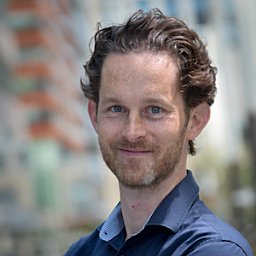
 Marcel van Gerven
· 5 previous affiliations
- Professor of Artificial Cognitive Systems · Since 2017
- Associate Professor · 2016–2017
- Postdoctoral Researcher · 2007–2009
- Machine2Learn2018–2023
- Chief Scientific Officer · 2018–2023
- Donders Centre for Cognition, Cognitive Artificial Intelligence2010–2017
- Assistant Professor · 2010–2017
- Institute for Computing and Information Sciences2009–2010
- Senior Postdoctoral Researcher · 2009–2010
- Radboud University Nijmegen1995–2000
- PhD, Artificial Intelligence · 1995–2000
Research Overview
Marcel van Gerven focuses on the computational mechanisms of learning, inference, and control across both natural and artificial cognitive systems. His research bridges machine learning, computational neuroscience, and dynamical systems to understand how biological brains process information. Recently, his work emphasizes neuromorphic intelligence, leveraging intrinsic noise and biologically plausible algorithms to develop more capable and efficient artificial intelligence solutions.
Research Trajectory
Van Gerven’s research trajectory is deeply rooted in understanding the computational mechanisms of the human brain, particularly in the research direction of Neural Reinstatement of Perceptual Patterns in Mental Imagery. His group has extensively investigated the relationship between visual perception and mental imagery. In Vividness of visual imagery depends on the neural overlap with perception in visual areas, he and his collaborators demonstrated that the moment-to-moment vividness of mental imagery relies on a broad network of brain areas and correlates with neural overlap in the visual system. Expanding on the temporal aspects of these processes, Differential temporal dynamics during visual imagery and perception utilized magnetoencephalography to reveal that imagery activates visual representations simultaneously, rather than in the distinct processing stages characteristic of perception. Further clarifying these mechanisms, Neural dynamics of perceptual inference and its reversal during imagery provided direct evidence that mental imagery involves a reversal of the typical feed-forward flow of information, while also showing that perception itself incorporates oscillatory feedback patterns. This foundational work in neuroscience naturally extends into broader areas such as Neural Decoding through Generative Latent Space Alignment and Universal Neural Decoding Across Idiosyncratic Brains.
Building on these biological insights, a major theme of van Gerven’s work is bridging natural and artificial systems, contributing significantly to the area of Representational Alignment of Artificial and Biological Neural Networks and the related direction of Aligning Deep Network Layers with Biological Sensory Hierarchies. He has proposed unifying theoretical frameworks to connect biological learning with machine learning optimization. In A Unified Perspective on Optimization in Machine Learning and Neuroscience: From Gradient Descent to Neural Adaptation, he explored how biological systems might rely on zeroth-order optimization, utilizing intrinsic neural noise for exploration rather than explicit gradients. This concept is formalized in Neuromorphic Intelligence, which frames intelligence through Dynamical Systems Theory and demonstrates how noise can be harnessed for learning. Translating this theory into algorithmic practice, his lab developed a biologically inspired approach in Noise-based reward-modulated learning. This algorithm uses local updates and global reward signals to train deep networks, offering a pathway to energy-efficient AI. He further demonstrated the physical viability of this approach in Noise-based local learning using stochastic magnetic tunnel junctions, showing how intrinsic device noise in neuromorphic hardware can be repurposed as a fundamental feature for learning. This line of inquiry also touches upon the broader area of Geometry and Complexity of Convolutional Optimization Landscapes. Advancing backpropagation-free learning strategies, van Gerven co-developed BLANP: Memory-Efficient Backpropagation-Free Local Training via Antithetic Node Perturbation, an approach using layer-local zeroth-order antithetic perturbation to remove inter-layer gradient propagation while bounding memory footprint. Furthermore, in An Educated Guess: Deriving Statistically Aligned Gradient Estimates for Zeroth-Order Optimization, van Gerven contributed to a spectral zeroth-order framework that samples search directions informed by forward-pass activation geometry to mitigate the curse of dimensionality on alternative hardware substrates.
Beyond theoretical frameworks, van Gerven applies advanced computational modeling to clinical, sensory, and complex physical systems. In the domain of sensory prosthetics, his research addresses the gap between raw sensor data and human perception. Point-SPV: end-to-end enhancement of object recognition in simulated prosthetic vision using synthetic viewing points introduced a deep learning framework that optimizes the conversion of images into phosphenes, significantly improving object discrimination for prosthetic vision users. Similarly, in auditory processing, Leveraging spatial cues from cochlear implant microphones to efficiently enhance speech separation in naturalistic listening scenes demonstrated that utilizing inter-channel phase differences can drastically improve speech separation in reverberant environments, even under simulated cochlear implant degradation. Extending spatial auditory modeling to self-supervised learning, van Gerven also helped introduce AudioSphere: Towards Self-Supervised Spatial Audio Representation Models, a multichannel masked autoencoder that learns joint acoustic and directional representations from Ambisonics for both frame-level localization and clip-level recognition tasks.
His methodological contributions also extend to clinical forecasting and large-scale simulation. Generative Modeling of Clinical Time Series via Latent Stochastic Differential Equations presented a framework for predicting patient health trajectories that explicitly models continuous-time stochasticity, improving uncertainty quantification for sparse data. To support massive-scale simulations, he contributed to Abmax: A JAX-based Agent-based Modeling Framework, which leverages GPU acceleration to overcome static shape limitations in agent-based modeling. Finally, his expertise in optimization has been applied to industrial challenges, such as in Automated Discovery of Laser Dicing Processes with Bayesian Optimization for Semiconductor Manufacturing, which utilized high-dimensional Bayesian optimization to automate and accelerate semiconductor production while maintaining material integrity.
Current Directions
Recent work investigates the intersection of biological plausibility and artificial intelligence, with a strong emphasis on neuromorphic computing and sensory augmentation. The most recent papers in the evidence address how intrinsic noise—often considered a limitation in traditional hardware—can be harnessed as a computational resource for learning and optimization in artificial systems. This includes developing biologically inspired algorithms that utilize local updates and stochasticity to train deep networks efficiently, alongside backpropagation-free and zeroth-order optimization methods for non-traditional hardware. Concurrently, ongoing research focuses on applying advanced generative models and deep learning frameworks to improve assistive technologies, such as enhancing speech separation for cochlear implants, self-supervised spatial audio representation, and optimizing object recognition in simulated prosthetic vision. Across these domains, the overarching theme is the translation of dynamical systems theory and computational neuroscience into robust, energy-efficient AI solutions.
Profile updated
Loading new papers…
Other researchers whose papers cluster into the same research directions — a proxy for overlapping technical interests and shared intellectual neighborhoods.
See something wrong? Report a mistake