

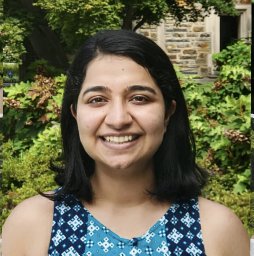
 Manya Wadhwa
· 6 previous affiliations
- New York UniversitySince 2025
- Graduate Research Assistant · Since 2025
- Salesforce (United States)Since 2026
- AI Research Intern · Since 2026
- The University of Texas at Austin2022–2025
- Graduate Research Assistant · 2022–2025
- Doctor of Philosophy - PhD, Computer Science · 2022
- Research Intern · 2024
- Goldman Sachs (United States)2019–2022
- Associate - NLP Research Engineer · 2021–2022
- Analyst - NLP Research Engineer · 2019–2020
- Johns Hopkins University2017–2019
- MS student · 2017–2019
- Master of Science - MS, Computer Science
Research Overview
Manya Wadhwa focuses on natural language processing, the evaluation of large language models, and computational methods for reasoning and self-correction. Her early work addressed applied machine learning in computer vision and information retrieval, before shifting toward the systematic assessment of language model outputs. Currently, she investigates how models utilize extended reasoning and cognitive behaviors to solve complex, creative tasks.
Research Trajectory
Wadhwa’s early research focused on applied machine learning in computer vision and medical imaging. She collaborated on developing deep belief network approaches for isolating and analyzing immature white blood cells in Overlapping cell nuclei segmentation in microscopic images using deep belief networks. Following this, she led work on emotion prediction in group settings. By converting individual facial expressions into spatial distributions, she developed models that outperformed standard baselines trained on raw images in Group Affect Prediction Using Emotion Heatmaps and Scene Information. This work contributed to areas such as restoring spatial context to multiple instance learning and robust affective behavior analysis in the wild.
Transitioning toward natural language processing and information retrieval, Wadhwa addressed the challenge of analyzing massive volumes of unstructured government data. She developed an automated system to map public comments to specific agency questions in Aligning Public Feedback to Requests for Comments on Regulations.gov. By leveraging fine-tuned semantic similarity techniques, this research advanced the broader area of mining actionable insights from unstructured feedback.
A major focus of Wadhwa’s recent trajectory involves the evaluation and refinement of large language models (LLMs). She introduced frameworks for LLM self-correction in Learning to Refine with Fine-Grained Natural Language Feedback. This work decomposed the refinement process into distinct competencies—detecting poor generations, generating natural language critiques, and applying fine-grained feedback—advancing the research direction of Sequential Decomposition of Text Error Correction alongside reasoning before repairing in language models. In parallel, she explored how to better capture human subjectivity in AI evaluation. She proposed Explanation-Based Rescaling (EBR) in Using Natural Language Explanations to Rescale Human Judgments, a method that uses LLMs to convert coarse Likert-scale judgments into fine-grained numerical scores based on annotator rationale. This contributed significantly to the area of Evaluating Generative AI with Large Language Models.
Continuing her focus on evaluation methodologies, Wadhwa developed automated systems to mine task-specific evaluation criteria from expert web advice in EvalAgents: Discovering Implicit Evaluation Criteria from the Web, supporting modular multi-stage inference for large language models. With collaborators, she also investigated the vulnerabilities of LLM-based evaluation protocols. In Pairwise or Pointwise? Evaluating Feedback Protocols for Bias in LLM-Based Evaluation, the research demonstrated that pairwise comparisons are highly susceptible to superficial stylistic biases compared to absolute scoring, advancing work in mitigating systematic biases in LLM-as-a-judge.
Wadhwa’s most recent work examines the boundaries of extended reasoning and multimodal capabilities. She participated in the creation of a synthetic benchmark to test the integration of textual and visual reasoning in ChartMuseum: Testing Visual Reasoning Capabilities of Large Vision-Language Models. She also collaborated on a critical analysis of prompting strategies in To CoT or not to CoT? Chain-of-thought helps mainly on math and symbolic reasoning. This study revealed that the benefits of Chain-of-Thought are largely confined to mathematical and symbolic logic, informing the research direction of The Domain Dependent Utility of Extended Reasoning. Finally, she explored how smaller models can acquire complex cognitive behaviors—such as verification and strategic retrying—through self-distillation from frontier models in SkillFactory: Self-Distillation for Learning Cognitive Behaviors. This research touches on several advanced areas, including Mitigating the Cold Start Problem in Reinforcement Learning and staged policy refinement for agentic reasoning.
Current Directions
The most recent papers in the evidence address the cognitive behaviors and reasoning capabilities of large language models. Recent work investigates how models can acquire complex skills—such as self-correction, verification, and strategic retrying—through self-distillation from larger frontier models. Additionally, ongoing research explores the boundaries of extended reasoning techniques, analyzing where methods like Chain-of-Thought prompting provide tangible benefits versus where they merely increase inference costs without improving performance on soft reasoning tasks. Finally, recent collaborations examine the integration of textual and visual reasoning, testing the limits of large vision-language models on complex, multimodal evaluation benchmarks.
Profile updated
Loading new papers…
Other researchers whose papers cluster into the same research directions — a proxy for overlapping technical interests and shared intellectual neighborhoods.
See something wrong? Report a mistake