

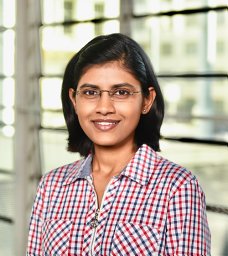
 Maitreyee Wairagkar
· 6 previous affiliations
- Deloitte (United States)Since 2022
- Project Scientist · Since 2025
- Postdoc · 2022–2025
- University of California, DavisSince 2022
- Project Scientist - Speech Neuroprosthesis · Since 2025
- Postdoctoral Scholar - Neuroengineering and BCI · 2022–2025
- Imperial College London2019–2022
- Postdoctoral Researcher - Affective Robotics · 2019–2022
- MedTech SuperConnector2019
- Team Lead – BrainBot project, MedTech SuperConnector Accelerator™ · 2019
- University of Reading2010–2019
- Research Assistant - Neural Rehabilitation technologies · 2015–2019
- PhD Researcher in Cybernetics - Brain Computer Interfaces · 2014–2019
- Research Assistant - Sensor Platform for Healthcare in a Residential Environment (SPHERE) project · 2016–2017
- MEng in Artificial Intelligence and Cybernetics · 2010–2014
- Research Fellow - Sensor Platform for Healthcare in a Residential Environment (SPHERE) project · 2018
Research Overview
Maitreyee Wairagkar focuses on brain-computer interfaces, speech neuroprosthetics, and socially assistive robotics. Her early work explored affective human-robot interaction and in-home monitoring technologies for aging and dementia support. More recently, she has shifted toward developing intracortical neural decoding systems to restore communication for individuals with severe speech impairments.
Research Trajectory
Maitreyee Wairagkar’s research trajectory demonstrates a distinct evolution from socially assistive robotics and ambient health monitoring toward advanced intracortical brain-computer interfaces (BCIs). Her earlier work primarily addressed the design and clinical application of robotic and Internet of Things (IoT) systems to support older adults and individuals living with dementia.
As a lead author, Wairagkar developed novel hardware and interaction paradigms for affective computing. This is exemplified by Emotive Response to a Hybrid-Face Robot and Translation to Consumer Social Robots, where she detailed the conceptualization, fabrication, and control of an IoT-enabled social robot. The project centered on a humanoid hybrid face that combined a rigid 3D-printed faceplate with a digital display, allowing the robot to convey complex facial movements and three-dimensional depth. The research mapped specific facial feature parameters to archetypal expressions and introduced pupil dilation as an additional degree of freedom for conveying emotion during human-robot interaction.
Alongside hardware design, Wairagkar contributed to synthesizing the broader landscape of assistive robotics. As the second author of Conversational Affective Social Robots for Ageing and Dementia Support, she helped review two decades of design trends in socially assistive robots (SAR). This work highlighted the necessity of conversational abilities and affective engagement for long-term user trust, while noting that clinical translation and robust patient benefit remained open challenges in the field.
During this period, Wairagkar also participated in larger collaborative efforts utilizing in-home sensing to monitor vulnerable populations. She contributed to An attention model to analyse the risk of agitation and urinary tract infections in people with dementia, which utilized machine learning models to integrate sensor data for the early detection of clinically significant events, aiming to reduce unplanned hospital admissions. Similarly, she was part of the research team for Discovering Behavioral Patterns Using Conversational Technology for In-Home Health and Well-Being Monitoring, an infrastructure project that fused environmental IoT data with voice interactions from conversational agents to identify behavioral patterns in households of people living with dementia.
By 2023, Wairagkar’s primary research focus transitioned to neuroprosthetics, specifically the decoding of neural activity to restore speech for individuals with severe motor impairments, such as those caused by brain injury or amyotrophic lateral sclerosis (ALS). Leading this new direction, she authored Synthesizing Speech by Decoding Intracortical Neural Activity from Dorsal Motor Cortex. This research addressed the limitations of existing point-and-click or handwriting BCIs, which are often slower than natural speech and lack expressive range. The work focused on translating speech-related neural patterns directly into a computer-synthesized voice, pushing toward more intuitive and rapid communication interfaces.
This focus on high-performance speech decoding culminated in her role as the second author on An Accurate and Rapidly Calibrating Speech Neuroprosthesis. This clinical study involved a patient with ALS and severe dysarthria who was implanted with microelectrode arrays in the left ventral precentral gyrus. The research demonstrated the ability to decode cortical neural activity associated with attempted speech directly into text on a screen, addressing historical BCI limitations regarding extensive training requirements and low accuracy.
Current Directions
The most recent papers in the evidence indicate that Wairagkar’s current research is heavily concentrated on clinical brain-computer interfaces and speech neuroprosthetics. Her work addresses the technical and practical barriers to deploying intracortical BCIs for individuals with severe paralysis and dysarthria.
A major theme in this recent work is the improvement of decoding accuracy and the reduction of calibration time for neural implants. By utilizing microelectrode arrays implanted in speech-motor regions of the brain, such as the ventral precentral gyrus and dorsal motor cortex, her research investigates how to reliably capture and translate attempted speech signals. The ultimate goal of these current directions is to bypass traditional, slow augmentative communication methods, replacing them with systems that can rapidly decode neural activity into either real-time text or highly intelligible synthesized speech.
Profile updated
| Title | Venue | Year |
|---|---|---|
| An Accurate and Rapidly Calibrating Speech Neuroprosthesis | New | 2024 |
| Discovering Behavioral Patterns Using Conversational Technology for In-Home Health and Well-Being Monitoring | IEEE Internet of Things Journal | 2023 |
| Synthesizing Speech by Decoding Intracortical Neural Activity from Dorsal Motor Cortex | Ner | 2023 |
| Conversational Affective Social Robots for Ageing and Dementia Support | IEEE Trans. Cogn. Dev. Syst | 2022 |
| Emotive Response to a Hybrid-Face Robot and Translation to Consumer Social Robots | IEEE Internet of Things Journal | 2022 |
| An attention model to analyse the risk of agitation and urinary tract infections in people with dementia | arXiv | 2021 |
| Emotive Response to a Hybrid-Face Robot and Translation to Consumer Social Robots | arXiv | 2020 |
Loading new papers…
Other researchers whose papers cluster into the same research directions — a proxy for overlapping technical interests and shared intellectual neighborhoods.
See something wrong? Report a mistake