

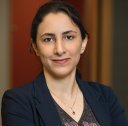
 Mahsa Shoaran
· 7 previous affiliations
- Cornell UniversitySince 2017
- Assistant Professor · Since 2017
- CICCSince 2018
- TPC Member · Since 2018
- ISSCCSince 2022
- TPC Member · Since 2022
- École Polytechnique Fédérale de LausanneSince 2020
- Associate Professor · Since 2025
- Assistant Professor · 2020–2025
- Doctor of Philosophy (Ph.D.), Electrical Engineering · 2011–2014
- Cornell Tech2017–2020
- Assistant Professor · 2017–2020
- California Institute of Technology2015–2017
- Postdoctoral Fellow · 2015–2017
- Sharif University of Technology2008–2010
- Master of Science (MSc), Integrated Circuit Design · 2008–2010
Research Overview
Mahsa Shoaran focuses on integrated circuit design, machine learning, and neurotechnology to develop diagnostic and therapeutic devices for neurological disorders. Her trajectory spans from early low-power cortical recording architectures to advanced system-on-chips for closed-loop neuromodulation. Currently, she investigates miniaturized brain-machine interfaces and hardware-efficient neural decoding models for real-time, on-implant processing.
Research Trajectory
Shoaran’s early research addressed the stringent hardware constraints of multichannel neural data acquisition. She introduced an area- and power-efficient approach for the compressive recording of cortical signals in Compact Low-Power Cortical Recording Architecture for Compressive Multichannel Data Acquisition, mitigating the hardware intensity typically associated with sub-Nyquist sampling. Building on these low-power design principles, she subsequently developed a complete system-on-chip (SoC) for seizure detection and control. The resulting A 16-channel 1.1mmimplantable seizure control SoC with sub-μW/channel consumption and closed-loop stimulation in 0.18µm CMOS demonstrated early detection and termination of seizures in animal models while drastically reducing the power-area product per channel.
As the field of neurotechnology advanced, her focus expanded to integrate machine learning directly into neural implants, reducing the reliance on external computation. She outlined this paradigm shift in Closed-Loop Neural Prostheses With On-Chip Intelligence: A Review and a Low-Latency Machine Learning Model for Brain State Detection, emphasizing the need for rapid symptom detection and on-site signal processing. This vision was realized in hardware with NeuralTree: A 256-Channel 0.227-μJ/Class Versatile Neural Activity Classification and Closed-Loop Neuromodulation SoC, a highly scalable closed-loop interface featuring a 256-channel front end designed to extract high-resolution neural biomarkers for disease-state detection. Concurrently, she contributed to foundational machine learning architectures that prioritize lightweight, interpretable decision processes, such as the framework presented in Tree in Tree: from Decision Trees to Decision Graphs, which recursively grows decision trees to form compact directed acyclic graphs.
Her work in machine learning architectures also extended to the broader area of Tabular Foundation Models for Heterogeneous Data. In XTab: Cross-table Pretraining for Tabular Transformers, her group proposed a federated learning framework that enables cross-table pretraining, allowing models to learn structural patterns across diverse datasets. This research contributes significantly to the emerging field of Foundation Models for Heterogeneous Tabular Data, providing powerful weight initializations for deep learning models on unseen tasks.
Returning to neurotechnology, Shoaran synthesized the state of the field in Intelligent Neural Interfaces: An Emerging Era in Neurotechnology, charting the transition from raw data acquisition to systems featuring on-implant AI. This work aligns with her broader contributions to the research direction of Energy Efficient Computing for Implantable Neural Prosthetics. To support the massive data requirements of modern implants, she developed high-throughput wireless solutions, such as the body channel communication system detailed in A 49.8mmFully Integrated, 1.5m Transmission-Range, High-Data-Rate IR-UWB Transmitter for Brain Implants, advancing the area of On-Chip Processing for High-Bandwidth Wireless Neural Interfaces.
In parallel, her lab produced several highly specialized, hardware-efficient decoding models. For epilepsy management, she introduced REST: Efficient and Accelerated EEG Seizure Analysis through Residual State Updates, an ultra-lightweight graph-based model designed to fit within a minimal memory footprint for real-time alerts. For motor restoration, she developed A Hardware-Efficient EMG Decoder with an Attractor-based Neural Network for Next-Generation Hand Prostheses, balancing portability with the high decoding accuracy needed for multi-finger robotic control. Pushing the boundaries of brain-machine interfaces (BMIs), her team presented 33.3 MiBMI: A 192/512-Channel 2.46mm² Miniaturized Brain-Machine Interface Chipset Enabling 31-Class Brain-to-Text Conversion Through Distinctive Neural Codes, demonstrating the feasibility of on-chip decoding for complex tasks like attempted handwriting prediction without relying on bulky benchtop computers.
Most recently, Shoaran's research has focused on refining neural decoding accuracy and model compression for permanent implantation. In the domain of Mitigating Neural Signal Non-Stationarity in Brain-Computer Interfaces, she co-authored BiND: A Neural Discriminator-Decoder for Accurate Bimanual Trajectory Prediction in Brain-Computer Interfaces, a two-stage architecture that improves the robustness of decoding two-handed movements. She also continued to optimize seizure detection algorithms with MT-NAM: An Efficient and Adaptive Model for Epileptic Seizure Detection, utilizing a distilled Neural Additive Model to drastically improve inference speed. To bring large-scale neural foundation models to power-constrained devices, she directed the development of BrainDistill: Implantable ECoG-based Motor Decoding with Task-Specific Knowledge Distillation, successfully compressing a high-parameter model into a microwatt-scale decoder. Finally, addressing the challenge of Universal Neural Decoding Across Idiosyncratic Brains, she contributed to RECTOR: Masked Region-Channel-Temporal Modeling for Affective and Cognitive Representation Learning, a self-supervised framework that groups sensors into adaptive functional regions, moving beyond rigid anatomical maps to improve robustness across different electrode layouts.
Current Directions
The most recent papers in the evidence, spanning 2025 and 2026, indicate a strong focus on advanced model compression and robust neural decoding for next-generation brain-computer interfaces. Current work investigates techniques such as task-specific knowledge distillation to deploy massive neural foundation models onto power-constrained, implantable devices safely. Additionally, recent research addresses the need for adaptive, self-supervised representation learning that can generalize across different subjects and electrode layouts, moving away from rigid anatomical mapping to improve the clinical viability of affective and cognitive brain-state decoding.
Profile updated
| Paper | Venue | Year |
|---|---|---|
| Tree in Tree: from Decision Trees to Decision GraphsGitHubBingzhaoZhu/ | NeurIPS | 2021 |
Loading new papers…
Other researchers whose papers cluster into the same research directions — a proxy for overlapping technical interests and shared intellectual neighborhoods.
See something wrong? Report a mistake