

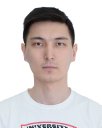
 Magauiya Zhussip
· 6 previous affiliations
- MTS AISince 2024
- Researcher · Since 2024
- Huawei Technologies (China)2020–2024
- Research Engineer · 2020–2024
- ST Unitas2019–2020
- AI Researcher · 2019–2020
- Graduate Research Assistant · 2017–2019
- Nazarbayev University2012–2017
- Undergrad student · 2012–2017
- Summer Research Intern · 2016
Research Overview
Magauiya Zhussip focuses on efficient machine learning, with specific emphasis on self-supervised signal restoration and the compression of large-scale foundation models. His early research developed unsupervised frameworks for image denoising and compressive sensing using statistical risk estimators. More recently, his work addresses the computational bottlenecks of large language models and generative architectures through advanced pruning, sparse dictionary learning, and state-space models.
Research Trajectory
Zhussip's early research addressed ill-posed inverse problems in computational imaging, specifically focusing on the area of Self-Supervised Medical Image Reconstruction without Ground Truth. He developed unsupervised frameworks capable of training deep neural networks directly from undersampled data. In Simultaneous compressive image recovery and deep denoiser learning from undersampled measurements, he combined Denoiser-based Approximate Message Passing (D-AMP) with Stein’s Unbiased Risk Estimator (SURE) to achieve compressive sensing recovery without clean target images, contributing to the broader direction of Noise-Aware Conditioning for Flexible Signal Restoration. He expanded on this data-driven regularization in Training Deep Learning Based Image Denoisers From Undersampled Measurements Without Ground Truth and Without Image Prior., demonstrating how to bypass the need for hand-crafted image priors.
To further advance work in the field of Self-Supervised Image Restoration Without Clean Ground Truth, he proposed an extended version of SURE (eSURE). In Extending Stein's unbiased risk estimator to train deep denoisers with correlated pairs of noisy images, he demonstrated how to leverage multiple correlated noise realizations per image, improving upon standard SURE which utilizes only a single realization. He provided further theoretical grounding for this approach in Theoretical analysis on Noise2Noise using Stein's Unbiased Risk Estimator for Gaussian denoising: Towards unsupervised training with clipped noisy images, advancing the area of Blind Risk Estimation for Robust Signal Recovery.
Transitioning to generative approaches for imaging, Zhussip investigated the computational bottlenecks of diffusion models. In A Modular Conditional Diffusion Framework for Image Reconstruction, he introduced a lightweight, plug-and-play module that adapts existing restoration networks for new tasks, significantly reducing inference time while maintaining image quality.
More recently, his focus has shifted toward the efficiency and deployment of large language models (LLMs). He has actively contributed to the research direction of Task-Aware Pruning for Specialized Model Compression. With collaborators, he participated in the development of training-free depth pruning techniques, detailed in ReplaceMe: Network Simplification via Depth Pruning and Transformer Block Linearization and ReplaceMe: Network Simplification via Layer Pruning and Linear Transformations. These methods approximate pruned transformer blocks with linear transformations calibrated on small datasets, avoiding the expensive fine-tuning typically required to heal structured pruning.
Expanding on model compression, he also explored alternatives to standard low-rank weight approximation. In COSPADI: Compressing LLMs via Calibration-Guided Sparse Dictionary Learning, he helped design a training-free framework that uses structured sparse factorization to compress weight matrices, a technique relevant to the area of Minimizing Layer Output Error for Low Bit Quantization. Building on the concept of dictionary learning, he subsequently introduced a framework for inter-block redundancy in Share Your Attention: Transformer Weight Sharing via Matrix-based Dictionary Learning, which decomposes attention projection matrices into shared atoms to drastically reduce parameter counts.
Beyond text and image modalities, Zhussip has applied efficient architectural paradigms to audio synthesis. In Speak, Edit, Repeat: High-Fidelity Voice Editing and Zero-Shot TTS with Cross-Attentive Mamba, he developed an autoregressive model that replaces standard self-attention with linear-time Mamba state-space models. By integrating cross-attention for text-to-audio alignment, this work achieves high-fidelity speech editing and zero-shot text-to-speech with a fraction of the memory footprint of traditional transformer-based approaches.
Current Directions
The most recent papers in the evidence indicate a strong focus on the computational efficiency of foundation models. A primary current direction involves post-training compression techniques for large language models, specifically exploring training-free structured pruning, sparse dictionary learning, and cross-layer weight sharing to reduce memory and parameter footprints without extensive fine-tuning. Concurrently, recent work investigates alternative architectures for generative tasks, such as leveraging linear-time state-space models (like Mamba) to replace memory-intensive self-attention in high-fidelity audio synthesis and voice editing.
Profile updated
Loading new papers…
Other researchers whose papers cluster into the same research directions — a proxy for overlapping technical interests and shared intellectual neighborhoods.
See something wrong? Report a mistake