

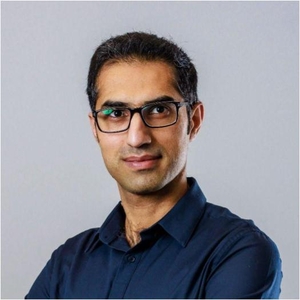
 M. Usman Rafique
· 7 previous affiliations
- ZooxSince 2025
- Senior Software Engineer · Since 2025
- Bastian Solutions2023–2025
- Researcher · 2023–2025
- Kitware Inc.2021–2023
- Senior Research And Development Engineer · 2021–2023
- Kitware (United States)2021–2023
- Researcher · 2021–2023
- University of Kentucky2016–2021
- Graduate Research And Teaching Assistant · 2016–2021
- Hong Kong Polytechnic University2015–2016
- Research Assistant · 2015–2016
- Master's degree, Mechatronics, Robotics, and Automation Engineering · 2008–2010
Research Overview
M. Usman Rafique focuses on computer vision and image synthesis, with specific research interests in medical imaging, geospatial analysis, and generative modeling. His work explores the development of efficient architectures for high-dimensional data and the integration of multi-modal imagery to improve scene understanding and conditional image generation.
Research Trajectory
Rafique’s research trajectory demonstrates a transition from specialized medical imaging applications toward broader problems in generative computer vision and multi-modal geospatial sensing. In 2020, his work contributed to the optimization of 3D medical data processing, specifically addressing the computational bottlenecks of 3D convolutional neural networks (CNNs) in the context of neuroimaging. By 2022, his focus shifted toward the synthesis of outdoor environments and the fusion of disparate visual perspectives—overhead and ground-level—to enhance semantic understanding of geographic spaces. This evolution reflects a consistent interest in improving model efficiency and leveraging auxiliary data sources to enhance classification and synthesis tasks.
Representative Work
In the domain of generative modeling, Rafique served as lead author for Unifying Guided and Unguided Outdoor Image Synthesis. This research addresses the challenge of generating diverse, realistic images of a scene under varying environmental conditions, such as changes in season, weather, or time of day. The work introduces a probabilistic framework capable of handling both unguided synthesis (where the model generates realistic conditions based on a source layout) and guided synthesis (where conditions are derived from a specific reference image). By formulating these as separate but related distributions, the approach ensures that synthesized images maintain the layout of the source while accurately reflecting the desired environmental conditions.
In geospatial vision, Rafique contributed as a second author to Revisiting Near/Remote Sensing with Geospatial Attention. This research investigates "near/remote sensing," a technique that performs joint inference over overhead imagery and ground-level photographs to improve segmentation accuracy. The core contribution is a geometry-aware attention mechanism that explicitly models the spatial relationship between pixels in ground-level views and their corresponding geographic locations in overhead maps. This approach incorporates both geometric features and the visual appearance of the multi-modal imagery to refine the feature extraction process.
Earlier in his trajectory, Rafique participated in research regarding efficient diagnostic tools for Alzheimer’s disease. In Dynamic Image for 3D MRI image Alzheimer’s Disease classification, he was part of a team that applied dynamic image technology to compress 3D MRI volumes into 2D representations. This method allowed for the use of 2D CNN architectures, which are significantly less computationally expensive than their 3D counterparts. The study demonstrated that this proposed model achieved a 9.5% improvement in classification accuracy over baseline 3D models while requiring only 20% of the training time.
Profile updated
| Title | Venue | Year |
|---|---|---|
| Unifying Guided and Unguided Outdoor Image Synthesis | Workshops @ CVPR | 2021 |
| Dynamic Image for 3D MRI image Alzheimer’s Disease classification | BIC @ ECCV | 2020 |
Loading new papers…
Other researchers whose papers cluster into the same research directions — a proxy for overlapping technical interests and shared intellectual neighborhoods.
See something wrong? Report a mistake