

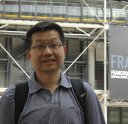
 Luke Ong
· 2 previous affiliations
- Nanyang Technological UniversitySince 2022
- Full Professor · Since 2022
- University of Oxford1994–2022
- Full Professor · 1994–2022
Research Overview
Luke Ong focuses on the semantics of programming languages, the formal verification of higher-order systems, and probabilistic programming. His early foundational work established game-semantic models for functional computation and advanced the model checking of infinite-state systems. More recently, his research addresses safe reinforcement learning, exact Bayesian inference, and the automated verification of neural network-controlled systems.
Research Trajectory
The early phase of the research trajectory centered on the model theory and proof theory of functional programming languages. In 1988, he introduced a formal system and a general method for constructing models of lazy languages in Fully Abstract Models of the Lazy Lambda Calculus, ensuring that the theoretical semantics aligned with practical evaluation strategies. This foundational work on semantics subsequently expanded to encompass control structures, as detailed in A Curry-Howard Foundation for Functional Computation with Control (1997). A significant development during this period was the application of innocent game semantics, which culminated in the comprehensive study On Full Abstraction for PCF: I, II, and III (2000), addressing long-standing questions regarding the full abstraction of PCF.
Building upon game semantics, the focus shifted toward the automated verification of infinite-state systems and higher-order programs. He established that the modal mu-calculus model-checking problem for trees generated by order-n recursion schemes is n-EXPTIME complete in On Model-Checking Trees Generated by Higher-Order Recursion Schemes (2006). This catalyzed deeper investigations into the area of Verifying Higher Order Recursion and Infinite State Systems. With collaborators, he demonstrated that collapsible pushdown automata are equi-expressive with recursion schemes as generators of ranked trees in Collapsible Pushdown Automata and Recursion Schemes (2008). Concurrently, he explored syntactic restrictions designed to simplify reduction, introducing a variant of the simply-typed lambda calculus in The Safe Lambda Calculus (2007). This work contributed directly to the research direction of Structural Constraints for Capture-Free Substitution and the broader field of Formalizing Capture-Avoiding Substitution. He continued to advance the verification of functional programs by extending these techniques to handle pattern-matching algebraic data types in Verifying higher-order functional programs with pattern-matching algebraic data types (2011), aligning with the area of Verifying Higher-Order Programs via First-Order Reductions.
In the following decade, the trajectory expanded to encompass probabilistic computation and inference. He addressed the challenge of proving termination for programs with continuous distributions in On probabilistic termination of functional programs with continuous distributions (2021), contributing to the research direction of Almost-Sure Termination for Probabilistic Program Inference and Verification. His work in probabilistic programming also tackled the computational expense of Bayesian inference; he guided the development of exact analytical solutions for discrete models using probability generating functions in Exact Bayesian Inference on Discrete Models via Probability Generating Functions: A Probabilistic Programming Approach (2023). Further exploring the semantics of universal probabilistic programming, he investigated how these systems handle branching logic and stochastic support in Beyond Bayesian Model Averaging over Paths in Probabilistic Programs with Stochastic Support (2024).
Most recently, the research has integrated formal verification techniques with modern machine learning and control systems. In the domain of reinforcement learning, he oversaw work bridging high-level logical task specifications with standard RL, proving that complex infinite-horizon objectives can be translated into limit-average reward problems in Reinforcement Learning with LTL and $\omega$-Regular Objectives via Optimality-Preserving Translation to Average Rewards (2024). This connects closely to the area of Strategic Reasoning via Automata Theoretic Reductions. He also contributed to hard-constrained reinforcement learning, helping to design an algorithm that dynamically balances safety and reward using trust regions in Safety-Biased Policy Optimisation: Towards Hard-Constrained Reinforcement Learning via Trust Regions (2025).
Expanding into stochastic safety, he formalized a refined framework for verifying finite-time safety and reach-avoid guarantees using polynomial optimization in Refined Barrier Conditions for Finite-Time Safety and Reach-Avoid Guarantees in Stochastic Systems (2025). Parallel efforts addressed the deployment of neural networks in control systems, leveraging proof certificates to verify linear temporal logic and $\omega$-regular properties in Verifying Omega-regular Properties of Neural Network-Controlled Systems via Proof Certificates (2025). Finally, his work has touched upon the automation of formal mathematics itself; in Most of a Formal Proof is Forced (2026), he and his collaborators demonstrated that a vast majority of low-level Lean 4 kernel expressions are deterministic, enabling highly efficient search strategies for language models.
Current Directions
Recent work investigates the intersection of formal verification, reinforcement learning, and automated reasoning. The most recent papers in the evidence address the challenge of ensuring safety and logical correctness in complex, learning-based control systems. This includes developing trust-region optimization methods for hard-constrained reinforcement learning and utilizing proof certificates to verify $\omega$-regular properties in neural network-controlled systems. Additionally, ongoing research explores the structural predictability of formal mathematics, leveraging language models to generate low-level kernel expressions for automated theorem proving. Together, these directions aim to bring rigorous, finite-time safety guarantees and exact inference capabilities to modern artificial intelligence and probabilistic programming environments.
Profile updated
Loading new papers…
Other researchers whose papers cluster into the same research directions — a proxy for overlapping technical interests and shared intellectual neighborhoods.
See something wrong? Report a mistake