

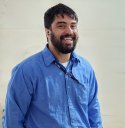
 Luiz Max Carvalho
· 3 previous affiliations
- Fundação Getulio VargasSince 2020
- Lecturer · Since 2020
- University of Edinburgh2014–2018
- PhD student · 2014–2018
- Undergrad student · 2009–2012
Research Overview
Luiz Max Carvalho focuses on Bayesian statistics, computational modeling, and probabilistic machine learning. His early work addressed phylodynamics and sequence simulation in evolutionary biology, before shifting toward foundational problems in Bayesian model combination and inference. His current research investigates generative flow networks and methods for handling unnormalized probability densities in complex distributions.
Research Trajectory
Carvalho’s early research applied computational statistics to biological processes, with a particular emphasis on evolutionary biology and phylodynamics. Serving as the senior author, he developed computational tools to model complex evolutionary scenarios, culminating in πBUSS: a parallel BEAST/BEAGLE utility for sequence simulation under complex evolutionary scenarios (2014). This work provided infrastructure for simulating sequence data, reflecting a foundational interest in the intersection of biology, computational statistics, and software development for statistical inference.
Over time, Carvalho’s focus transitioned toward core methodological challenges in Bayesian machine learning, specifically the combination of predictive distributions. Standard approaches to combining models typically rely on linear density mixtures, which can introduce undesirable traits such as multi-modality. As a co-author, Carvalho addressed these limitations in Locking and Quacking: Stacking Bayesian model predictions by log-pooling and superposition (2023). This research introduced novel non-linear methods for combining Bayesian models, contributing to the research direction of Logarithmic Pooling for Non-Dilutive Model Composition. A key innovation in this work was the use of the Hyvärinen score to optimize model weights without needing to calculate intractable normalizing constants, directly addressing challenges in the broader area of Approximating the Intractable Partition Function.
Most recently, Carvalho has focused on Generative Flow Networks (GFlowNets), a class of models designed to sample from distributions over compositional objects. In 2024, he co-authored Embarrassingly Parallel GFlowNets, which introduced a provably correct "divide-and-conquer" framework for training these models in parallel. By training local models on data shards and merging them via an aggregating balance condition, the framework enables efficient sampling from complex product distributions, such as Bayesian posteriors. This work advances themes such as Neural Sampling and Inference for Unnormalized Densities by minimizing the communication overhead between clients and a central server.
Alongside this methodological development, Carvalho has participated in broader collaborative analyses of flow network architectures. As a contributing author on Analyzing GFlowNets: Stability, Expressiveness, and Assessment (2024), he helped investigate how fluctuations in balance conditions impact model accuracy across state graphs, leading to the proposal of a weighted balance loss designed to accelerate training convergence.
Current Directions
The most recent papers in the evidence address the training, scaling, and evaluation of Generative Flow Networks for complex probabilistic modeling. Recent work investigates how to distribute the training of these models across parallel architectures to efficiently sample from Bayesian posteriors. A central focus of this ongoing research is developing robust sampling mechanisms for unnormalized distributions, ensuring theoretical correctness and stability in the underlying flow networks. This includes analyzing the heterogeneous effects of balance violations across state graphs and designing novel loss functions that tie a node's influence on accuracy to the reward associated with its descendants.
Profile updated
Loading new papers…
Other researchers whose papers cluster into the same research directions — a proxy for overlapping technical interests and shared intellectual neighborhoods.
See something wrong? Report a mistake