

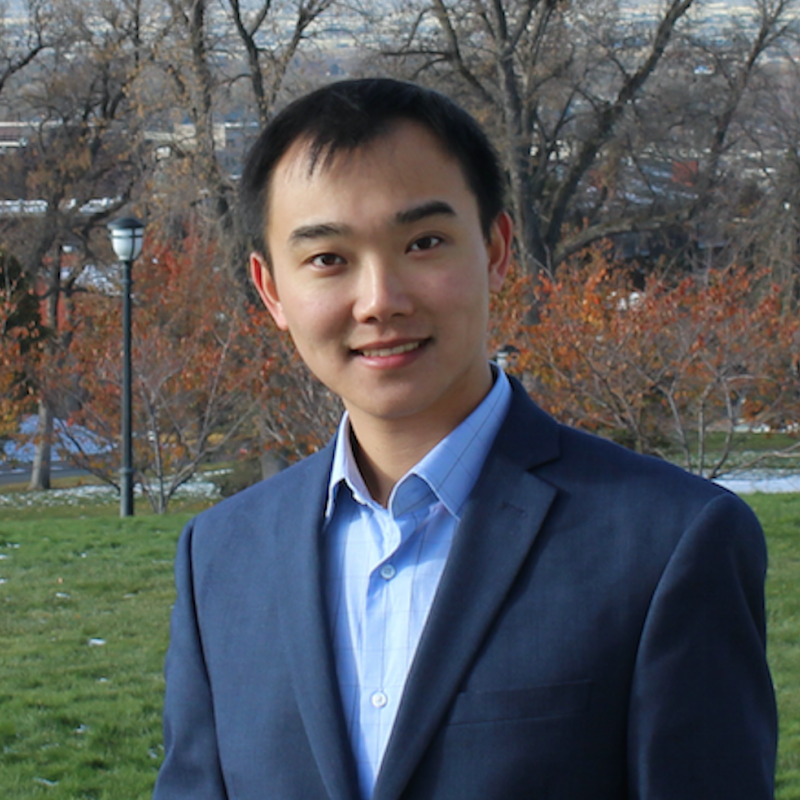
 Luanzheng Guo
· 3 previous affiliations
- Pacific Northwest National LaboratorySince 2020
- Computer Scientist · Since 2020
- University of WashingtonSince 2025
- Affiliate Assistant Professor · Since 2025
- University of California, Merced2015–2020
- PhD student · 2015–2020
Research Overview
Luanzheng Guo focuses on high-performance computing, distributed system fault tolerance, and compiler infrastructure for sparse tensor algebra. Early collaborative research addressed computer vision challenges, while the primary trajectory emphasizes resilience and optimization in large-scale scientific computing environments. The most recent work targets domain-specific languages and multi-level intermediate representations for tensor operations.
Research Trajectory
Luanzheng Guo’s early research involved computer vision and image processing. As a second author, Guo contributed to Indoor frame recovering via line segments refinement and voting (2013), which proposed an iterative voting mechanism to estimate frame structures in complex indoor scenes. This work addressed the challenges of occlusions and weak object boundaries by refining line segments through revising, connecting, and adding operations, ultimately enforcing cross-ratio constraints to build robust structural models.
In subsequent years, the research focus shifted significantly toward high-performance computing (HPC) and distributed systems, specifically addressing the reliability of scientific applications running across thousands of compute nodes. This transition aligns with the broader research direction of Algorithmic Resilience for Exascale and Warehouse Computing. As first author, Guo developed MATCH: An MPI Fault Tolerance Benchmark Suite (2020). This work provided a structured methodology to evaluate and compare different Message Passing Interface (MPI) fault tolerance designs, a critical requirement for safety-critical applications where system failures are statistically inevitable at scale. By enabling applications to efficiently resume from system failures, this benchmarking effort contributes to themes such as Tiered Asynchronous State Persistence for Distributed Systems and the area of Checkpoint-Free Resilience for Large-Scale Distributed Computing, providing the necessary infrastructure to guide the selection of efficient recovery techniques.
Expanding into compiler optimization for scientific computing and machine learning, Guo co-authored A High Performance Sparse Tensor Algebra Compiler in MLIR (2021). As a second author, Guo helped design a domain-specific language (DSL) and compiler framework to automatically generate optimized kernels for mixed sparse-dense tensor operations. This research addressed the performance challenges associated with diverse sparse storage formats and hardware architectures, utilizing multi-level intermediate representations to streamline tensor algebra implementation.
Current Directions
Based on the most recent papers in the evidence from 2021, Guo's work investigates the intersection of compiler infrastructure and high-performance computing. A primary focus is the development of domain-specific languages and multi-level intermediate representations (MLIR) to automate and optimize sparse tensor algebra. By abstracting the complexities of hardware architectures and sparse data formats, this research aims to improve the performance and portability of tensor operations critical to machine learning and data analytics. Additionally, the emphasis on MPI fault tolerance benchmarking indicates a sustained interest in ensuring the reliability and integrity of distributed scientific applications as they scale to exascale environments.
Profile updated
| Paper | Venue | Year |
|---|---|---|
| MATCH: An MPI Fault Tolerance Benchmark SuiteGitHubkakulo/ | arXiv | 2021 |
Loading new papers…
Other researchers whose papers cluster into the same research directions — a proxy for overlapping technical interests and shared intellectual neighborhoods.
See something wrong? Report a mistake