

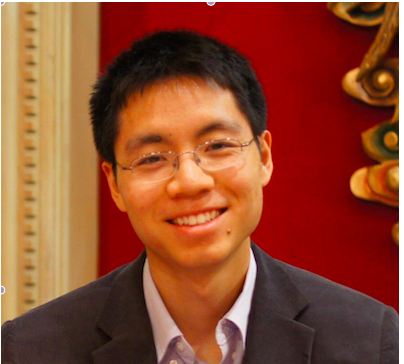
 Louis Chen
· 1 previous affiliation
- Naval Postgraduate SchoolSince 2019
- Assistant Professor · Since 2019
Research Overview
Louis Chen focuses on data-driven robust optimization, stochastic programming, and decision-making under uncertainty. His trajectory spans foundational work in distributionally robust linear and discrete optimization to correlation-robust models for network influence maximization. Most recently, his research addresses adversarial robustness in statistical testing and methods for training neural networks under malicious label noise.
Research Trajectory
Chen completed his PhD in Operations Research at MIT in 2019 and is currently an Assistant Professor at the Naval Postgraduate School. His early research concentrated on robust optimization in operations management, specifically addressing decision-making environments where joint probability distributions are ambiguous or only partially known. A central contribution from this line of inquiry is detailed in Distributionally Robust Linear and Discrete Optimization with Marginals. In this work, Chen and his co-authors established primal-dual formulations for evaluating robust bounds on expected optimal values when only marginal distributions are specified, identifying structural conditions under which these bounds can be efficiently computed.
Expanding into network theory and discrete optimization, Chen investigated how adversarial conditions affect diffusion processes. In Correlation Robust Influence Maximization, he departed from the classic independent cascade model to study influence maximization where the diffusion process is adversarially adapted to the seed set. This research demonstrated that the worst-case expected influence under unknown correlations can be efficiently computed and approximated, providing a more resilient approach to network seeding than models assuming independent edge probabilities.
By 2024, Chen’s methodological focus broadened to include optimistic frameworks for handling data corruption and dubious modeling assumptions. In Rockafellian Relaxation and Stochastic Optimization Under Perturbations, he explored joint optimization over both the decision space and model perturbations. This approach offered an alternative to traditional, highly conservative risk-based formulations by allowing models to systematically absorb and adjust to inaccuracies.
Simultaneously, Chen began applying his expertise in adversarial frameworks to foundational statistical procedures and machine learning. As the first author of On the Adversarial Robustness of Benjamini Hochberg, he analyzed the widely used procedure for controlling the False Discovery Rate in multiple hypothesis testing. The paper revealed a critical vulnerability, demonstrating theoretically and algorithmically that an adversary can break the procedure's statistical guarantees by subtly perturbing a single test score.
Most recently, Chen has adapted his optimization techniques to address the pervasive challenge of label noise in deep learning. In Enhancing Learning with Noisy Labels via Rockafellian Relaxation, he introduced an architecture-independent loss reweighting approach. By effectively pruning likely-incorrect samples and redistributing their influence to clean ones, the method improves a neural network's capacity to handle highly noisy data without requiring a clean validation set. This work connects his optimization background to broader research themes, such as the area of Robust Learning with Noisy Labels via Sample Selection and the direction of Learning from Noisy Labels without Clean Validation Data.
Current Directions
The most recent papers in the evidence indicate a sustained focus on the intersection of robust optimization and machine learning, particularly concerning data integrity and adversarial vulnerabilities. Chen is actively contributing to the research direction of Learning Under Malicious Noise in Features and Labels. His current methodological developments address how to train reliable models when datasets contain high levels of synthetic or human-generated errors.
Rather than treating noise as a simple random nuisance, this work models it as a structural or adversarial challenge. To this end, his recent projects explore the broader area of Learning with Instance-Dependent Label Noise and utilize techniques related to the theme of Bi-Level Optimization for Meta-Learned Sample Weighting. By dynamically adjusting the influence of potentially corrupted samples during training, Chen's ongoing research seeks to build machine learning systems that maintain their performance guarantees even when deployed in messy, real-world environments.
Profile updated
| Title | Venue | Year |
|---|---|---|
| Enhancing Learning with Noisy Labels via Rockafellian Relaxation | ICLR | 2026 |
| Robustness to Dependency in Influence Maximization | Management Science | 2025 |
| Distributionally Robust Max Flows | Symposium on Simplicity in Algorithms | 2025 |
| Distributionally Robust Linear and Discrete Optimization with Marginals | Operations Research | 2025 |
| Mitigating the Impact of Labeling Errors on Training via Rockafellian Relaxation | arXiv | 2024 |
| Rockafellian Relaxation and Stochastic Optimization Under Perturbations | Mathematics | 2024 |
| On the Adversarial Robustness of Benjamini Hochberg | NeurIPS | 2024 |
| Correlation Robust Influence Maximization | NeurIPS | 2020 |
| Distributionally Robust Omnichannel Stocking Decisions in Quick Fulfillment Systems | Ssrn | 2019 |
| Distributionally Robust Linear and Discrete Optimization with Marginals | Ssrn | 2018 |
Loading new papers…
Other researchers whose papers cluster into the same research directions — a proxy for overlapping technical interests and shared intellectual neighborhoods.
See something wrong? Report a mistake